A Structured Interview Needs Scoring Anchors, Not Just a Shared Question List
Build a structured interview around job evidence and behavior-based scoring anchors. Compare two fictional candidates without mistaking a weighted score for certainty.
Two interviewers ask the same question. One hears confidence and gives a high score; the other hears missing detail and gives a low score. A common script has reduced one source of variation, but the evaluation can still depend on what each person thinks a strong answer sounds like.
A structured interview needs a shared definition of relevant evidence as well as shared questions. The goal is to compare candidates against job requirements using a process that another reviewer can understand.
The U.S. Office of Personnel Management describes standardized questions and common rating standards as central features. This article develops an original rubric for a fictional analyst role. It is not a validated selection instrument or legal guidance for a particular jurisdiction.
Start with a real job requirement
A broad label such as communication can mean many things. For an analyst, one relevant behavior might be explaining a data limitation before a manager acts on a result. Another role may need a different communication task.
Define the competency through observable work. Then design a question that can reveal it. Avoid asking for an impressive story and only later deciding which skill the story supposedly measured.
| Design element | Fictional analyst example |
|---|---|
| Job requirement | Communicate a material limitation before a decision |
| Question | Describe a time the evidence did not support the requested conclusion |
| Permitted probe | What did you say, and what happened next? |
| Evidence | Specific actions, reasons, limitations and outcome |
| Scoring basis | Predefined descriptions of relevant behavior |
The question should fit the level of the role. An entry-level candidate may have useful evidence from coursework, volunteering or a small project. Requiring a large corporate example can accidentally test prior opportunity rather than the intended skill.
Write anchors before hearing candidates
An anchor describes what a score means in terms of evidence. For the fictional competency, a low response might omit the limitation entirely. A middle response might identify it but leave the consequence unclear. A stronger response might explain its decision relevance and propose a proportionate next step.
| Illustrative level | Evidence described by the anchor |
|---|---|
| 1 | No relevant example or action is established |
| 3 | Identifies a limitation and communicates a plausible consequence |
| 5 | Connects the limitation to the decision, explains alternatives and follows up on the result |
These anchors are intentionally brief. A real assessment needs more precise guidance tied to the job, including how to handle incomplete evidence. Do not assume that a candidate must repeat the rubric's vocabulary to demonstrate the behavior.
Standardize probing without scripting every human response
OPM's explanation of structured interviews emphasizes the same predetermined questions, order and evaluation standards. A planned probe can clarify missing information without giving one candidate a private coaching session.
Decide in advance which follow-ups are permitted and under what conditions. A request for the candidate's own action is different from suggesting the stronger action you hoped to hear.
Keep access needs and reasonable accommodations within the applicable process. Consistency of assessment does not require ignoring legitimate differences in how candidates can access the interview.
Record evidence before the overall impression
Take concise notes about what the candidate said they did, why they did it and what evidence supports the result. Separate observation from interpretation. “Explained the missing records and offered two options” is more useful than “seems analytical.”
Candidates can describe team achievements without making their own contribution clear. Ask the standardized probe about their role. A large outcome does not establish personal responsibility, and a modest outcome does not necessarily imply poor judgment.
Avoid treating polish, speed or similarity to the interviewer as automatic evidence of competence unless the actual job requirement justifies the measure. The point of the rubric is to make that reasoning visible.
Compare fictional scores transparently
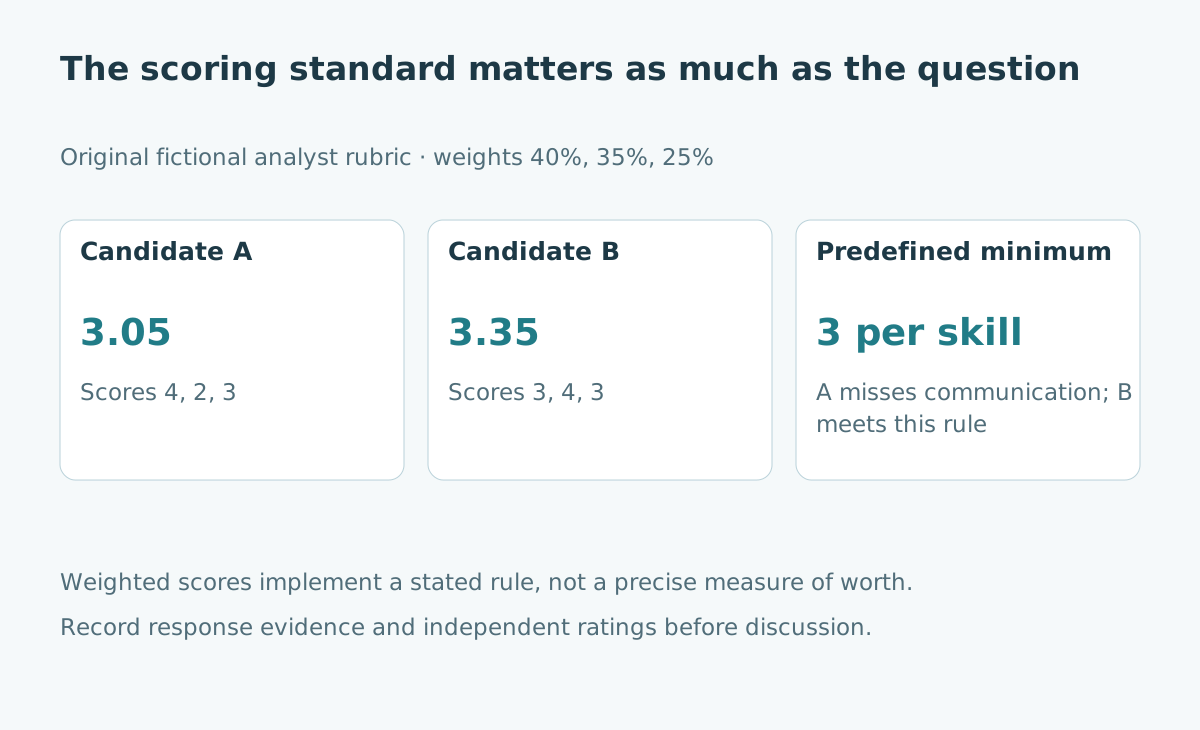
Suppose three competencies have predetermined weights: analysis 40%, communication 35% and collaboration 25%. Candidate A receives scores 4, 2 and 3; candidate B receives 3, 4 and 3 on the proposed five-point scale.
| Candidate | Analysis | Communication | Collaboration | Weighted score |
|---|---|---|---|---|
| A | 4 | 2 | 3 | 3.05 |
| B | 3 | 4 | 3 | 3.35 |
For A, the calculation is 4 × 0.40 + 2 × 0.35 + 3 × 0.25 = 3.05. For B, it is 3.35. These numbers apply a stated administrative decision rule; they are not precise measurements of a person's underlying value.
If the job also requires a minimum of 3 on every essential competency, A does not meet that illustrative rule while B does. Set such requirements before seeing the candidates. Changing weights to favor a preferred person undermines the comparison.
Calibrate the rubric with examples
Have reviewers independently score the same practice responses and compare the evidence behind disagreements. Keep the initial ratings so that discussion does not erase the variation you were trying to understand.
A disagreement can reveal an unclear anchor, a different interpretation of the job or missing information in the response. Resolve the cause rather than simply averaging every pair of scores. Update the rubric before the real process where feasible, and document its version.
Training does not establish that the instrument predicts job performance. That requires appropriate validation and monitoring. A standardized process can still measure the wrong construct consistently.
Connect the interview to other evidence
An interview can reveal reasoning and past behavior, but a work sample may test a different part of the role. Decide which evidence each assessment contributes and avoid counting the same impressive story repeatedly under different labels.
For a candidate, the practical preparation is to select concrete examples, explain personal actions and acknowledge limits. Inventing an outcome or overstating ownership makes the evidence less useful, even if the answer sounds stronger.
As a self-check, every interviewer asks identical questions but scores “leadership presence” without a definition. What remains unstructured? The interpretation and scoring standard. A shared script alone does not solve it.
For a complementary assessment, read work-sample hiring. Keep each tool tied to the work it is intended to measure.
Sources and limits
- OPM: Structured Interviews: standardized questioning and evaluation.
- OPM: how structured interviews differ: common order, scales and standards.
Checked October 23, 2026. The role, anchors, weights and candidates are fictional. The worksheet requires adaptation and appropriate validation before consequential use.