An Annual Subscription Payment Improves Cash Before It Becomes a Year of Revenue
Separate subscription cash collections from earned revenue and remaining service obligations with an original annual-plan worksheet and cancellation scenarios.
A small software company sells an annual plan and receives the entire payment today. The bank balance rises immediately. The company still has to provide access, support and the promised service over the coming year. Those are different events, and treating them as one can turn a healthy-looking sales dashboard into a poor spending decision.
Annual prepayment is useful for understanding subscription businesses because it separates four questions: What did the customer agree to buy? How much cash has arrived? How much service has been delivered? What remains to be provided or refunded? A single “sales” number cannot answer all four.
This is an evergreen accounting and decision-making guide, checked on 28 October 2026. It uses an original simplified contract rather than company financial results. The framework follows IFRS 15's revenue-recognition overview, which links revenue to fulfillment of customer promises rather than simply receipt of money.
Define the contract before dividing by twelve
Imagine a fictional subscription priced at 1,200 currency units for twelve months of uninterrupted access, starting at the beginning of month one. Assume one service obligation, evenly delivered benefits, immediate payment, no taxes, no separate setup service, no financing adjustment and no refund rights in the base case.
Those assumptions matter. A bundle containing consulting, a software license and continuing support might require a different analysis. Usage charges, discounts and contractual changes can also affect the schedule. “Annual subscription” is a commercial label, not a complete accounting policy.
The example assumes a contract appropriately recognized under IFRS 15, with access provided over time. A real business must assess its actual promises, enforceable terms and applicable reporting framework. Do not use the arithmetic here to bypass that assessment.
Separate collection from earned revenue
Under the original assumptions, one month's service represents 100 currency units of revenue. Receiving 1,200 upfront does not mean twelve months of service have already occurred.
The issued IFRS 15 standard, particularly paragraph 106 and application guidance B44, explains the obligation recorded when payment precedes transfer of the promised goods or services. This is a contract liability, often described as deferred revenue in a subscription context.
It is not the same as a loan payable. In the base case, the business owes future service rather than an automatic cash repayment. Its existence is still important: the company has received resources while retaining an obligation to perform.
Build a schedule you can reconcile
For the fictional contract, use cumulative collections alongside cumulative revenue and the remaining service obligation. Do not call the first column “cash balance,” because the company may already have spent some of the money.
| Reporting point | Cumulative cash collected | Cumulative revenue | Remaining contract liability |
|---|---|---|---|
| Payment received, before service | 1,200 | 0 | 1,200 |
| End of month 1 | 1,200 | 100 | 1,100 |
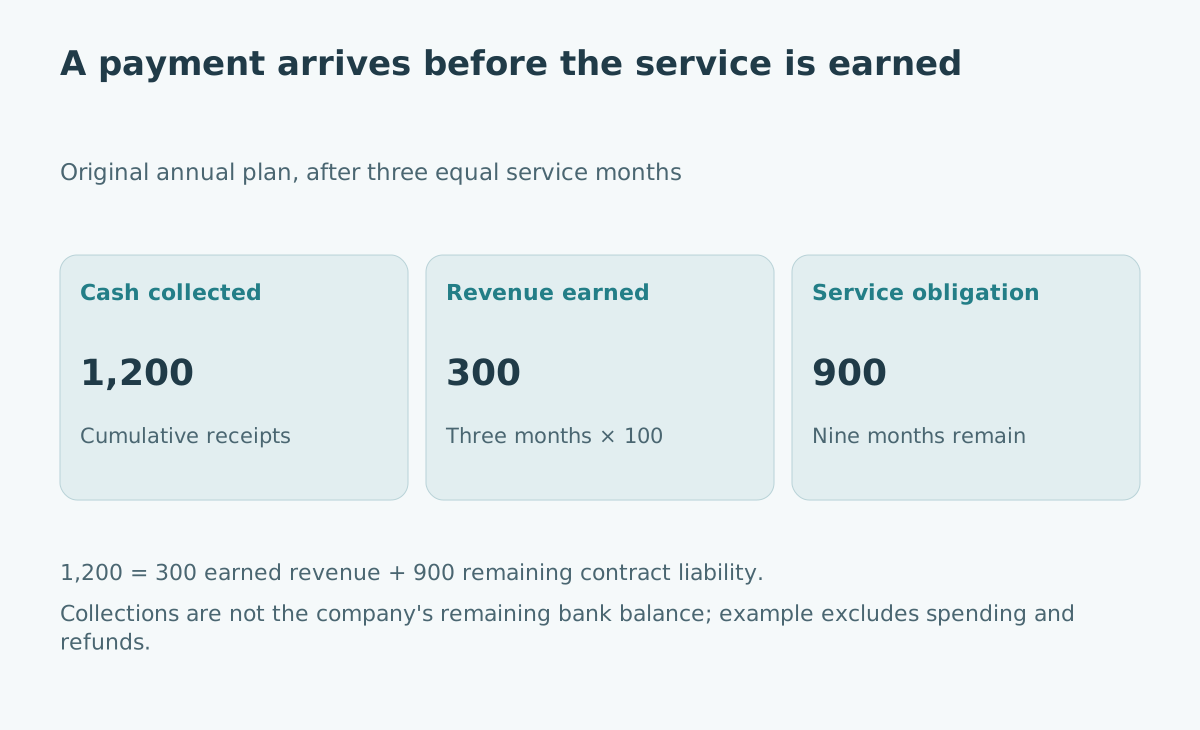
| End of month 3 | 1,200 | 300 | 900 |
| End of month 6 | 1,200 | 600 | 600 |
| End of month 12 | 1,200 | 1,200 | 0 |
With no modifications or refunds, the identity is collected amount = cumulative revenue + remaining contract liability. This is a check on this schedule, not a universal balance-sheet equation.
The monthly simplification is deliberate. Real reporting may allocate by days or another appropriate measure of progress, so months with different lengths need not have equal amounts.
Use a second worksheet for cash runway
Suppose the company spends 250 on acquisition immediately and expects 40 per month of direct service cash outflow for this customer. After three months, assume those are the only cash movements. Collections are 1,200; acquisition spending is 250; service outflow is 120; the resulting cash contribution is 830.
The contract liability remains 900 under the revenue schedule. That does not make the calculation inconsistent. One number describes cash after selected outflows; the other describes remaining customer service measured using the contract's revenue allocation.
The direct service spending for the remaining nine months is an assumed 360. It is not necessarily the full cost of fulfilling the contract: the business may also need engineering, hosting commitments, support coverage and overhead. A prepayment should therefore inform a forward cash forecast, not authorize spending its entire unearned portion.
Cancellation has more than one meaning
A customer can switch off automatic renewal while retaining access until the paid term ends. Alternatively, a contract can terminate early with a refund or a service obligation can change. These are not interchangeable events.
Stripe's subscription revenue-recognition documentation illustrates why software behavior deserves inspection: its schedules are based on finalized invoice line periods, and canceling subscription status alone does not change those schedules. This describes that product's processing, not a substitute for an entity's accounting assessment.
A useful operational test asks whether a cancellation request changes renewal, current access, an invoice, a credit note or an actual refund. Review all affected records. A dashboard flag is insufficient evidence that the service promise disappeared or that a refund reached the customer.
Test one explicit refund alternative
Return to the original contract after three complete service months. Now change the assumptions: suppose an agreed termination ends access immediately and requires a 900 refund for the nine unprovided months. Assume no penalty and no other adjustment.
Under this simplified alternative, cumulative earned revenue stays 300. Cash retained from the customer's payment becomes 300 after the refund. The 900 remaining service liability is removed through settlement of the termination obligation, with presentation depending on timing and the applicable accounting assessment.
This scenario is not a claim that every dissatisfied subscriber is entitled to a pro-rata refund. The point is to make the policy explicit before forecasting liquidity. If many annual customers can obtain refunds, a large bank balance may be less available for discretionary spending than it first appears.
Keep retention metrics separate from accounting
A business could receive many annual prepayments in one month and have little renewal cash arrive for eleven months. Revenue can appear comparatively smooth while cash collections remain concentrated. Conversely, stronger collections can reflect a shift in billing terms rather than improved customer retention.
Track renewal cohorts, scheduled service periods, refund exposure and collection dates alongside recognized revenue. For example, distinguish ten customers switching from monthly to annual billing from ten genuinely new customers. Both might increase current collections, but their implications for growth differ.
For a related cash-timing question, see working capital and the gap between invoice terms and payment. Subscription recognition adds another layer: even prompt collection can precede the economic delivery the payment funds.
Sources and evidence limits
- IFRS Foundation, IFRS 15 overview, five-step recognition framework; checked 28 October 2026.
- IFRS 15, issued 2026 text, selected recognition and contract-liability provisions; checked 28 October 2026.
- Stripe, Revenue Recognition with subscriptions and invoicing, product-specific scheduling and cancellation examples; checked 28 October 2026.
The worked amounts and contract are invented for explanation. Taxes, acquisition-cost accounting, complex contract modifications and jurisdiction-specific consumer rights require separate analysis; this article does not prescribe their treatment.