Learning From Video: Put a Short Recall Check Between the Segments
Turn educational videos into active practice with short recall checks, feedback and a next-day test. Understand what an online lecture study can establish.
You finish a twenty-minute explanation and recognize every diagram. Then someone asks you to explain the mechanism without replaying the video. The answer feels unexpectedly hard. Recognition while the explanation is visible and independent recall after it disappears are different tasks.
A useful intervention is to interrupt the viewing with a few questions that require an answer. The aim is to make each pause reveal what you can retrieve, so that the next replay has a purpose. It is not to add a large quiz that consumes the time reserved for learning.
A 2025 research report from Iowa State University, written by members of the study team, describes evidence for this approach. The practical study routine below is an adaptation, not the exact experimental protocol and not a guaranteed improvement for every learner.
What the research actually tested
The team studied more than 700 students at universities and community colleges in the United States and Canada. Students watched a twenty-minute STEM lecture divided into four five-minute segments. Between segments they answered questions or saw review slides; learning was assessed immediately and a day later.
The authors reported benefits from intermittent quizzes. Their study also included distraction conditions, with a surprising result in one comparison. That finding is not a general prescription to watch competing videos while studying. The relevant paper is In-lecture quizzes improve online learning for university and community college students.
This evidence concerns particular lectures, learners, comparisons and tests. It does not establish the ideal pause interval for every subject, nor demonstrate that an identical routine solves all difficulties with long-term retention.
Make the pause require retrieval
A question at the bottom of the screen is easy to treat as decoration. Pause the video, hide the answer and produce something: a sentence, a calculation, a diagram or a predicted output. Reading the instructor's solution before trying removes the diagnostic part.
For a beginner, choose a small task whose prerequisites have just been explained. If the question demands several methods not yet taught, failure may reveal a poorly designed question rather than weak attention. Aim for an answer that can be checked quickly enough to preserve momentum.
| Subject | Weak pause activity | More informative response |
|---|---|---|
| Python | Reread the code | Predict output and trace one variable |
| Biology | Copy a definition | Draw the mechanism from memory |
| Economics | Replay the chart | Explain what changed and what was held fixed |
| Statistics | Recognize a formula | Choose a method and state its assumptions |
Use a twenty-eight-minute plan
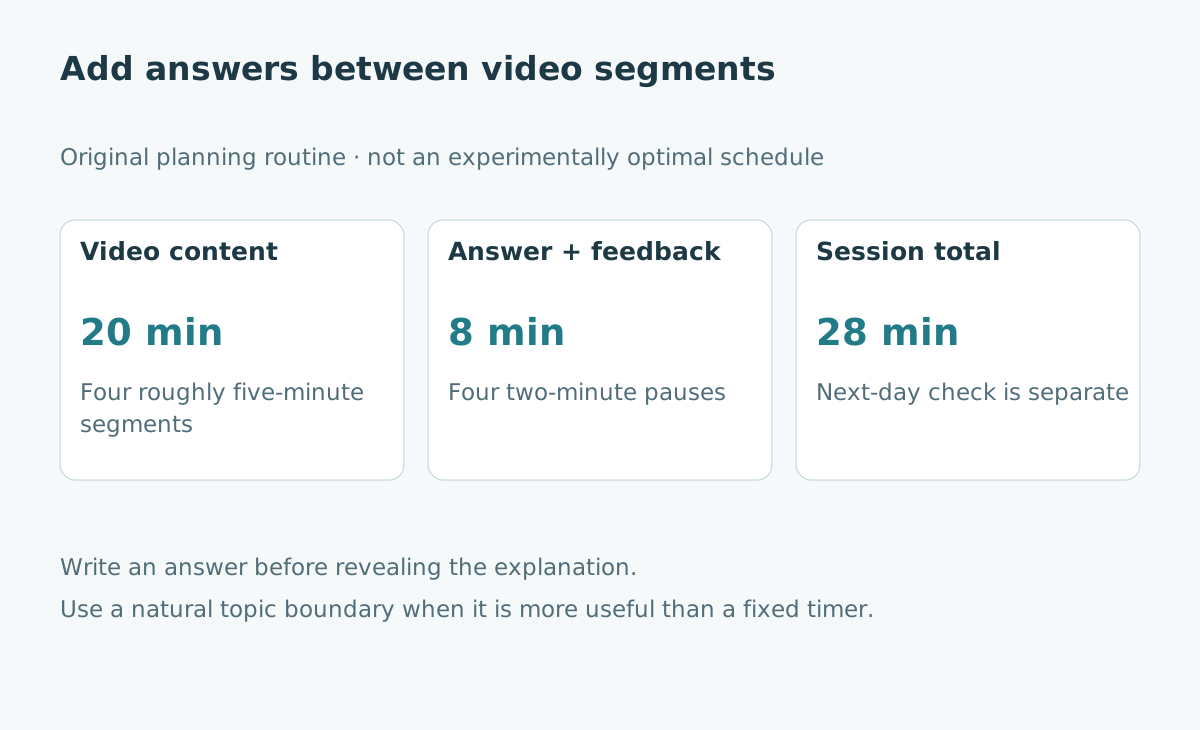
For a twenty-minute video, start with four roughly five-minute segments and allow two minutes after each. In that pause, spend about one minute answering, then use the rest to compare and correct. These are manageable starting values, not research-derived optimal timings.
If the lecture has a natural topic boundary at minute seven, use it. Cutting a worked calculation in half merely to satisfy a timer can create an unnecessary burden. Long demonstrations may need a prediction before the next step rather than a summary of an unfinished procedure.
| Stage | Time budget | Observable output |
|---|---|---|
| Video segments | 20 minutes total | Attend to the explanation |
| Four answer-and-feedback pauses | 8 minutes total | Four short responses and corrections |
| Next day, separately | 5 minutes | Recall without replaying first |
For a long course, apply the routine selectively to dense sections. Every example need not become an elaborate test. A sustainable habit that exposes one important misunderstanding is more useful than a plan you abandon after two lectures.
Design three kinds of questions
First ask for the core relationship: “Why does a larger denominator reduce this quantity when the numerator stays fixed?” This checks understanding beyond repeating a label.
Second ask for a worked action: “Given these two rows, what does this join return?” Choose input small enough to calculate manually. Then compare the predicted result with the demonstrated result.
Third ask for a boundary: “When would this rule fail?” A student learning averages might explain why a mean can conceal very uneven values. A student learning an algorithm might identify an input type it does not accept.
Rotate these question types rather than forcing all three into every pause. The goal is evidence about learning, not a large volume of answers.
Correct the reason for the error
A useful correction records the mistaken step and the replacement rule. “Wrong” is too vague to guide the next session. “I treated a missing value as zero, so the denominator changed” tells you what to practice.
Keep your original answer visible. If you overwrite it with the solution, you lose the evidence needed to distinguish misunderstanding from a calculation slip. Write one new example that would expose the same mistake, then try it later.
When you are completely stuck, inspect a small hint before the full answer. Afterwards, close the explanation and produce the reasoning again. Recopying the supplied solution does not show that you can now perform the task independently.
Keep next-day recall separate
A next-day check answers a different question from an immediate pause. Before rewatching, explain the central idea, solve a fresh small problem and identify one exception. Score against the lecture or another trusted answer after attempting it.
Use the result to choose the next activity. If terminology is missing, brief retrieval prompts may help. If the method is recalled but applied to the wrong problem, practice choosing among similar-looking cases. If a calculation breaks at a prerequisite, repair that skill before replaying the entire lecture.
Do not infer a stable learning gain from one easy test. Compare several sessions with similar difficulty and record independent performance, not only how focused the video felt.
A worked example for database learning
After a segment about candidate keys, close the notes. Ask: “If both NIM and national ID uniquely identify a student, why is the pair {NIM, Name} not necessarily a candidate key?” A useful answer states that candidate keys are minimal; if NIM alone suffices, the extra attribute makes that combination nonminimal.
Then create a different table and identify the assumptions needed to establish uniqueness. This turns a definition into a reasoning task. The next day, solve a fresh key-identification example without first reviewing yesterday's wording.
For the longer routine, see retrieval practice and spacing. Between-video questions check the current explanation; spaced practice tests whether it remains available later.
Sources and scope
- Iowa State: study authors explain their experiment, May 14, 2025.
- Original study, Communications Psychology, 2025. The publisher page could not be fully retrieved during this review; the factual summary above follows the authors' university-hosted account.
Checked October 22, 2026. The schedule, questions and database example are original practical adaptations. No universal effect size is claimed.