A Wearable That Recorded Nothing Did Not Necessarily Observe Inactivity
Separate missing wear time from observed inactivity in wearable trial data. Use an original example to audit valid days, participant selection and summary denominators.
This guide explains research and technology. It does not provide diagnosis or treatment, and regulatory status should be checked with the relevant authority.
A dashboard reports fewer daily steps. Before interpreting that as a change in activity, ask a less exciting question: was the device collecting interpretable data for the same portion of each day? A watch left charging cannot tell an investigator what its wearer did during that interval.
The issue becomes especially important when wearable measurements contribute to a clinical investigation. A technically valid file can still contain incomplete observation periods. Removing those periods changes the evidence available; replacing them with zero changes the values. Neither operation is a neutral housekeeping choice.
The FDA's Digital Health Technologies for Remote Data Acquisition in Clinical Investigations is final guidance issued in December 2023, not an October 2026 announcement. Its recommendations provide a useful foundation for examining this persistent data problem.
Separate a measurement from an observation opportunity
A genuine measured zero and an absent measurement carry different information. Zero might describe no detected steps during a valid observation interval. An empty field might mean the device was not worn, lost power, failed to synchronize, or produced data that did not meet an analysis rule. The investigator needs evidence to distinguish these possibilities.
For an original data design, keep the recorded value, observation duration, quality status, and missingness reason in separate fields. Preserve unknown reasons as unknown. A flat table with only participant, date, and steps invites the software to treat absent observation as an ordinary numerical value.
Define the analysis rule before seeing the result
The FDA guidance, Section IV.E, recommends prespecifying endpoints and source data in the statistical analysis plan, planning to reduce missing data, and addressing missingness and quality issues. Its discussion also considers device usability and operational factors such as charging and transmission. It does not supply the universal daily wear threshold used in this article's example.
For the worksheet only, call a day valid if it has at least ten hours of usable wear-time data. Suppose a separate demonstration rule requires at least four valid days for a participant-level summary. Real studies must justify their own definitions for their device, population, endpoint, and question; these round numbers do not establish a suitable protocol.
Keep the expected days in the quality denominator
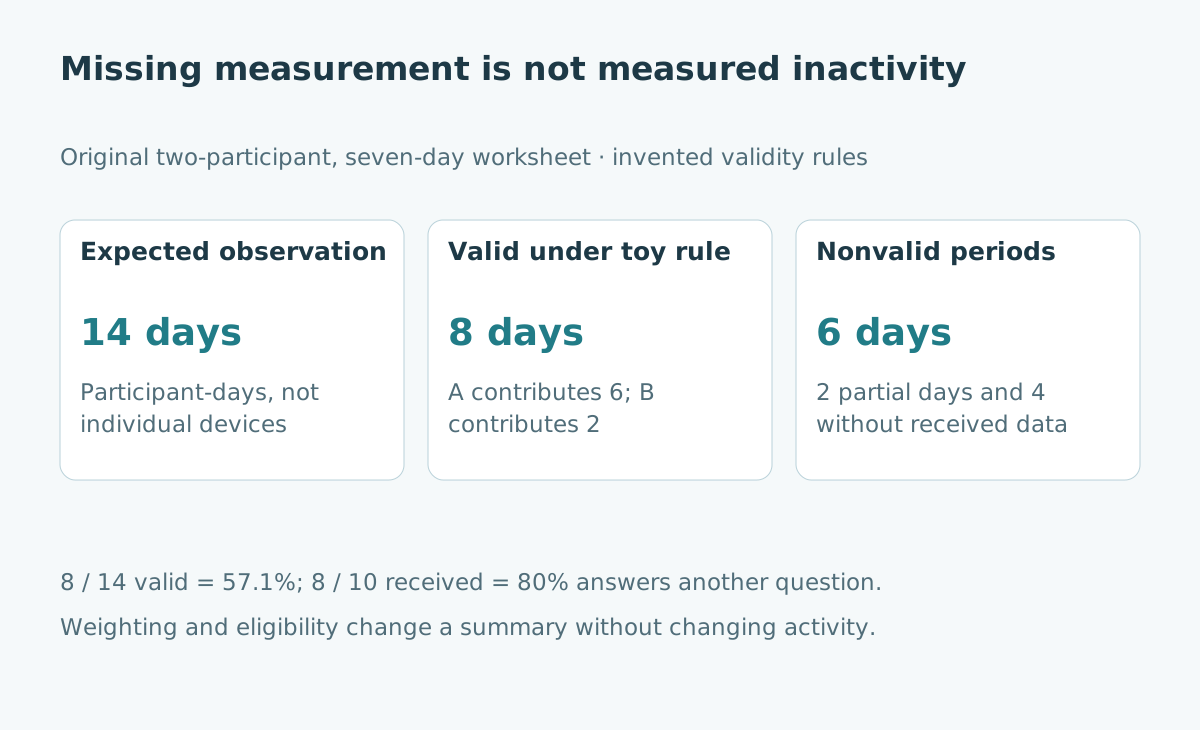
Imagine two fictional participants, A and B, each scheduled for seven days of observation. A has six valid days and one day without received measurements. B has two valid days, two partial days below the illustrative wear-time rule, and three days without received measurements.
| Original observation category | Participant A | Participant B | Total |
|---|---|---|---|
| Scheduled days | 7 | 7 | 14 |
| Valid days under the worksheet rule | 6 | 2 | 8 |
| Partial days below the rule | 0 | 2 | 2 |
| No received measurements | 1 | 3 | 4 |
Eight of fourteen scheduled participant-days are valid: 57.1%, rounded to one decimal place. Ten days have some received measurements, but received and valid are different categories. Reporting eight valid days out of ten received days gives 80%; that conditional figure hides the four absent days unless they are reported separately.
Show how aggregation changes the question
Suppose A's six valid daily counts total 36,000 steps, giving a valid-day mean of 6,000. B's two valid counts total 4,000, giving a mean of 2,000. These are invented values, not clinical observations.
| Original summary calculation | Result | What the calculation weights |
|---|---|---|
| Pool valid days: 40,000 / 8 | 5,000 steps | A contributes six days; B contributes two |
| Average the two participant means | 4,000 steps | A and B receive equal weight |
| Apply the four-valid-day eligibility rule | 6,000 steps | Only A remains eligible |
None of these three numbers is automatically the study's correct endpoint. They answer different questions. The final row is especially easy to misread: a higher displayed mean appears after a selection rule excludes B, without any participant becoming more active. An analysis report must explain its population and weighting.
Do not repair the gap with silent zeroes
If an analyst incorrectly gives every nonvalid day a zero and divides the valid-day total by all fourteen scheduled days, the result is approximately 2,857.1 steps. That arithmetic is straightforward; its interpretation is unsupported. It assumes an unobserved or insufficiently observed day had no activity.
Conversely, dropping every missing day does not establish that the remaining days represent the missing ones. The observed daily means above describe observed data under the worksheet rule. They do not recover a person's complete weekly activity. Any missing-data method needs explicit assumptions appropriate to the intended analysis, with qualified statistical review.
Investigate why the data are missing
In a fictional follow-up log, a missing transmission might later arrive from local device storage. Another gap might reflect nonwear. A third might follow a device replacement that changed the identifier. Those situations call for different data checks, even when all initially display an empty cell.
Record when the gap was detected, what evidence was available, and whether the record was subsequently recovered or remained unavailable. Do not infer participant behavior solely from a connectivity indicator. A person can wear a device while offline, and a connected device can sit unused. Device-specific evidence is needed to interpret either case.
Make the selection visible across groups and time
For an original quality report, show scheduled participants, expected days, received days, valid days, and participants retained for each summary. Preserve the same definitions when comparing groups or visits. A table that displays only the final eligible sample cannot show where observation coverage changed.
Also inspect whether missingness clusters in particular circumstances. If people with more difficulty wearing or charging the device are less represented, the analyzed sample may describe a narrower group. The worksheet cannot determine the resulting bias or supply a treatment-effect correction. It identifies the assumption that a specialist must examine.
Keep data quality separate from clinical benefit
More valid measurements can improve the description of what was observed, but completeness alone does not validate an endpoint or establish that an intervention benefits patients. Accuracy, relevance, trial design, and the clinical meaning of the outcome remain separate questions.
When reading a wearable result, ask for both the outcome and its observation denominator. That small request makes a surprisingly large difference: it reveals whether the report summarizes activity, device availability, or a selected subset of both. For related distinctions, read biomarkers and patient benefit and why valid JSON Lines records do not prove a complete delivery.
Sources and reading notes
- FDA final-guidance information page, December 2023, checked October 26, 2026.
- FDA full guidance, especially Sections IV.A, IV.E, and Appendix B. It contains nonbinding recommendations. All numerical rules and counts in this article are original teaching assumptions, not FDA recommendations or treatment advice.