Stop Jumping From a Solved Example to a Blank Page: Fade the Help One Step at a Time
Move from reading solved examples to solving alone with a four-stage fading worksheet. Practice a complete cost equation and test transfer without hidden hints.
A solved example makes sense while you read it. Then the next problem removes every line of support, and you cannot decide where to begin. The jump may be too large: recognizing an explained solution and generating the whole solution independently demand different actions.
Worked-example fading offers an intermediate route. Begin with a complete solution, then remove selected steps until you produce the procedure yourself. The purpose is to change what you must generate, rather than simply rereading the same answer with fewer words on the page.
Research on the transition from examples to problem solving discusses this approach. This article develops an original algebra worksheet and a progression rule; it does not claim an experimentally optimal number of stages or a guaranteed score improvement.
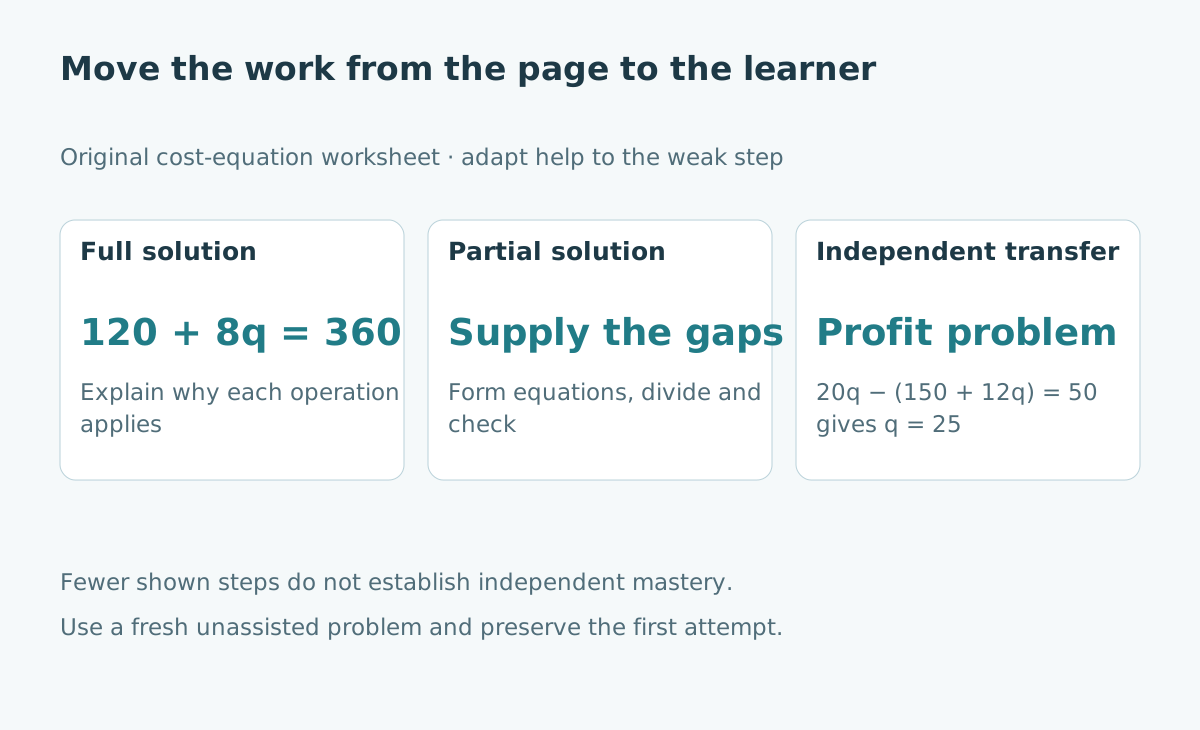
Identify the skill being transferred
Choose a small procedure with understandable steps. In the example here, the learner converts a fixed-plus-variable cost description into an equation, isolates the unknown quantity, calculates it and checks the answer.
A learner who cannot yet divide accurately may need a prerequisite repair. A learner who can calculate but cannot translate the text needs a different prompt. Fading is useful only when the support targets the actual difficulty.
Write the learning goal as an action: “Given a new cost description, define the quantity, form the equation and justify each operation.” That is more informative than “understand cost problems.”
Study one complete example actively
A workshop charges a fixed fee of 120 units plus 8 units per item. The total bill is 360 units. Let q be the number of items.
| Step | Worked solution | Why the step is valid |
|---|---|---|
| Model | 120 + 8q = 360 | Fixed fee plus per-item cost equals the total |
| Remove fixed fee | 8q = 240 | Subtract 120 from both sides |
| Isolate quantity | q = 30 | Divide both sides by 8 |
| Check | 120 + 8 × 30 = 360 | The result satisfies the original condition |
Before moving on, explain why dividing 360 by 8 immediately would be wrong. It would treat the fixed fee as if it purchased additional items. This explanation exposes the model, not just the arithmetic.
Cover the worked solution and reconstruct the four actions in words. If you cannot do that, revisit the part you could not generate rather than copying the entire table again.
Remove one step
For a new problem, keep the model and subtraction but hide the division result. Suppose a service charges 100 units plus 10 per item, with a total of 400. Show 100 + 10q = 400 and 10q = 300, then ask the learner to finish and check.
The answer is q = 30. Require a sentence explaining why the division is appropriate. A correct number obtained by guessing is different evidence from a correct method that can be repeated.
This stage isolates the final calculation. It is appropriate when the learner is still learning the procedure, but it does not yet demonstrate independent equation formation.
Remove more support at the actual weak point
Next, give the new description and the variable definition, but leave the equation and calculation blank. A job has a fixed fee of 150 units, a variable cost of 12 per item and a total of 450. The learner should form 150 + 12q = 450, then obtain q = 25.
| Proposed stage | Support shown | Work the learner must generate |
|---|---|---|
| Full example | All steps and reasons | Explain the relationships |
| One missing step | Model and subtraction | Divide and check |
| Several missing steps | Description and variable | Form and solve the equation |
| Independent task | Fresh problem only | Choose the model, solve and justify |
Removing the last step first is one possible design. If equation formation is the central difficulty, spend more attention there. Do not turn the order of this worksheet into a rule that every topic must follow.
Add self-explanation at the decision point
The research indexed under Atkinson, Renkl and Merrill's 2003 study combined fading with prompts about the principles behind solution steps. The useful practical distinction is between explaining why a step applies and merely narrating what is written.
“What operation comes next?” can be answered from a familiar pattern. “Why does this operation preserve the equality?” asks for a reason. For a statistical method, the corresponding prompt might ask which assumptions justify using it.
Keep the prompts short. If explaining every symbol overwhelms the learner, target the step where method selection or misunderstanding is most likely. A long written reflection is not automatically a better explanation.
Decide when to reduce support
Use observable performance. Can the learner complete the missing step, explain it and check it without seeing the answer? If not, identify whether the problem is the concept, an earlier prerequisite or a simple execution error.
A reasonable starting rule is to seek repeated correct independent attempts on different small examples before removing more help. This is an original planning suggestion, not a validated threshold. Adjust it to difficulty and the consequences of error.
Preserve the first attempt. If the learner replaces it with the model answer, you lose the information needed to choose the next level of support.
Test transfer with a changed surface
Now change the question. A business sells each item for 20 units. Its costs are a fixed 150 plus 12 per item. How many items produce a profit of 50 units under this simplified model?
The equation is 20q − (150 + 12q) = 50. Rearranging gives 8q = 200 and q = 25. The arithmetic resembles earlier work, but the learner must first distinguish revenue, cost and profit.
Success on the earlier cost worksheet does not guarantee this transfer. If the learner subtracts the target profit from the fixed cost without modeling the relationship, restore help at the modeling step rather than giving more division practice.
Keep a genuinely independent check
At the end of a session, put away the scaffold and solve a fresh problem. Repeat a brief check after a delay. Label whether a hint was used so that supported performance is not reported as independent mastery.
As a self-check, a learner completes ten worksheets while every equation is supplied. What skill remains uncertain? Translating a new description into the correct equation. More completed pages do not answer that question by themselves.
For the broader foundation, see cognitive load and worked examples. This worksheet focuses on the specific transition from supplied steps to generated reasoning.
Sources and limits
- Renkl and Atkinson, 2003: theoretical analysis of transitions from example study to problem solving.
- Atkinson, Renkl and Merrill, 2003, abstract indexed by ERIC: fading combined with self-explanation prompts.
Checked October 23, 2026. Research framing follows published abstracts; no unverified effect size is claimed. All equations, stages and progression suggestions are original teaching adaptations.