A Bad Outcome Does Not Tell You Which Part of the Decision Was Bad
Review workplace decisions using the evidence available before the outcome. Separate process, execution and results with an original decision-audit example.
The delivery arrived late, so the supplier choice must have been foolish. Another team skipped the review and happened to meet its deadline, so its shortcut must have been sensible. Both conclusions move too quickly from what happened to how well someone decided.
An outcome matters: customers experience it, budgets absorb it and future plans should learn from it. But the outcome alone does not reveal the information available before the choice, whether the reasoning used that information well or whether execution followed the plan.
This evergreen guide offers an original workplace decision audit. Its purpose is to keep those questions distinguishable, especially when a disappointing result creates pressure to identify a single mistake. It is not a method for excusing poor outcomes or declaring an employee competent from a polished explanation.
Reconstruct the information boundary
Start by fixing the decision time. Which facts, estimates, constraints and alternatives were available then? Separate them from information learned afterward. A warning received before approval belongs in the review of the choice; a genuinely new event belongs in a different part of the explanation.
Use contemporaneous evidence where possible: the quote, source data, approval message and stated assumptions. A person's later recollection can be useful, but it should not silently replace the earlier record.
The aim is an accurate reconstruction. An attractive rationale written after the event does not establish that the decision was actually made for those reasons.
Understand the outcome-bias finding
Baron and Hershey's 1988 paper reported five studies in which undergraduates evaluated described decisions involving medical cases or monetary gambles. Favorable outcomes led to more favorable evaluations, even when participants were given the relevant information available to the decision maker.
That finding identifies a judgment problem in the studied scenarios. It does not measure how biased your organization is, or prove that hiding every outcome will improve every performance review.
The practical question is whether your explanation of the process would change solely because a different possible outcome occurred. If so, inspect which new evidence justifies the change.
Make the choice explicit in a small example
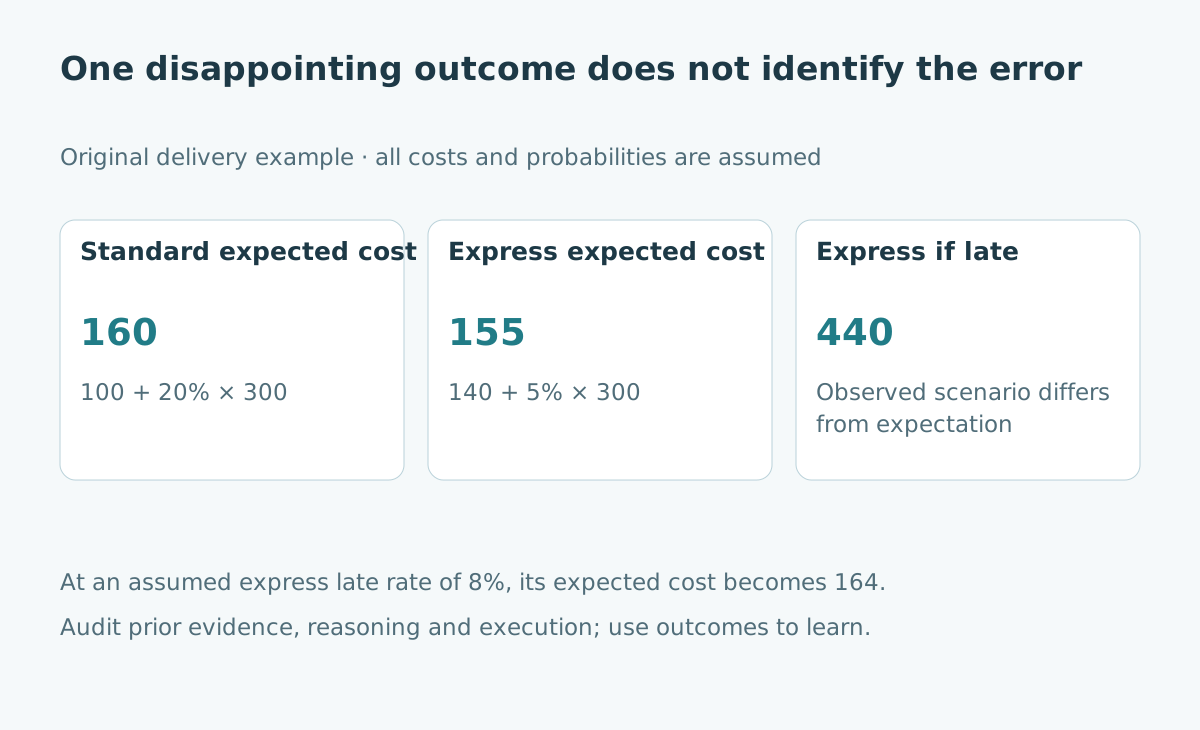
Imagine a team choosing a delivery service for a noncritical internal event. For this fictional model, a late delivery causes an additional cost of 300 units. The team considers only shipping cost plus that late-delivery cost and initially uses the assumed probabilities below.
| Option | Shipping cost | Assumed probability of lateness | Expected total cost | Realized total if late |
|---|---|---|---|---|
| Standard | 100 units | 20 % | 100 + 0.20 × 300 = 160 | 400 units |
| Express | 140 units | 5 % | 140 + 0.05 × 300 = 155 | 440 units |
Under this simplified expected-cost criterion, express is lower by 5 units. That statement is conditional on the inputs and criterion. It does not establish which service any real team should buy.
Review the assumptions before celebrating the calculation
A correct calculation cannot rescue unsupported probabilities. Ask where the lateness estimates came from, whether they apply to this route and whether recent disruption makes the comparison unreliable. Also ask whether the 300-unit consequence captures the important effects of delay.
The small expected-cost difference is sensitive to an input change. If the express lateness probability were 8 % rather than 5 %, its expected total would be 140 + 0.08 × 300 = 164 units. Standard would then be lower under the unchanged assumptions.
That sensitivity is useful before choosing. Afterward, it identifies a specific estimate to examine rather than using “bad judgment” as an explanation for everything.
Compare possible results without inventing a counterfactual
Suppose the team chooses express and the delivery is late. The realized cost is 440 units in the fictional model. That is a disappointing result, but a 5 % lateness estimate did not mean lateness was impossible.
You also do not observe whether standard would have arrived on time for this same delivery. Avoid claiming that the unchosen option “would definitely have saved 340” simply by comparing the observed express cost with standard's on-time cost.
Investigate what happened. If express missed its promised service because the team supplied the wrong address, execution may explain the failure. If the route statistics were misread, the problem may begin before the choice.
Audit process, execution and outcome separately
Use a review table that asks for evidence rather than an overall label. The following is an original diagnostic worksheet, not a validated employee-rating scale.
| Review layer | Question to answer | Evidence to inspect |
|---|---|---|
| Decision framing | Was the right objective and constraint identified? | Event requirements and approved criterion |
| Input quality | Were costs and probabilities reasonably supported? | Comparable route records and quotations |
| Reasoning | Were alternatives and sensitivity assessed correctly? | Calculation and documented checks |
| Execution | Was the selected plan followed? | Address, dispatch time and confirmation |
| Outcome and learning | What occurred, and what changes future beliefs? | Delivery record, cause investigation and later comparable cases |
A weak process can produce an on-time parcel. A well-supported choice can still encounter a possible late delivery. The review should be capable of recognizing both combinations.
Use an independent first pass when practical
Give a reviewer the pre-decision package before revealing the result, where confidentiality and the task permit. Ask for an assessment of framing, evidence and reasoning. Then reveal the outcome and ask what additional information changes the assessment.
This is an original audit design suggestion, not a guarantee against bias. The reviewer may still infer the result from the selected materials or share the team's assumptions. Preserve the first assessment so the difference can be examined.
The exercise helps distinguish learning something new about the process from merely feeling differently about it after seeing the result.
Learn from outcomes across comparable cases
Keeping outcomes separate during one review does not mean discarding them. Repeated deliveries provide information about whether lateness estimates are credible, whether a service has changed and whether execution problems recur.
Compare like with like: service level, route, season and the meaning of “late.” A rate from a different population may not answer the relevant question. Do not turn one failed delivery into a precise new probability.
When outcomes repeatedly contradict the model, investigate and revise it. The discipline is to say which belief changed, what evidence changed it and how that affects the next choice.
Apply rigor in proportion to the decision
NASA's decision-analysis guidance connects alternatives, criteria and uncertainty to the decision maker's knowledge and preferences. It also emphasizes documenting assumptions and limitations. The office audit here adapts that general principle; it is not a NASA process requirement.
A routine reversible purchase may need only a short review. A consequential decision deserves more scrutiny of missing alternatives, downside exposure and the value of additional information. Good documentation supports scrutiny, but the underlying evidence still has to be sound.
For managing uncertainty before a choice, see business pilots and the value of information. This audit addresses the later question: what does the observed result justify changing about our assessment?
Sources and limits
- Baron and Hershey, 1988: primary outcome-bias studies, published in the Journal of Personality and Social Psychology.
- NASA, Section 6.8: Decision Analysis: decision alternatives, criteria, uncertainty and stated limitations.
Checked October 26, 2026. The delivery scenario, review table and first-pass procedure are original teaching adaptations. Assumed probabilities are not measured supplier performance, and the example is not investment, procurement or safety advice for a real decision.