Business Interruption Insurance: A Covered Loss Can Still Leave a Cash Gap
Separate insured business-income loss from cash needed to reopen, using a hypothetical waiting-period calculation and a practical policy-review worksheet.
The business has insurance, but wages are due before any claim payment arrives. That is the uncomfortable gap between being covered in principle and having enough money to keep operating. A policy limit cannot answer the cash-timing question on its own.
Before the next renewal, put the policy wording beside a short recovery budget. Ask which event triggers cover, what income measure is used, when the covered period starts, and which bills must be paid while the claim is assessed. The exercise can reveal problems without assuming a disaster will happen or that a claim will be accepted.
Read the current guidance with the right jurisdiction
The US National Association of Insurance Commissioners' business-interruption overview, updated June 25, 2026, distinguishes property damage from business-income losses. It describes cover linked to a covered event and emphasizes policy-specific wording. Optional contingent and extended cover can address different situations, subject to their terms.
This is current consumer guidance, not an October announcement of a new universal insurance rule. Policy language, jurisdiction, endorsements, and circumstances determine an actual claim. A shutdown alone does not prove that the coverage trigger is satisfied.
The Washington State insurance commissioner's business-insurance guide likewise describes business interruption in terms of a covered loss forcing closure. These US sources explain the general distinction; they do not establish coverage for a business elsewhere. Use the worksheet below with the contract and a qualified insurance professional responsible for your market.
Separate three questions that often get combined
The first question is coverage: did a covered event cause a loss meeting the contract's conditions? The second is quantification: what amount does the policy's calculation recognize? The third is liquidity: when must the business pay cash, and when will usable funds arrive?
A claim can be uncertain even if your internal loss estimate is clear. Conversely, a claim that is eventually accepted may not provide cash before a rent or payroll deadline. Keep these questions in separate worksheet columns so that a modeled entitlement does not silently become a confirmed bank receipt.
| Question | Evidence needed | Mistake to avoid |
|---|---|---|
| Is the event covered? | Policy, endorsements, facts, and causation | Treating any interruption as insured |
| How is loss measured? | Policy definition and supportable accounts | Claiming all missing sales without adjusting costs |
| What limits apply? | Limit, sublimit, period, and excess wording | Assuming the headline limit covers every category |
| When is cash needed? | Actual payment dates | Using monthly totals without timing |
| When is cash available? | Confirmed resources and payment information | Counting an unagreed claim as immediate cash |
A useful review also identifies who can notify the insurer, authorize temporary arrangements, and preserve supporting records. Confusion over ownership can create delay precisely when the business is least able to absorb it.
Build the loss estimate from the economic activity
Consider a hypothetical workshop that would ordinarily earn $4,000 of daily revenue. It avoids $1,600 of variable spending when closed. Continuing fixed costs are $1,400 per day, leaving an expected operating profit of $1,000 on an ordinary day.
The contribution lost during a complete closure is $2,400 per day: revenue of $4,000 less saved variable costs of $1,600. This contribution would otherwise support the $1,400 of continuing fixed costs and the $1,000 profit. Adding those fixed costs again to the $2,400 would double count them.
| Ordinary daily activity | Hypothetical amount | Treatment during complete closure |
|---|---|---|
| Revenue | $4,000 | Lost in this simple case |
| Avoidable variable cost | $1,600 | Saved, so deducted from revenue loss |
| Contribution | $2,400 | Economic amount lost before further adjustments |
| Continuing fixed costs | $1,400 | Still payable under the example |
| Expected operating profit | $1,000 | Contribution less continuing fixed costs |
This is an economic planning model, not a statement that every policy uses the word “contribution” or this exact formula. Insurance definitions can differ from accounting labels. Reconcile your internal model to the policy's definitions before using it in a claim submission.
Seasonality matters too. A weekday average may be unsuitable for a holiday closure or a business with concentrated trading days. Keep evidence for the revenue that would reasonably have occurred, rather than selecting the best historical days to inflate the estimate.
Apply an explicitly hypothetical waiting-period rule
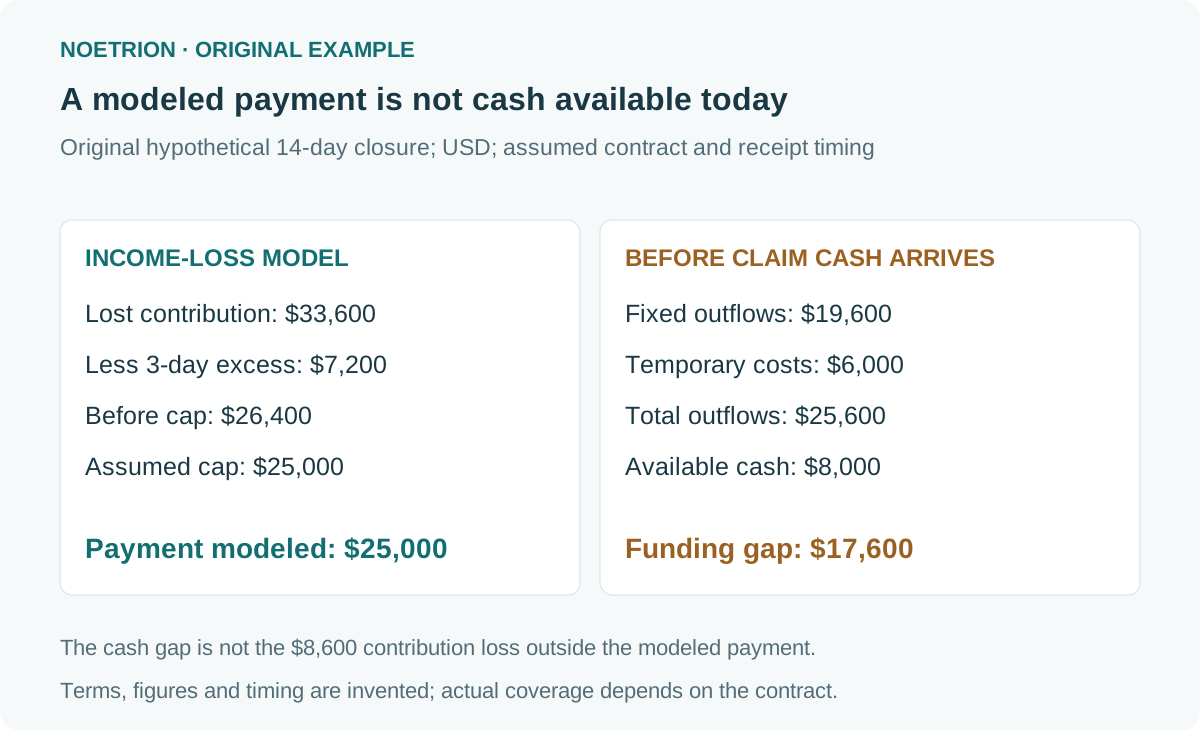
Assume a 14-day complete closure. For the example only, suppose a fictional policy excludes the first three days through a time excess, recognizes the following 11 days at $2,400 per day, and caps this particular modeled income payment at $25,000. Assume the event otherwise qualifies and ignore other adjustments.
The full economic contribution loss is 14 × $2,400 = $33,600. The amount after the assumed three-day time excess is 11 × $2,400 = $26,400. Applying the assumed cap gives $25,000. The difference from the full loss is $8,600: $7,200 from the three excluded days plus $1,400 from the cap.
Do not generalize the three-day rule. Real contracts may use different waiting periods, deductibles, franchises, definitions, limits, or measurement periods. Different waiting-period provisions can produce different results.
Ask the insurer or broker to show how the actual wording would treat a short interruption and a longer one. Request the calculation assumptions in writing. That is more useful than asking only whether the policy “covers business interruption.”
Calculate the cash required before reimbursement
Now look at the same workshop's immediate cash needs. Continuing fixed outflows during the 14-day closure total $19,600. Suppose it also must pay $6,000 for temporary arrangements before reopening. Its modeled cash requirement through reopening is $25,600.
Assume accessible unrestricted cash is $8,000 and no claim money arrives before those bills fall due. The funding gap is $17,600. That figure differs from the $8,600 economic loss outside the modeled payment because the questions differ: one measures uncovered contribution; the other measures cash needed before receipts.
| Reopening cash item | Hypothetical amount | Assumption |
|---|---|---|
| Continuing fixed outflows | $19,600 | 14 days × $1,400 |
| Temporary arrangements | $6,000 | Paid before reopening |
| Total immediate outflows | $25,600 | Excludes separate property-repair costs |
| Accessible cash | $8,000 | Unrestricted and available in time |
| Gap before any claim receipt | $17,600 | No other receipts assumed |
The $6,000 is included in the cash plan without assuming it is insured. A property repair, an extra expense, and a business-income loss may sit under different sections or limits. Keep them separate until the actual contract and claim assessment establish their treatment.
Even after reopening, receipts may lag sales, as the working-capital cash-gap guide explains. Extend the dated cash plan if customers pay later or trading recovers gradually. Do not stop the analysis at the day the doors reopen merely because that date is convenient.
Rehearse a recovery timeline
Write a plausible timeline covering incident discovery, notification, safety assessment, temporary operations, repairs, reopening, and income recovery. Identify the evidence available at each stage. Safety and lawful access take priority over trying to minimize a spreadsheet's closure duration.
For each major payment, record its due date and which source can actually fund it. An unapproved credit application is not available cash. A possible insurance advance is not a confirmed receipt. If an advance is agreed, record its amount and expected date separately from the final claim estimate.
Noetrion's inventory lead-time article helps identify why replacement parts can become usable later than a shipping arrival estimate. In a recovery plan, those acceptance and installation steps can affect the practical interruption period. That operational forecast still needs to be reconciled with the policy's restoration-period wording.
Preserve records that explain both loss and mitigation
Keep accessible copies of the policy, endorsements, accounts, sales records, payroll, supplier agreements, photographs, and relevant correspondence. Store them securely and make sure an authorized backup person can retrieve them if the usual location or employee is unavailable.
Document decisions about temporary operations and mitigation. Record the expected benefit, quoted cost, authorization, and actual result. This supports a coherent account of what happened; it does not guarantee that every expense is recoverable.
Separate contemporaneous facts from later estimates. “The equipment supplier quoted four weeks on this date” is more precise than “replacement always takes four weeks.” Preserve revisions so another reader can see why the plan changed as information improved.
Use the same discipline for exclusions and dependencies. If a supplier disruption is the concern, verify whether the actual contract has relevant contingent coverage and what triggers it. Ordinary business difficulties or a supplier's financial failure should not be assumed covered simply because a supply chain is involved.
Turn renewal into a decision review
At renewal, compare the current operation with the assumptions behind the existing cover. Has the business added a location, changed its mix of high-margin work, become dependent on specialized equipment, or taken longer to replace critical inputs? An unchanged limit may represent a changed level of protection.
Bring the loss model and dated cash plan to the discussion. Ask which assumptions the policy recognizes, which it excludes, and what evidence an actual claim would require. Then decide how insurance, accessible reserves, and feasible continuity arrangements work together.
For a reader exercise, extend the fictional closure to 21 days while retaining the same assumed three-day time excess and $25,000 cap. Economic contribution loss becomes $50,400. The pre-cap modeled amount becomes $43,200, so the cap still limits payment to $25,000. The gap from full contribution loss grows to $25,400.
That result is not a recommendation to buy a particular limit. It shows why duration can matter as much as the daily amount. The best next step is to test your actual contract against a recovery process you can explain and finance.
Sources, dates, and limits
- NAIC business-interruption overview, updated June 25, 2026: covered-event context and policy-specific differences.
- Washington State Office of the Insurance Commissioner business-insurance guide, checked October 21, 2026: business interruption tied to a covered loss.
All workshop figures and policy terms are hypothetical and independently calculated. No actual claim, settlement timetable, premium, or legal entitlement is predicted. Coverage must be determined from the applicable contract and facts in the relevant jurisdiction.