Earnings per Share Can Rise 25% While Total Profit Stays Exactly the Same
Work a buyback example in which EPS rises without profit growth. Separate cash spent, weighted-average shares, dilution and the capital-allocation decision.
Educational analysis, not a personal investment or payment recommendation. Check the dated sources and the rules that apply in your jurisdiction.
A company announces higher earnings per share. It also spent cash repurchasing its shares. Before concluding that the operating business became more profitable, examine both parts of the ratio.
Earnings per share relates an earnings numerator to a share-count denominator. A change in either can move the result. Understanding which changed helps separate business performance from capital-allocation effects.
The IFRS Foundation's IAS 33 overview identifies the earnings numerator and weighted-average share denominator, and distinguishes basic from diluted EPS. This article, checked October 26, 2026, uses an original simplified example. It is a reading method for financial statements, not a recommendation about current stocks or whether every repurchase creates value.
Write down the numerator and denominator
Assume a fictional company earns 40 monetary units attributable to its ordinary shareholders over a period. Ten ordinary shares are outstanding throughout that period. There are no preference-share adjustments or potentially dilutive instruments in the example.
Basic EPS is 40 divided by ten, or four units per share. That tells us how the defined earnings relate to the shares outstanding. It does not state how much cash was generated or distributed.
For an actual company, read the earnings definition and reconciliation rather than assuming a headline profit number is the appropriate numerator. Also check that the comparison uses the same reporting period and a consistent performance measure.
Isolate the full-period buyback effect
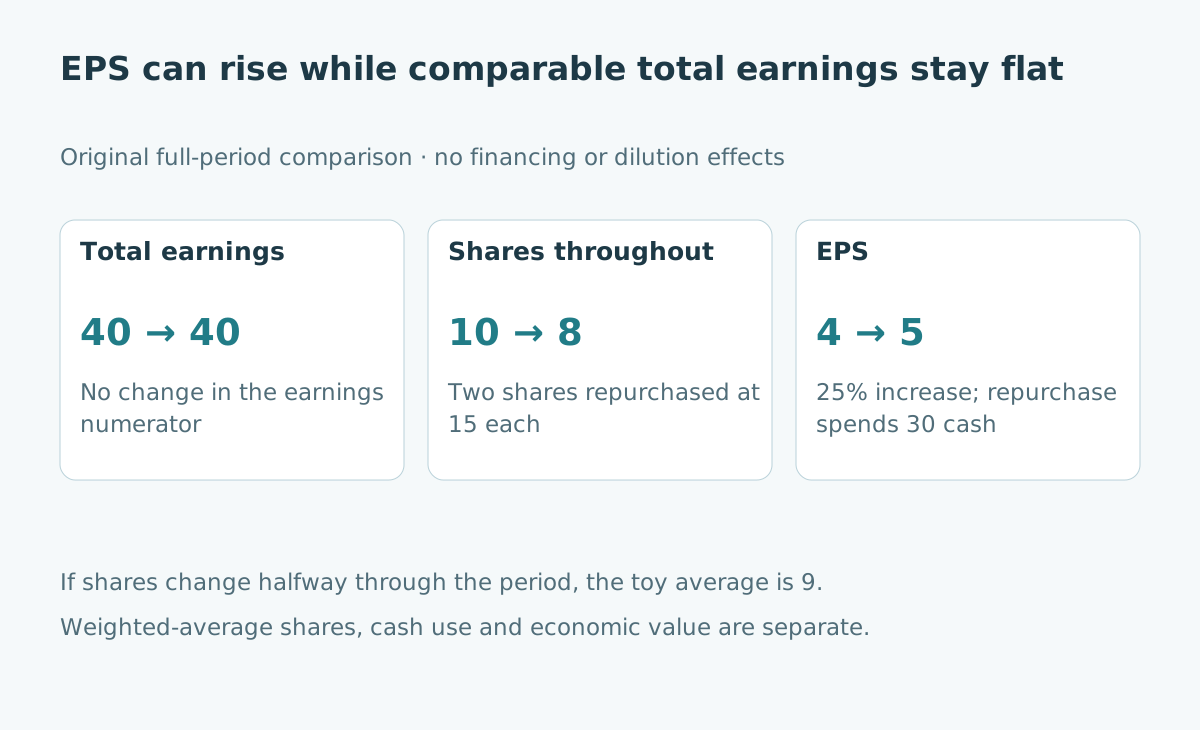
Imagine an alternative period in which the company begins with eight shares because it previously repurchased two. The repurchase price was 15 per share, requiring 30 cash. For the experiment, assume comparable earnings remain exactly 40.
| Original comparison | Ten shares throughout | Eight shares throughout |
|---|---|---|
| Earnings attributable to ordinary shareholders | 40 | 40 |
| Share denominator | 10 | 8 |
| EPS | 4 | 5 |
| Change in total earnings | — | 0% |
| Change in EPS | — | +25% |
The increase from four to five is 25%, even though total earnings did not grow. A 20% reduction in shares produces a 25% increase in this ratio because eight, rather than ten, is the new divisor.
Keep the cash use visible
The company spent 30 to acquire the two shares. If it had 50 cash immediately before that isolated transaction and no other simultaneous cash movement, cash immediately afterward would be 20.
These cash balances refer to the transaction itself, not the end of a later earnings period. The example does not assume that period earnings arrive as cash or reconstruct a full statement of cash flows.
For the continuing shareholders, the exercise changes the number of shares and the resources left inside the business. The increase in EPS is observable arithmetic. Whether the cash was well spent is a further economic question that cannot be settled by the EPS increase alone.
Use weighted averages for an in-period transaction
The full-period example deliberately keeps timing simple. Suppose instead ten shares are outstanding for exactly half a reporting period and eight for the other half. With only this change, the time-weighted average is nine shares.
| Hypothetical share history | Weighted-average shares | EPS if earnings remain 40 |
|---|---|---|
| Ten throughout | 10 | 4.0000 |
| Ten for half, eight for half | 9 | 4.4444 |
| Eight throughout | 8 | 5.0000 |
Using the ending count of eight for the middle row would overstate the ratio in this construction. Actual calculations follow the applicable accounting requirements and transaction dates. The simple half-period example is not a substitute for those requirements.
Read an issuer's note as a reconciliation
A primary issuer disclosure filed with the SEC for June 2026 separately presents basic weighted-average shares, potentially dilutive shares and repurchase information. The point of consulting that disclosure is its structure, not using its reported figures as the inputs to our invented company.
A practical reading worksheet can place four items beside one another: reported earnings, basic weighted-average shares, diluted weighted-average shares and actual repurchase spending. Record the period and units for each.
An authorization to repurchase shares is different from completed transactions. A reduction in one period-end share count is also different from the weighted-average count used in that period's EPS. Keep both distinctions in the note you prepare.
Check dilution before judging the net reduction
Repurchases can coexist with new share issuance or share-based compensation. A gross number of shares bought back therefore need not equal the net reduction in the relevant denominator.
In a separate original example, suppose a company repurchases two shares but issues one new ordinary share at the start of the comparison period. Starting from ten, it then has nine throughout that period. Holding earnings at 40 produces EPS of about 4.4444, rather than five.
This example concerns actual issued shares. Potentially dilutive instruments introduce a different calculation. Read the diluted EPS reconciliation and applicable rules rather than subtracting an arbitrary number of options from a share count. Basic and diluted EPS answer related questions but are not interchangeable labels.
Restore the economic effects the experiment excluded
Our unchanged-profit assumption isolates a denominator effect. A real cash-funded repurchase might reduce future interest income or available investment resources. Debt funding can add financing obligations. Taxes, fees and the timing of transactions can also change the result.
Those effects belong in an economic assessment even when the accounting ratio is correctly calculated. A proposal should identify the alternatives for the cash and the consequences of retaining less liquidity.
The repurchase price also matters. Spending 30 to acquire two shares states the transaction's cost; it does not establish the shares' underlying value. A higher subsequent EPS does not prove that 15 was an attractive purchase price.
Explain growth with a short bridge
An original analysis bridge can first hold shares constant to examine the earnings change, then hold earnings constant to examine the denominator change. Label the chosen order because contributions to a ratio depend on the decomposition method.
Conclude with the facts the bridge supports: total earnings changed by this amount, the weighted-average denominator changed by that amount, and cash was deployed through these transactions. Avoid turning the bridge into a claim that every repurchase is good or bad.
For the difference between an earnings measure and cash, read profit versus operating cash flow. For another denominator problem, see net revenue retention and cohort boundaries.
Sources and evidence limits
- IFRS Foundation: IAS 33 Earnings per Share, checked October 26, 2026. Supports numerator, weighted-average denominator and dilution distinctions.
- SEC-hosted issuer note: Net Earnings per Share and Share Repurchases, June 2026, checked October 26, 2026. Illustrates reading an issuer's EPS and repurchase reconciliations; it is not SEC investment advice or an assertion that all accounting-framework details are identical.
All company values, share histories and cash balances in the worked examples are invented. They exclude real-world effects where stated and do not forecast an actual issuer's performance.