A 2% Invoice Discount Can Represent an Expensive Twenty Days of Extra Credit
Calculate the twenty-day cost of declining a 2/10 net 30 discount. Compare actual cash dates, funding costs, fees and liquidity before paying early.
An invoice offers a 2% discount for early payment. Two percent sounds modest until you ask what the extra payment buys: how much cash can you retain, and for how many additional days?
The answer is a short-term financing comparison. It is not simply a question of whether 2% sounds attractive or whether a company generally prefers to keep money in its bank account.
Thompson Rivers University's working-capital teaching material explains “2/10, net 30” as a discount for payment within ten days, with the full amount due within thirty days. The US Treasury's discount-evaluation page also frames early-payment discounts against the value of retaining funds, in its federal-payment context.
This article, checked October 27, 2026, develops an original business example. Federal payment rules and benchmark rates are not treated as instructions for every private business.
Translate the terms into cash dates
Assume a fictional accepted invoice of 10,000 monetary units. For the example, its agreed terms permit payment of 9,800 on day ten or payment of 10,000 on day thirty. These exact dates and amounts are assumptions, not an interpretation of a real contract.
| Assumed option | Payment date | Cash payment |
|---|---|---|
| Take the 2% discount | Day 10 | 9,800 |
| Decline the discount and pay on time | Day 30 | 10,000 |
| Difference | 20 additional days | 200 additional units |
The comparison is not between paying today and never paying. It is between two settlement choices for the same accepted obligation. The later option retains cash temporarily but requires a larger eventual payment.
Use the cash retained as the denominator
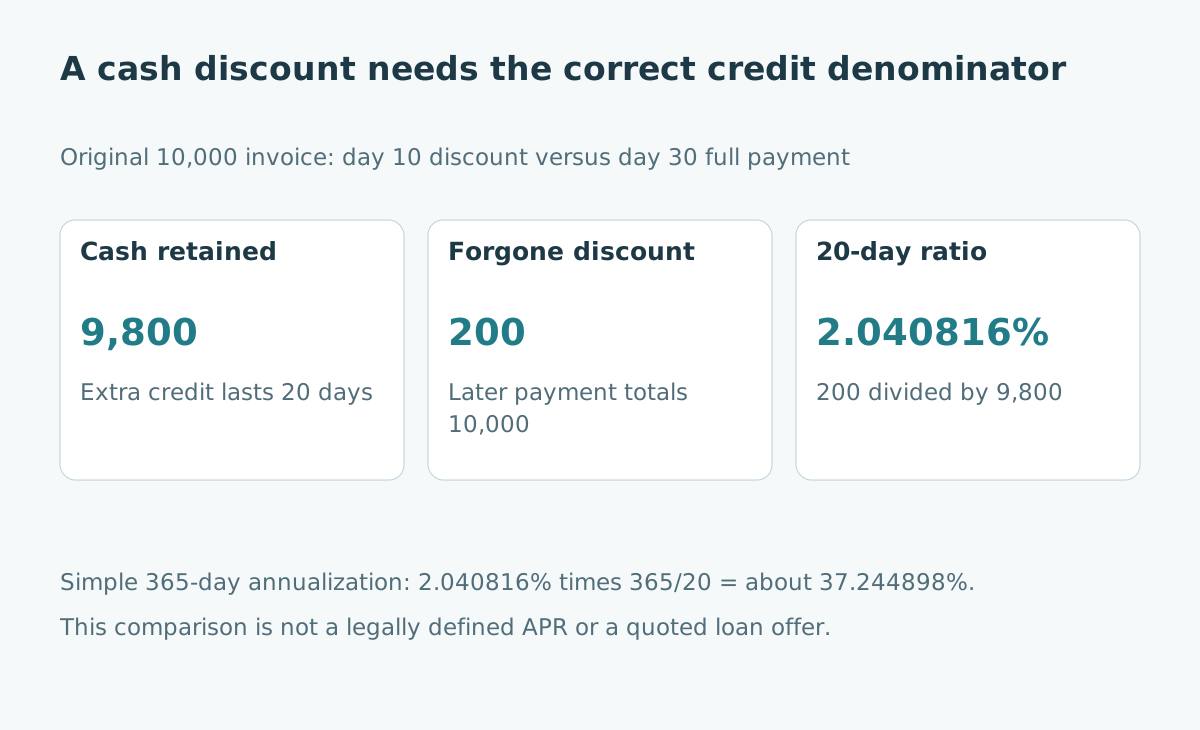
By not making the discounted payment on day ten, the business retains 9,800 for twenty additional days. The extra 200 paid on day thirty is the cost of choosing that option in this simplified model.
The twenty-day financing ratio is 200 divided by 9,800, approximately 2.040816%. Using 200 divided by 10,000 gives the invoice's 2% discount rate, which answers a different question.
For an invoice amount I and discount fraction d, the discounted payment is I × (1 − d). The forgone discount is I × d. Their ratio is therefore d/(1 − d). The invoice amount cancels, but the actual monetary saving remains important for cash planning and transaction costs.
Annualize only to make a consistent comparison
Using a simple 365-day convention, multiply the twenty-day ratio by 365/20. The result is about 37.244898% per year on that comparison basis.
This is not a prediction that the business will repeat the same transaction continuously for a year. It does not compound reinvested savings, and it is not a statutory annual percentage rate. Its purpose is to put a short cash interval on an explicitly stated scale.
A different day-count convention changes the annualized figure. Comparing annualized numbers without checking their conventions can create another denominator error. The original twenty-day cash difference remains 200 whichever comparison convention you choose.
Compare a real funding alternative on the same dates
Suppose an approved hypothetical funding option advances exactly 9,800 on day ten and is repaid on day thirty. Assume simple interest of 12% per year on a 365-day basis, with no principal changes during those twenty days.
Interest would be 9,800 × 0.12 × 20/365, approximately 64.44. Add an assumed fee of 40, and the total funding cost is about 104.44.
| Original twenty-day funding comparison | Amount |
|---|---|
| Discount available | 200.00 |
| Assumed interest | 64.44 |
| Assumed fee | 40.00 |
| Total assumed funding cost | 104.44 |
| Difference before other effects | 95.56 |
Under only these assumptions, the funding cost is below the discount. That arithmetic does not establish that borrowing is available, permitted or appropriate for an actual business.
Include the costs a headline rate leaves out
An actual offer might contain a minimum fee, unused-line charge, collateral requirement or a different interest convention. Settlement delays could also leave fewer discount days than the accounting system suggests.
Compare the full incremental cash cost over the relevant dates. Do not assume a displayed annual interest rate includes every charge. Equally, do not assign an entire existing credit-line fee to one invoice if that fee would be paid regardless; state which costs are incremental and why.
If cash is already available, the alternative is its next-best feasible use rather than an imaginary loan. That use might be another obligation or a liquidity buffer, not necessarily an interest-bearing investment.
Protect the payment's validity and liquidity needs
A positive arithmetic spread is not permission to pay an invalid or disputed invoice. Confirm that the amount, supplier details, goods or services, and discount eligibility have been appropriately checked under the business's procedures.
Then examine cash needs through day thirty and beyond. Paying early can reduce the buffer available for payroll, taxes or other obligations. A small apparent saving may not compensate for a serious liquidity shortfall or a financing condition the business cannot accept.
This is also why a financially constrained buyer may rationally decline a mathematically attractive discount. The calculation describes the trade-off; it does not remove the constraint.
Keep the supplier's decision separate
For the supplier, the same terms exchange part of the invoice value for earlier collection. The benefit depends on its financing situation, collection uncertainty and operating needs.
Do not infer that a supplier offering a discount is distressed. Nor should the buyer assume it may take the discount after the agreed deadline. Both sides need clear terms and consistent payment handling.
If terms are being negotiated, compare alternative dates and amounts directly. A longer net period changes the credit interval; a different discount changes both the saving and the amount paid early. Recalculate instead of carrying the old annualized number into the new arrangement.
Create a reviewable payment note
A compact original worksheet can record the validated invoice amount, discounted amount, discount deadline, net deadline, settlement processing time, funding option, incremental charges and remaining cash buffer. Assign an owner for confirming that payment actually qualifies.
Keep the decision explanation in cash amounts and dates first. Add annualization only when it aids comparison. This makes the conclusion easier to verify and reduces the chance that an impressive percentage overwhelms a missing operational detail.
For broader timing context, see working capital and invoice terms. For the distinction between reported profit and spendable resources, see profit versus operating cash flow.
Sources and evidence limits
- Thompson Rivers University: Working Capital Management, checked October 27, 2026. Supports the meaning of discount and net-payment terms.
- US Treasury Bureau of the Fiscal Service: Formula and Calculator for Discounts, checked October 27, 2026. Supports comparing early-payment benefits with the value of funds in federal payments; no live calculator result or current benchmark is reproduced here.
The invoice, rates, fees and funding availability are invented. The displayed annualization is independently calculated under the stated convention, not presented as a legal lending disclosure or personalized financing advice.