Fixing an Air Leak Does Not Automatically Cut Compressor Power by the Same Percentage
Connect compressed-air leak repair to compressor controls and metered energy. Separate reduced air demand from power savings while protecting useful duty.
A maintenance team finds and repairs several compressed-air leaks. The repair is real, but the electricity meter does not fall by the same percentage as the estimated reduction in wasted air. That result does not mean the repair was pointless. It means the path from air demand to electrical consumption needs examination.
A compressor supplies a system with controls, storage, pressure requirements and changing production demand. Removing one demand does not dictate exactly how the complete system will respond.
The US Department of Energy's leak-reduction tip sheet connects leak repair with adjustment of compressor operation to realize energy savings. This established engineering guidance was checked on October 27, 2026. It is not a new equipment announcement or a guarantee of a particular saving at your plant.
Define the air service before assessing the saving
What does production require at the point of use? A complete description includes air quantity, pressure, quality and the times when the service must be available.
A reduction in electrical consumption is not a successful improvement if the required equipment can no longer perform its accepted task. Conversely, a repair might improve pressure stability before it produces a large visible change in the electricity total.
An original assessment note should state the useful service, the measurement locations and the period being compared. It should distinguish planned production from maintenance downtime. This makes the comparison reviewable without assuming that two similar calendar days represent identical duty.
Separate demand-side repair from supply-side response
A leak is an unintended use of compressed air. Repairing it addresses the demand side. The supply side must then respond through the compressors' actual control behavior.
The DOE's compressed-air sourcebook describes system controls as the link between supply and demand, and emphasizes part-load performance and coordination among compressors. This explains why a flow estimate alone cannot determine electrical savings.
For a single machine, inspect its operating states. For a multi-compressor installation, establish which unit supplies base demand, which adjusts to changes, and which remains running. A local improvement may be absorbed by a different unit or operating state than the repair team expected.
Ask what unloaded operation consumes
Load/unload control can reduce useful air delivery while the motor continues running. Unloaded operation is therefore different from a stopped machine with no comparable operating draw.
Natural Resources Canada's compressed-air reference guide explains this distinction and describes variable-speed control responding to demand within its operating range. It also notes that operation below the minimum speed can involve other control modes.
Neither description makes one controller universally best. The relevant evidence is the installation's power profile across its actual duty. Do not apply a pump cube-law calculation to a compressor simply because both machines have rotating motors. The performance relationships and operating tasks must be established for the equipment being assessed.
Keep three measurements in separate columns
A leak estimate, a compressor power reading and an electricity total describe different quantities. Mixing them can turn a reasonable repair estimate into an unsupported financial claim.
| Measurement | Useful question | What it does not establish alone |
|---|---|---|
| Estimated leak air flow | How much unintended demand may have been removed? | The complete electrical saving |
| Electrical power in kW | What is the draw at this operating condition? | Energy over the entire shift |
| Electrical energy in kWh | What was consumed over the measured period? | Whether useful production was comparable |
Record how air-flow quantities are defined and measured. Record whether electrical readings cover one compressor, the compressor room or additional treatment equipment. A consistent boundary matters more than the appearance of extra decimal places.
Work an original metering example
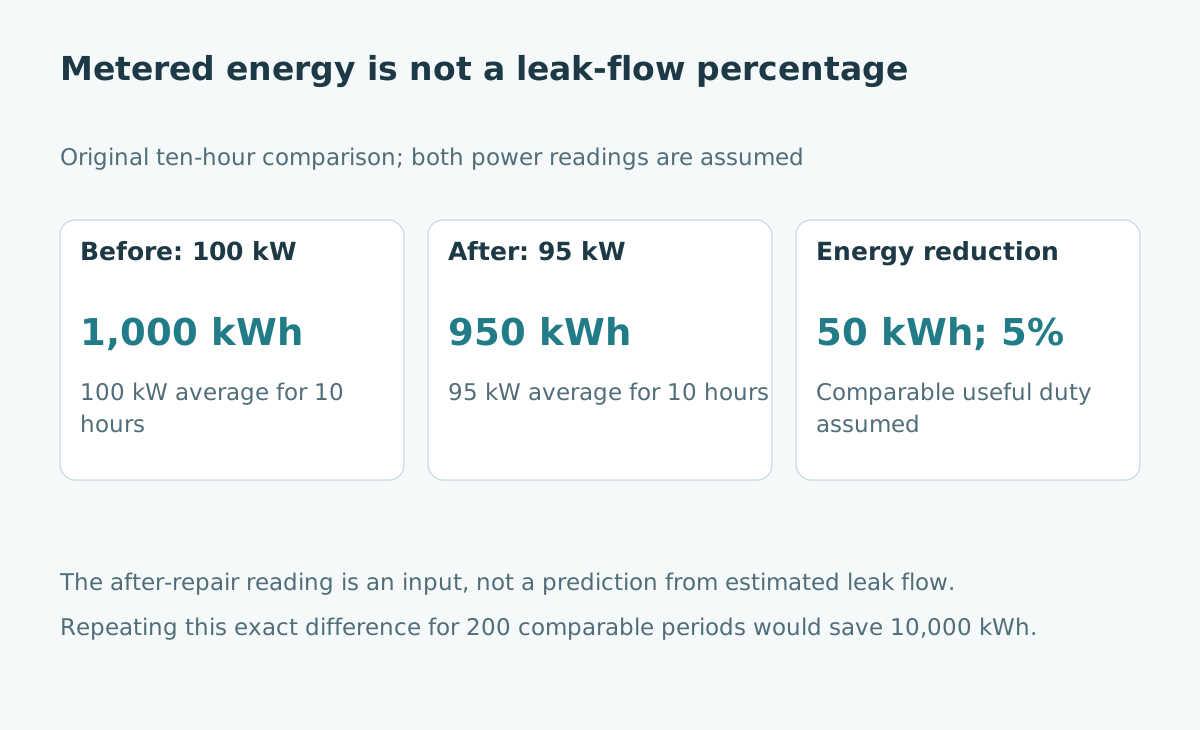
Assume a fictional ten-hour baseline observation has an average electrical draw of 100 kW at the defined compressor-system meter. Its measured-period energy would be 1,000 kWh.
For a comparable after-repair observation, assume the average reading is 95 kW for ten hours. Energy would be 950 kWh. The difference is 50 kWh, or 5% of the baseline energy.
| Original hypothetical comparison | Before | After |
|---|---|---|
| Average electrical power | 100 kW | 95 kW |
| Observation duration | 10 hours | 10 hours |
| Electrical energy | 1,000 kWh | 950 kWh |
| Reduction from baseline | — | 50 kWh, or 5% |
The 95 kW figure is an assumed monitoring result for teaching purposes. It was not calculated by multiplying baseline power by an air-leak percentage. The example does not claim that repairing any particular leak produces this outcome.
Inspect pressure and timing without changing requirements blindly
Before and after readings should include pressure at relevant locations and times. A header measurement may not reveal the minimum pressure experienced by a distant end use during a short demand event.
If pressure or controls changed at the same time as the repairs, record that fact. The comparison now evaluates a package of changes rather than leak repair alone. That package may be valuable, but its explanation should match the evidence.
Any control or pressure adjustment needs installation-specific engineering review and the applicable equipment procedures. The worksheet here is a way to organize evidence, not an instruction to reduce pressure or bypass safeguards.
Build the annual estimate from operating periods
A ten-hour difference is not automatically a daily saving throughout the year. The duty may change across production levels, shifts and shutdown periods.
For an original planning example, if the exact 50 kWh difference were credibly repeated for 200 comparable operating periods, the modeled reduction would be 10,000 kWh. That multiplication is valid only for the stated repeatability assumption. It is not evidence that the assumption holds.
Convert energy to cost using the relevant tariff components. A reduction in energy does not necessarily reduce a demand charge if the billed peak is unchanged. Repair costs and any additional maintenance also belong in an economic comparison.
Treat leak management as a continuing process
A repair record can include an identifier, location, finding date, repair date and verification result. Connect the record to operating observations instead of ending the process when the work order is closed.
Repeat the review when production or compressor sequencing changes. A previously appropriate configuration may no longer match the duty. Preserve periods where the expected saving did not appear; they can identify a measurement gap or an operating condition that the original assessment missed.
For another example of a local speed claim versus complete output, read robot cycle time and production throughput. For the limits of transferring power ratios into energy claims, see pump speed, system curves and energy.
Sources and evidence limits
- US DOE: Minimize Compressed Air Leaks, Tip Sheet 3, revised August 2004. Supports linking repair with compressor operation.
- US DOE: Improving Compressed Air System Performance, checked October 27, 2026. Supports the supply-demand and system-control distinction.
- Natural Resources Canada: Compressed Air Reference Guide, checked October 27, 2026. Supports the control-mode explanations.
All metering values and extrapolations above are invented illustrations. No generic leak fraction is presented as a guaranteed electrical or financial saving.