Feedback Uptake: Decide Which Revision to Make—and Show Why
Turn comments into defensible revisions with a feedback decision worksheet, a checked example, and research on judging suggestions rather than accepting all.
Your report comes back with twelve comments. Some ask for clearer wording, one questions the calculation, and another suggests a stronger conclusion. You could accept everything and produce a cleaner-looking document while making its central claim less defensible.
Using feedback well means deciding what to change, why the change is justified, and how to check the result. It is an active judgment task, whether the comments come from a lecturer, a classmate, or an AI assistant. The number of suggestions accepted is a poor stand-alone measure of learning.
Recent research makes that distinction especially useful. A September 2026 experiment tested a small intervention: requiring students to explain their acceptance or rejection decisions. The findings support a closer look at the reasoning behind a revision, while leaving important limits on what a short explanation can accomplish.
Feedback is information to evaluate
A comment can identify a genuine weakness without supplying the best repair. “Your conclusion is too broad” may be correct; “therefore claim that the intervention works for everyone” is not a reasonable solution. Separate the diagnosis from the proposed change.
In their 2018 conceptual paper, Carless and Boud describe feedback literacy through appreciating feedback, making judgments, managing affect, and taking action. That framework is useful for organizing the work, but it is not a controlled trial proving a particular worksheet improves grades.
The practical consequence is that neither obedience nor defensiveness is the goal. You need enough understanding of the task and its standards to assess a suggestion. When that understanding is missing, clarification is a legitimate next action.
What the September 2026 experiment found
Tao, Meyer, and Kizilcec's September 20, 2026 preprint reports a randomized course activity involving 129 students, data-analysis proposals, and mixed-quality AI revision suggestions. Requiring written reasons reduced adoption of flawed suggestions from 65% to 41%, a 24-percentage-point difference. Acceptance of sound suggestions was not reduced in the reported comparison.
The remaining 41% matters: justification did not eliminate poor decisions. The authors also report superficial explanations and gaps in monitoring and domain knowledge. Writing “this makes it better” is not the same as checking whether it does.
This review could verify the indexed primary abstract, rather than the full methods or later learning outcomes. The work is a preprint; peer-review status is not established here. Its result does not guarantee that every justification prompt, subject, or feedback source produces the same effect.
Separate revision uptake from revision quality
A student who accepts nine of ten comments has a 90% acceptance rate. If several comments are wrong, that rate can reward an undesirable outcome. A student who rejects an inaccurate recommendation may be showing stronger judgment.
Keep at least three questions separate: did the learner engage with the suggestion, was the decision reasonable, and did the resulting work improve against the task criteria? Merely counting edits answers none of these completely.
A January 30, 2026 opinion article by Helm and Hesse argues that writing instruction should support students' processing and use of feedback, rather than focus only on generating better comments. It supplies an instructional argument, not a new efficacy trial. The distinction between a useful design proposal and tested impact should remain visible.
An original example: four comments on one report
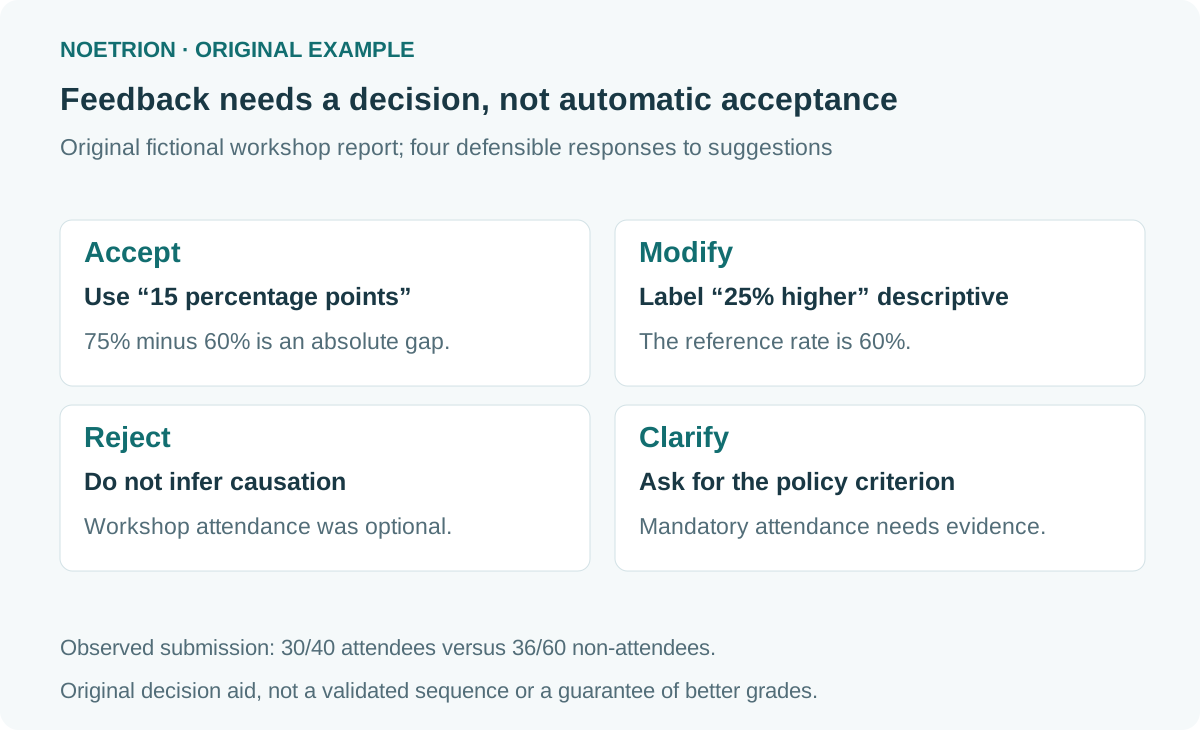
Consider a fictional student report about an optional study workshop. Of 40 attendees, 30 submitted the follow-up assignment. Among 60 non-attendees, 36 submitted it. Attendance was not randomized, and no information about prior motivation or workload is available.
The draft says: “Submission was 75% for attendees and 60% for non-attendees. The workshop increased submission by 15%, so the university should require it for every student.” The arithmetic is partly useful, but the wording and causal claim need work.
| Suggestion | Decision | Reason and proposed action |
|---|---|---|
| Replace “15%” with “15 percentage points” | Accept | The absolute difference is 75% − 60% = 15 points |
| Say the workshop caused the difference | Reject | Optional attendance permits selection differences |
| Add that a relative comparison is 25% higher | Modify | Correct as a descriptive comparison; label the denominator and avoid causality |
| Recommend mandatory attendance immediately | Clarify | Ask what policy evidence and resource criteria the assignment requires |
The relative difference is (75 − 60) / 60 = 25%, using the non-attendee rate as the reference. Neither version establishes that the workshop caused additional submissions. Different wording does not repair an unsupported design assumption.
For the statistical distinction, see correlation versus causation. If the feedback concerns the research source itself, use the questions in reading research papers critically.
Write the revision and preserve the limit
A defensible revision might say: “In this fictional sample, 30 of 40 attendees submitted the assignment, compared with 36 of 60 non-attendees. The observed rates differ by 15 percentage points. Because attendance was optional, this comparison does not establish a causal workshop effect.”
A proportionate next step could be to investigate whether groups differed beforehand and clarify what additional evidence a policy decision needs. It should not quietly invent missing information or promise that controlling for one variable would settle every concern.
The revision is longer than the original claim, but its extra words do work: they name the counts, establish the comparison, and state the inference boundary. After that repair, you can shorten the language without removing those essentials.
Use a decision worksheet with evidence
For each substantial suggestion, record the affected passage, the issue, your decision, the evidence, the change, and the check. One clear sentence in each field is often enough. The worksheet is an editorial tool, not a research-validated assessment scale.
| Field | Weak entry | Useful entry |
|---|---|---|
| Issue | “Numbers are bad” | “Absolute and relative differences are mixed” |
| Decision | “Agree” | “Accept the percentage-point correction” |
| Evidence | “The comment sounds right” | “75% minus 60% equals 15 points” |
| Change | “Make it academic” | “Replace causal wording with observed comparison” |
| Check | “Read again” | “Verify counts, denominator, and remaining causal verbs” |
A rejection also needs evidence. “I prefer my version” may explain a stylistic choice, but it does not resolve a factual objection. If the task rubric explicitly requires a convention, identify that requirement before deciding to keep an alternative.
Prioritize the changes that can alter the conclusion
Begin with issues that affect correctness, interpretation, or required coverage. A wrong denominator can reverse the meaning of a paragraph. A clumsy sentence may be inconvenient without changing the result. Both deserve attention, but their consequences differ.
Suppose the fictional learner has 45 minutes. Allocate 20 minutes to checking the central claim and calculations, 15 to rewriting and verifying the argument, and 10 to clarity and formatting. The total is 45 minutes. This is an illustrative budget, not a proven optimal ratio.
If the first check reveals that the source cannot support the main claim, revise the plan. Spending the remaining time polishing the unsupported argument would not recover its value. Prioritization must respond to what the review discovers.
Ask for clarification without outsourcing judgment
A useful question identifies a specific uncertainty: “Does this comment ask me to report the relative difference, or to explain why the observational comparison is not causal?” That gives a lecturer or peer something concrete to answer.
Ask for the criterion or reasoning before requesting a replacement paragraph. A fully rewritten answer can hide the distinction you needed to learn. Once you understand the issue, try the repair yourself and explain why it addresses the comment.
With AI feedback, keep course rules and data permissions in view. Do not upload confidential material merely to obtain a second opinion. A second tool's agreement is also not independent confirmation of a fact; check the calculation or authoritative source directly.
Check the revised work, then test a fresh example
Compare the new passage with the assignment criteria. Did the revision remove the original error? Did it introduce a stronger claim elsewhere? A cautious sentence followed by an unsupported recommendation leaves the problem unresolved.
For a short follow-up, change the workshop counts: 24 of 32 attendees submit, versus 30 of 50 non-attendees. The rates are again 75% and 60%, giving the same 15-point difference and 25% relative comparison. Explain why the new counts still do not establish causation.
Then change the non-attendee rate to 50%. The absolute gap becomes 25 points and the relative comparison becomes 50% higher. If you can explain the denominator rather than repeat a memorized number, the revision has given you something reusable.
End by recording one rule for the next assignment: “Label the comparison and check the inference before strengthening the conclusion.” Feedback has become useful when it changes a defensible decision, not simply when it produces more edits.
Sources and verification boundaries
- Carless and Boud, The development of student feedback literacy, 2018. Conceptual framework; institutional abstract and record reviewed.
- Tao, Meyer, and Kizilcec, Think Before You Accept, September 20, 2026 preprint. Indexed primary abstract reviewed; full-method verification and peer-review status unavailable in this review.
- Helm and Hesse, Stop perfecting the feedback, start supporting the uptake, January 30, 2026. Opinion article; not an efficacy experiment.
Checked October 21, 2026. Workshop counts, revision examples, and worksheet are original and fictional. No grade gain is claimed for the suggested workflow.