A Grid-Forming Inverter Can Support the Waveform Without Creating More Energy
Separate grid-forming control from power and energy capability. Work a battery example and build a test matrix for faults, recovery and restoration.
A battery supplier says its inverter can operate in grid-forming mode. The claim sounds like the answer to an increasingly practical question: how does an electricity system maintain a usable voltage waveform when more generation connects through power electronics?
It is a meaningful capability, but a project still needs several separate answers. How much power can the equipment deliver? For how long? What happens during a fault? Which other devices must operate for the promised service to work?
The US Department of Energy's UNIFI explanation distinguishes inverters that help establish voltage and frequency from traditional grid-following equipment that relies on an existing reference. Its discussion includes possible restoration applications. This is useful background checked on October 24, 2026, rather than a claim that a new inverter standard was issued today.
The practical lesson is to evaluate a specified service under specified conditions. A label on a controller cannot replace an operating envelope.
Ask what the inverter is controlling
A useful first question is whether the device requires an external grid reference for its normal control task or helps establish that reference itself. That difference concerns the behavior of the equipment at its connection point.
It does not mean a grid-forming device can impose any desired voltage on any network. The network, other controls and hardware constraints still matter. Nor does the distinction mean grid-following resources provide no useful support. Project documents should describe the required behavior rather than rely on a contest between two labels.
For a procurement discussion, replace “supports the grid” with a concrete scenario: the initial operating point, the disturbance, the acceptable response and the conditions for returning to normal operation.
Keep the capability questions separate
A controller, an inverter power stage and an energy source are parts of one system. Changing a control algorithm does not automatically enlarge the other parts.
| Question | What the answer should identify | What it cannot establish alone |
|---|---|---|
| Can the device form a voltage reference? | Control behavior and tested conditions | Unlimited power delivery |
| Can it increase active power? | Available upward headroom | Duration of that increase |
| Can it maintain delivery? | Usable energy and replenishment | Fault response quality |
| Can it restore a de-energized section? | Tested restoration sequence and dependencies | Universal black-start capability |
This separation also makes a sales demonstration easier to assess. A clean voltage trace is evidence about one observed response, not a complete resource-adequacy study.
Work the headroom calculation first
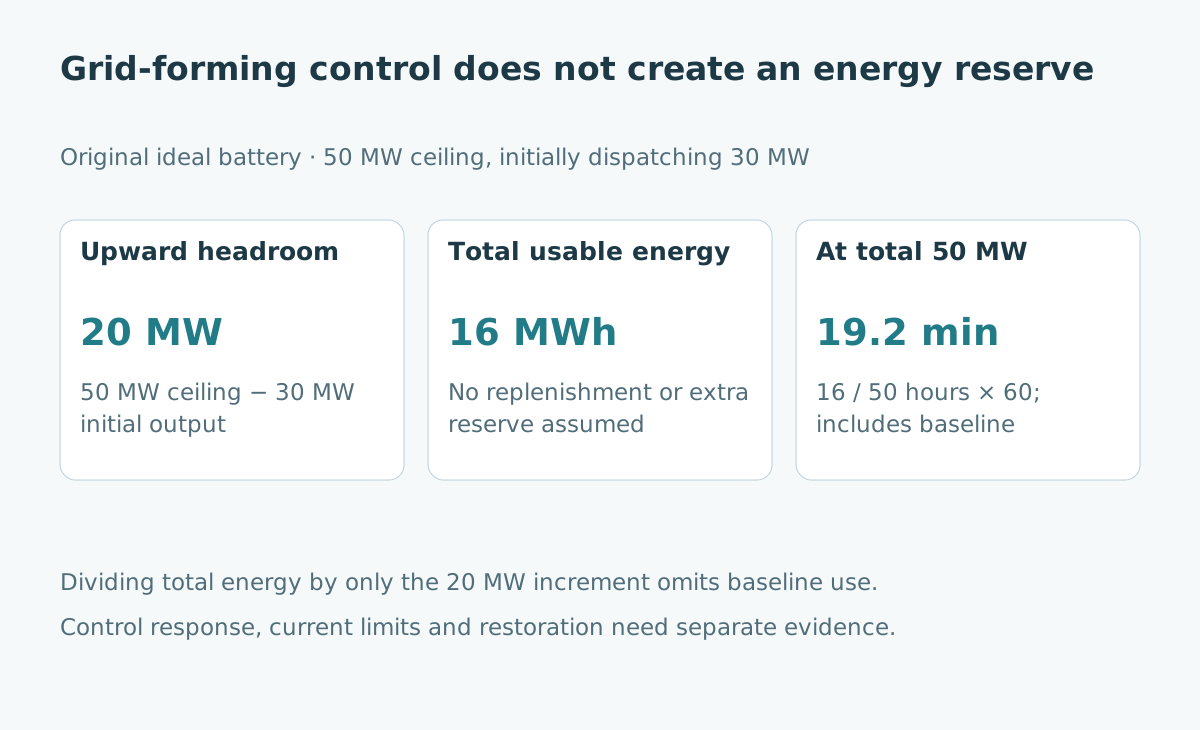
Consider an invented battery project with a 50 MW active-power ceiling under the assumed operating conditions. It is initially dispatching 30 MW. Its nominal upward headroom is 50 minus 30, or 20 MW.
The word nominal matters. For this arithmetic, assume the full 50 MW ceiling remains available. Actual acceptance criteria would need to account for the equipment's applicable limits, including any reactive-power duty. A 50 MW label by itself does not demonstrate simultaneous delivery of every promised service.
If the project is asked to increase output by 25 MW from the initial point, its requested total would be 55 MW. That exceeds the assumed ceiling. Increasing the energy inventory would not solve this particular power-limit problem.
Then check the total energy obligation
Now assume 16 MWh of usable energy remains available for discharge, already expressed at the output boundary used in this ideal calculation. With no replenishment and constant total output of 50 MW, duration is 16 divided by 50 hours: 0.32 hours, or 19.2 minutes.
Dividing 16 MWh by the 20 MW increase instead gives 48 minutes. That would be the duration of an explicitly separate 16 MWh incremental energy budget. It is not the duration of this battery when the same 16 MWh must also fund its original 30 MW output.
| Constant total output | Energy used in ten minutes | Ideal duration from 16 MWh |
|---|---|---|
| 30 MW | 5 MWh | 32 minutes |
| 50 MW | 8.333 MWh | 19.2 minutes |
The example assumes constant delivery, no charging and no additional reserve requirement. It illustrates why the energy denominator must match the complete power obligation. It does not predict a real battery's dispatch or service revenue.
Test the boundary where current is constrained
An engineering review should ask what happens when a disturbance demands more current than the equipment can safely deliver. What changes in the control response? Which service takes priority? What evidence describes recovery after the limit stops binding?
The 2020 national-laboratory research roadmap treats protection, fault ride-through, voltage recovery and modeling as connected research areas. It is a historical technical foundation, not a certification that a present product passes a particular network requirement.
An original test worksheet can turn that broad concern into reviewable evidence. Record the model version, initial dispatch, assumed network condition, disturbance and recovery criterion for each case. Preserve unsuccessful results as well as the demonstration selected for a presentation.
Treat restoration as a complete sequence
Black start is a system task. An isolated inverter demonstration does not show that an entire restoration path will work.
For a hypothetical project, list the required auxiliary supplies, switching steps, connected loads, communications and operator actions. Identify who authorizes each stage. Then ask which steps were represented in the test and which remain assumptions.
A claim can be precise without being grand: “The tested configuration energized this defined section under these initial conditions.” That statement is more useful for engineering decisions than an unrestricted promise to restart a grid. Grid-forming capability should not be interpreted as proof that every product or installation includes black-start functionality.
Make interfaces part of the evidence
A project can meet a local control target while interacting poorly with equipment outside the test boundary. A model review should therefore identify which neighboring devices are represented and which are simplified.
The useful procurement artifact is a matrix of obligations and evidence. For each promised service, list the responsible component, operating envelope, evidence location and unresolved dependency. If two parties assume the other supplies a reference, energy reserve or recovery instruction, the gap becomes visible before commissioning.
Modeling and staged tests help explore these cases. They do not remove the need to establish whether the represented conditions are appropriate for the installation being assessed.
Read a grid-forming claim in four passes
First identify the control behavior. Second identify the available power and energy. Third examine constrained operation and recovery. Fourth examine the dependencies of the complete service.
This approach gives an engineering team a practical way to ask better questions without pretending a short article can approve an electrical design. Installation-specific protection, interconnection and commissioning decisions require qualified engineering assessment.
For the underlying arithmetic, see battery sizing in MW and MWh. For the evidence boundary between a model and a deployed system, see digital-twin validation.
Sources and evidence limits
- US Department of Energy: UNIFI Consortium, checked October 24, 2026. Supports the high-level control distinction and restoration context.
- Lin and colleagues: Research Roadmap on Grid-Forming Inverters, November 2020. Supports the need to examine interacting control, protection and recovery questions; it is not presented as a new 2026 requirement.
All project values and the review worksheet are original explanatory examples. No equipment qualification or measured field performance is asserted.