Before Negotiating a Job Offer, Decide What You Would Do Without a Deal
Prepare a job-offer negotiation by separating your alternative, acceptance threshold, target and opening request. Use a worked decision model and evidence limits.
The recruiter asks what would make the offer acceptable. You have a salary number in mind, but you have not decided what you would do if the employer declines. That missing comparison can make both an enthusiastic acceptance and an ambitious counteroffer poorly grounded.
Preparation begins with four different things: your best available alternative, the least attractive agreement you would prefer to it, your desired outcome and the request you choose to make. They should inform one another without becoming interchangeable.
This evergreen guide develops an original preparation sheet for a job-offer discussion. It focuses on decision thresholds and negotiation process. For identifying the components of a package first, use the separate salary-range and total-compensation guide.
Write the alternative as an action you can actually take
BATNA means best alternative to a negotiated agreement. In an offer discussion it might be accepting another valid offer, remaining in your current role or continuing a financially feasible job search. “Find something better” is a hope until you specify what action is available and what it requires.
Record the alternative's status and deadline. An interview invitation is not an offer. An expired offer is not available leverage. Staying in a role may be feasible while continuing a search, whereas leaving immediately may require resources you do not have.
Then ask what you can improve before negotiating: clarify an existing offer, investigate a missing benefit or extend a genuine decision window. These actions strengthen the information behind the comparison without requiring invented competing offers.
Separate the acceptance threshold from the target
The reservation point is the boundary at which the proposed agreement is no more attractive than your alternative under the comparison you have chosen. An aspiration or target describes an outcome you want to achieve. The opening request is what you communicate during the discussion.
Your threshold is not automatically the amount you should request. A weak alternative can justify accepting a particular agreement while still leaving room to seek a better one. Conversely, an ambitious request does not establish that the employer can or will meet it.
Include essential nonfinancial conditions. If a required working arrangement is unavailable, a salary threshold alone does not decide acceptability. Keep that condition visible rather than hiding it inside an arbitrary money conversion.
Build a comparable threshold before discussing numbers
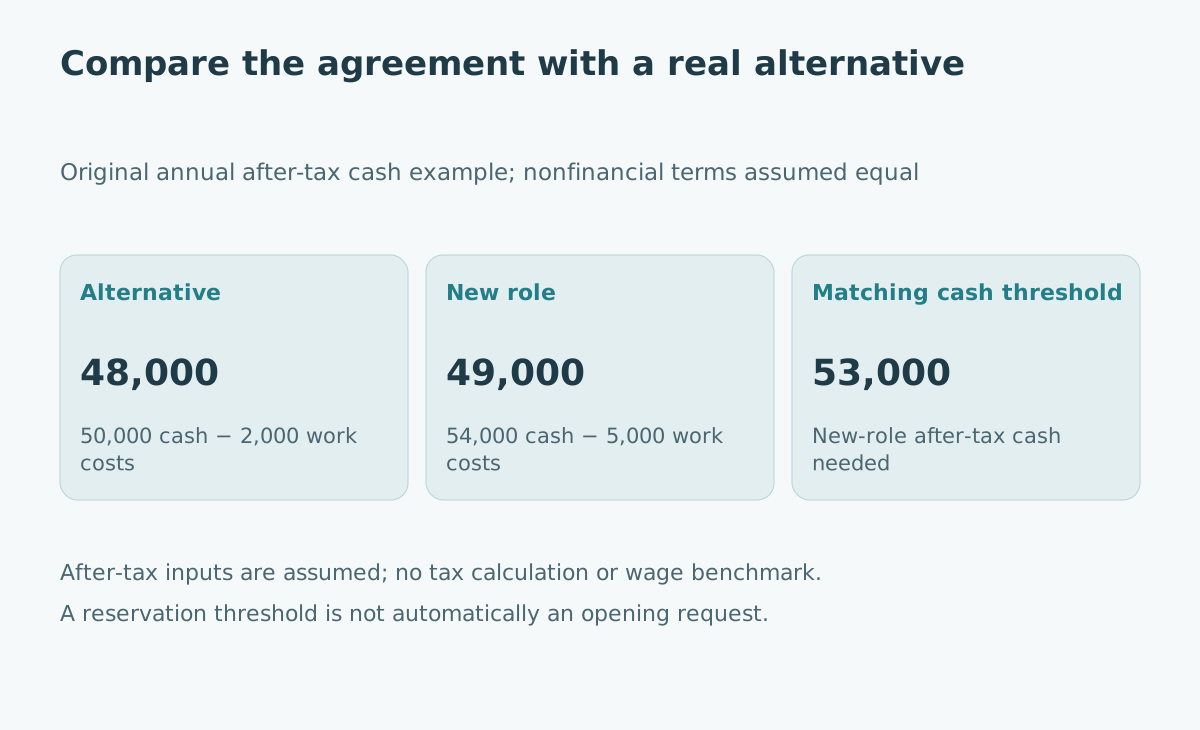
Consider fictional annual after-tax cash amounts supplied as assumptions. Taxes and mandatory deductions have already been accounted for in those inputs; this example does not estimate them. Assume the roles are equivalent on the nonfinancial conditions that matter to the candidate.
| Comparison item | Available alternative | Proposed new role |
|---|---|---|
| Annual after-tax cash, assumed | 50,000 | 54,000 |
| Annual work-related cash costs, assumed | 2,000 | 5,000 |
| Cash remaining after these costs | 48,000 | 49,000 |
The alternative leaves 50,000 − 2,000 = 48,000. With 5,000 of work costs, the new role needs 53,000 after-tax cash to match it. At 54,000, its advantage on this deliberately narrow measure is 1,000.
An employer normally quotes gross compensation, so do not send the 53,000 threshold as though it were a gross salary request. Translate proposed gross packages using reliable information about deductions and terms before comparing them. If those inputs are uncertain, keep a range rather than treating the threshold as exact.
Prepare the opening request with relevant evidence
Link the request to role scope and credible compensation information: responsibilities, level, location and relevant demonstrated skills. For example: “Given the ownership of the reporting pipeline and the stakeholder responsibilities, could we discuss a higher recurring base within the budget for this level?” Then state the specific gross amount you can substantiate.
Galinsky and Mussweiler's 2001 experiments found first-offer advantages in the studied negotiations, but also found that focusing on relevant alternatives, reservation information or one's own target could counter anchoring. Those experiments do not establish a universal instruction to name a number first in every job discussion.
If the role budget and scope are unclear, seek clarification. An unsupported opening number can anchor you to your own guess as readily as to an employer's expectations.
Do not confuse a weak alternative with a low aspiration
Maaravi, Heller and Levy's 2023 research examines how negotiation alternatives affect first offers and reservation prices. In its simulated settings, low-power negotiators could make less favorable first offers than offers they would receive by moving second. A debiasing exercise improved their openings without eliminating that pattern.
This qualifies the simple “always go first” advice. It does not predict an individual employer's response or prove that waiting always benefits a candidate. The study concerns specified experimental roles and alternatives.
A practical response is to prepare the target separately from the alternative. Check whether the number you plan to request reflects the role's evidence or merely the relief you would feel at escaping an unattractive current situation.
Trade across terms without losing the threshold
Ask which terms are genuinely adjustable. Base salary, start date, working pattern or a signing payment may involve different constraints and different decision makers. Prioritize a few changes that matter instead of treating every possible benefit as equally valuable.
Return each proposed package to the comparison sheet. A one-time payment can improve the first year while leaving the recurring position unchanged. An additional review meeting is not a promised salary increase. A verbal description of flexibility may need clarification in the written terms.
The employer's private acceptance boundary is not observable from your threshold. Nor does a published salary range prove that a bargaining zone exists for your requested package. Prepare to learn about constraints during the discussion.
Manage deadlines and concessions deliberately
List the actual decision dates and identify which questions must be answered before each. Request additional time when useful, but treat an extension as unresolved until confirmed.
Make a concession conditional and understandable: “If the base is fixed, could we discuss the working arrangement and confirm it in the offer?” Avoid bargaining against yourself by repeatedly lowering a request before the employer responds.
Keep a short decision record after each exchange: proposed terms, remaining questions and next action. This is an original practical workflow, not an experimentally validated script or a guarantee of a higher offer.
Recheck the alternative before accepting
Compare the final written agreement with the still-available alternative. Update costs, dates and nonfinancial conditions when new information arrives. A threshold is useful because it makes assumptions explicit; it should change when those assumptions genuinely change.
If the final agreement falls below your boundary, you can decline, seek another modification or consciously revise your priorities. Record the reason rather than quietly changing the arithmetic to justify an emotionally attractive choice. For a structured comparison of uncertain outcomes, see scenario-based decision making.
Sources and limits
- Galinsky and Mussweiler, October 2001: First Offers as Anchors: primary experimental abstract reviewed; anchoring and negotiator focus.
- Maaravi, Heller and Levy, January 20, 2023: Low Power, First Offers, and Reservation Prices: full primary research article reviewed; simulated negotiation alternatives and openings.
Checked October 30, 2026. This is an evergreen decision guide. Its financial scenario, preparation sheet and suggested wording are original illustrations. Research findings do not establish a guaranteed negotiation outcome or determine an individual's correct acceptance threshold.