Teaching a Topic Can Expose Gaps—If You Check the Explanation
Use a short teaching task to inspect what you understand. Separate preparation, explanation and delayed recall, with an original accuracy-check worksheet.
You explain a database concept to a friend. The story flows, the example sounds sensible and your friend nods. Later, a practice question changes one condition and your explanation no longer works. Teaching produced a polished performance, but the missing condition survived it.
Learning by teaching can be useful precisely because an audience creates demands: select important ideas, organize them and make the connections understandable. The benefit is not established by the length of the explanation or by the listener's politeness. What matters is which knowledge the activity brings into use and what happens when its accuracy is checked.
This evergreen guide offers an original teaching-and-checking routine. It distinguishes preparing to teach, explaining from memory and checking later performance. The workflow is a practical adaptation, not an intervention directly validated by the studies below.
Begin with the question the learner needs answered
Choose a small target rather than a whole chapter. “Explain why an identifier must be unique in this example” is easier to inspect than “teach databases.” State what the listener should be able to explain or decide afterward.
Then write the essential claims privately before the session. For a database key, these could concern the object being identified, the uniqueness requirement, the meaning of a duplicate and the consequence for a particular operation. Use accurate course material to define the target.
This is preparation, not a demand to memorize a script. Its purpose is to make omissions and unsupported claims visible when you later compare the explanation with the source.
Know what teaching expectancy actually tested
In Nestojko and colleagues' 2014 experiments, participants studied passages expecting either a test or an opportunity to teach. All were subsequently tested; nobody actually taught. Those expecting to teach produced more complete and organized recall, with advantages on some comprehension measures, especially main points.
The important boundary is that preparing to teach was the manipulated activity. The study does not show that every later classroom explanation improves learning, nor that an audience's approval verifies understanding. The publisher abstract and metadata were reviewed here rather than the complete article.
For an individual session, adopt the useful question without borrowing an unsupported guarantee: if you had to teach this tomorrow, which central idea and relationships would you need to organize today?
Separate explaining from reading an answer aloud
Koh, Lee and Lim's 2018 study compared teaching without notes, teaching with notes, retrieval practice and a control activity. Its summary reports that the teaching-without-notes and retrieval groups outperformed the teaching-with-notes and control groups on a comprehension test one week later.
That result supports taking retrieval seriously when interpreting a teaching activity. It does not establish that retrieval is the only possible mechanism or that speaking is always superior to other practice. The reviewed material was the authors' published summary, not a complete methodological appraisal.
For your session, record what help you used. Explaining while inspecting the answer and explaining after closing it are different observations. Both may have a place, but merging them into one success mark hides what was independently available.
Give the listener a useful role
Ask the listener to identify one unclear connection and request one changed example. They do not need to pretend to be an examiner. A question such as “What changes if two records share that identifier?” is more useful than a general verdict that the explanation was good.
An imagined audience can also create a clear communication target. Record a short explanation or write it for a specific beginner. However, an absent listener cannot reveal which parts confused a real person. Keep that limitation visible.
Avoid making confidence or verbal speed the criterion. A hesitant explanation can contain correct reasoning; a fluent explanation can omit the decisive condition. Preserve the actual claims so they can be checked.
Audit four claims in a concrete example
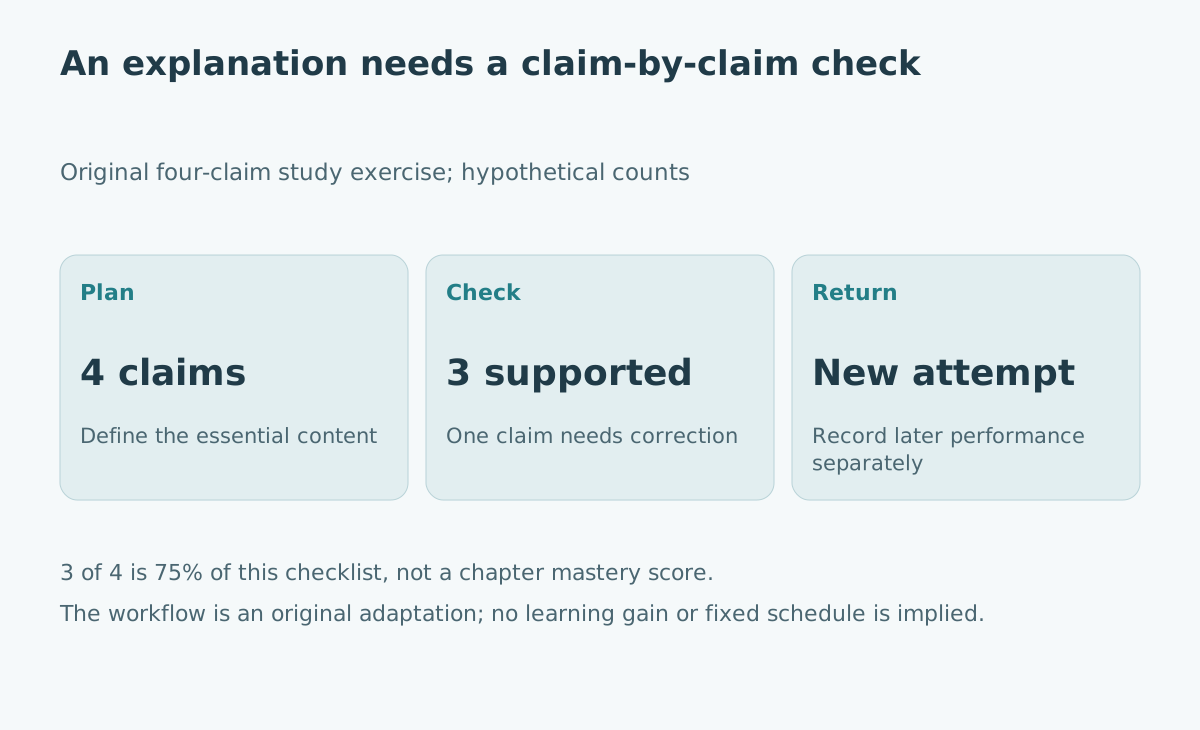
Imagine an original study exercise containing four planned claims. After the explanation, comparison with the course source supports three; one requires correction. Keep the original response and the corrected version rather than replacing the first record.
| Claim in the exercise | Evidence to inspect | Possible repair |
|---|---|---|
| What the identifier refers to | The defined record or entity | Name the unit explicitly |
| What uniqueness requires | The relevant constraint | Add the missing scope |
| Why a duplicate matters | A small example with two records | Trace the ambiguity |
| What happens in a changed case | A prediction and its reason | Revise the overgeneralization |
Three supported claims out of four is 75% of this checklist. It is not a score for the whole chapter, proof of durable memory or a validated measure of teaching quality. The unresolved claim may be the most important one.
Repair the claim before rehearsing the delivery
Find the point where the reasoning stopped matching the source. Was the definition incomplete, the example unsuitable or the conclusion too broad? Change the underlying claim before polishing the wording.
Then explain the corrected relationship in a fresh example. If the original problem involved customer IDs, a different fictional record type can reveal whether you understood the condition or merely memorized the previous sentence. Keep the core rule consistent while changing the surface details.
This proposed accuracy check prevents a practical failure: repeatedly rehearsing an unchecked explanation. The studies cited above do not establish the effectiveness of this exact repair routine. Its immediate value is that the explanation becomes inspectable.
Keep a later attempt separate from the finished recording
Return after a meaningful delay and produce the central explanation before replaying the corrected version. Record what you recalled, what condition was missing and whether you could handle the changed case.
If all four claims are now supported, that is a later observation under the stated conditions. It should not erase the earlier three-of-four record or turn into a permanent mastery label. A familiar recording can make recognition easier than independent explanation.
For broader scheduling principles, see retrieval practice and spacing. For examining the reasoning inside one step, use self-explanation and mechanism checks. Teaching adds an audience and a communication goal; those related guides address different parts of the learning process.
Judge the routine by useful understanding
A short session should leave an explanation, an accuracy check and a concrete next action. If most of the time goes into editing video or designing slides, ask whether production work is displacing the concept you intended to learn.
Use teaching selectively for ideas that benefit from organization or changed examples. Other tasks may require direct problem solving, reading, pronunciation practice or supervised procedures. One useful technique does not need to become the default for every subject.
The useful outcome is modest and testable: you can identify which claims were supported, correct a missing condition and inspect a later attempt. Finishing an explanation is the start of that evidence, not its substitute.
Sources and limits
- Nestojko, Bui, Kornell and Bjork, 2014, published May 21, 2014: primary publisher abstract and metadata reviewed; teaching expectancy in passage-learning experiments.
- Koh, Lee and Lim, 2018, first published April 15, 2018: primary published summary reviewed; teaching, retrieval and one-week comprehension comparison.
Checked October 31, 2026. The database exercise, four-claim checklist and repair workflow are original. No universal learning gain, optimal teaching duration or causal mechanism exclusive to teaching is claimed.