Self-Explanation Works Best When You Explain the Missing Link, Not Just Rewrite the Sentence
Learn to distinguish paraphrasing from self-explanation. Use an average-speed example, targeted prompts and a correction log to test your understanding.
You finish rewriting a textbook paragraph in simpler words. The result reads clearly, and every sentence feels familiar. Then a problem changes one condition, and the method no longer seems obvious. Your notes may have preserved the statement without making the relationship behind it usable.
Self-explanation asks you to supply that relationship. Why is this denominator appropriate? Which condition makes this step valid? What would change if that condition disappeared? These questions create something you can check, instead of treating fluency as the final result.
The method has a research history, including Chi and colleagues' 1989 study of learning from examples. This article provides an original worksheet for using the idea. It offers no promised percentage improvement and does not turn a classic laboratory result into a universal study rule.
Recognize what an explanation adds
A paraphrase changes wording while keeping approximately the same information. That can help clarify vocabulary. A self-explanation goes further by connecting the statement to a principle, an earlier idea or a consequence that the statement leaves implicit.
Suppose the source says, “Average speed equals total distance divided by total elapsed time.” A paraphrase might replace “elapsed” with “taken.” An explanation might say that each hour must contribute according to how long the traveler spends at its speed. That connection helps decide whether averaging two speed numbers is legitimate.
The practical aim is a checkable inference. Long answers, technical vocabulary and polished prose do not establish that an inference is correct.
Choose a point where the reasoning could break
Do not begin by explaining every sentence on the page. Pick the step that selects a method, changes a representation or relies on an assumption. Those are useful places to discover whether you understand the relationship.
In a programming lesson, ask why the operation mutates an object rather than creating a separate one. In an economics lesson, ask what is held constant in a comparison. In a probability lesson, ask which population supplies the denominator.
Choose one point and write your answer before consulting the explanation. If you read the answer first, the resulting sense of recognition may conceal the very gap you wanted to inspect.
Work through an average-speed example
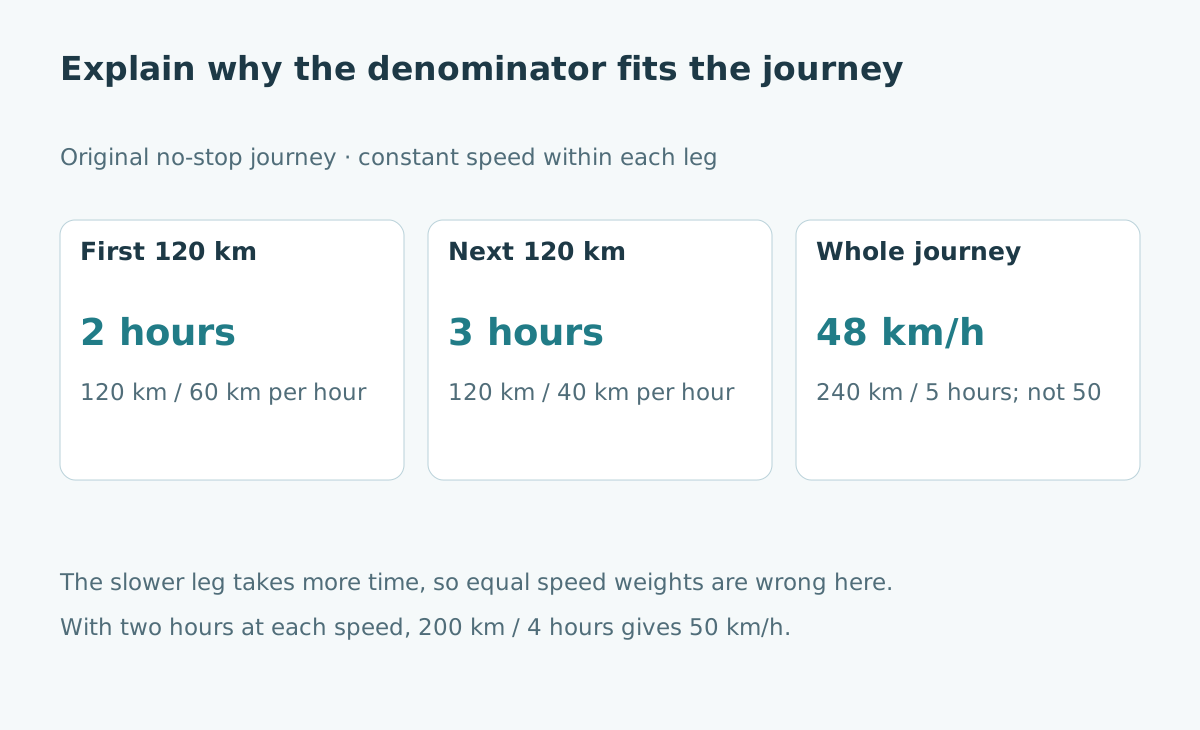
Consider an invented journey with no stops. A traveler covers 120 kilometres at 60 kilometres per hour, then another 120 kilometres at 40 kilometres per hour. Assume each speed is constant during its leg.
| Quantity | First leg | Second leg | Whole journey |
|---|---|---|---|
| Distance | 120 km | 120 km | 240 km |
| Speed | 60 km/h | 40 km/h | To be calculated |
| Time: distance divided by speed | 2 hours | 3 hours | 5 hours |
The average is 240 divided by 5, or 48 kilometres per hour. The tempting calculation, (60 + 40) divided by 2, gives 50. It gives the two speed values equal weight, although the traveler spends more time moving at the slower speed.
The missing link is time weighting. Equal distances do not create equal durations when the speeds differ. The formula is useful because its quantities represent the journey being averaged.
Compare three kinds of response
Use the same prompt each time: “Why is the answer 48 rather than 50?” Notice what each answer establishes.
| Response | What it provides | What remains to check |
|---|---|---|
| “Divide all the distance by all the time.” | A restatement of the rule | Why the two speeds cannot simply be averaged |
| “The slower leg lasts three hours, so it has more time weight.” | A relationship explaining the discrepancy | Whether the learner can apply it when durations change |
| “If both legs lasted two hours, the average would become 50.” | A prediction under a changed condition | Whether the predicted distances and total agree |
These categories are an original diagnostic aid, not a validated scoring instrument. A short response can contain the needed relationship; a long response can avoid it completely.
Make a prediction before recalculating
Now change the journey. Keep the speeds at 60 and 40 kilometres per hour, but travel for two hours at each speed. Predict whether the overall average will be above, below or equal to 50 before calculating.
The first leg covers 120 kilometres, the second 80. The total is 200 kilometres over four hours, so the average is 50 kilometres per hour. Equal durations justify equal weighting of these two constant speeds.
The changed condition makes the explanation useful. If you still predict 48 because that was the previous answer, return to the quantities and their units. Memorizing the exception is another way to miss the relationship.
Check an explanation against something independent
An explanation can be plausible and wrong. Compare it with a trusted worked solution, a teacher's explanation, a derivation or a small case whose result you can independently calculate. Mark what changed in your reasoning.
For this example, check the result by asking whether 48 kilometres per hour for five hours gives the original 240 kilometres. It does. That consistency check supports the arithmetic, while the two-leg calculation explains the time weighting.
If the checking source is another generated answer, examine the derivation rather than accepting agreement as proof. Two answers can share the same mistaken assumption.
Keep a correction log small enough to use
Record the first explanation, the specific error and the revised relationship. “I was confused” gives little direction for the next attempt. “I weighted two speeds equally even though their durations differed” identifies a repairable choice.
Use four fields: claim, reason, check and correction. Add a fresh question only after the correction is clear. You do not need to rewrite the whole chapter because one denominator was wrong.
A possible next question uses 90 kilometres at 45 kilometres per hour and 150 kilometres at 75. Both legs take two hours, so the average is 240 divided by 4, or 60 kilometres per hour. Explain why the simple average works in this case.
Use research without exaggerating its reach
The 1989 research analyzed how students studied physics examples. Its findings connect stronger self-explanation with subsequent problem solving; that is different from proving that any explanation prompt will cause the same improvement for every learner.
A 1994 study by Chi and colleagues examined prompted explanations while eighth-grade students learned from a circulatory-system text. It reported greater gains for the prompted group. That small, specific study supports investigating the method, rather than guaranteeing this worksheet's effectiveness in another subject.
Your explanation still needs accurate prior knowledge and feedback. Generating more sentences cannot substitute for correcting a mistaken model.
Finish with an unassisted question
Close the example and solve a new problem without its headings. Then explain the step where you selected the denominator. Record whether you needed a hint; supported success and independent success provide different information.
The useful outcome is an explanation that survives a changed condition. If you can state a rule but cannot predict when its shortcut fails, you have found a precise target for another study attempt.
For related practice design, see worked-example fading and learning-transfer tests. They address the support and assessment surrounding this reasoning step.
Sources and limits
- Chi, Bassok, Lewis, Reimann and Glaser, 1989: primary research on self-explanations during example study.
- Chi, de Leeuw, Chiu and LaVancher, 1994, author-hosted paper: prompted self-explanation during text learning.
Checked October 24, 2026. This is an evergreen learning guide. Journey values, prompts and the correction log are original teaching adaptations, not a replicated intervention or a validated mastery threshold.