Before Calculating, Ask What Unit the Answer Must Have
Catch formula and conversion mistakes by carrying units through calculations. Practice rates, energy and percentages, then check what units cannot prove.
A calculator returns a clean number even when the expression is wrong. Dividing a travel time by a distance works perfectly as arithmetic, but it does not produce a speed. If you erase the units before calculating, that mistake can survive until the final answer.
A unit check adds a small question before the arithmetic: what kind of quantity should the result represent? You can then inspect whether the proposed calculation produces that quantity. This is useful when selecting a remembered formula, reviewing a spreadsheet or deciding whether two reported values can be combined.
This evergreen guide uses original teaching examples. It draws on NIST's guidance for expressing quantities and OpenStax's dimensional-analysis lesson. A passed unit check is a consistency test, not proof that the data, assumptions or model are correct.
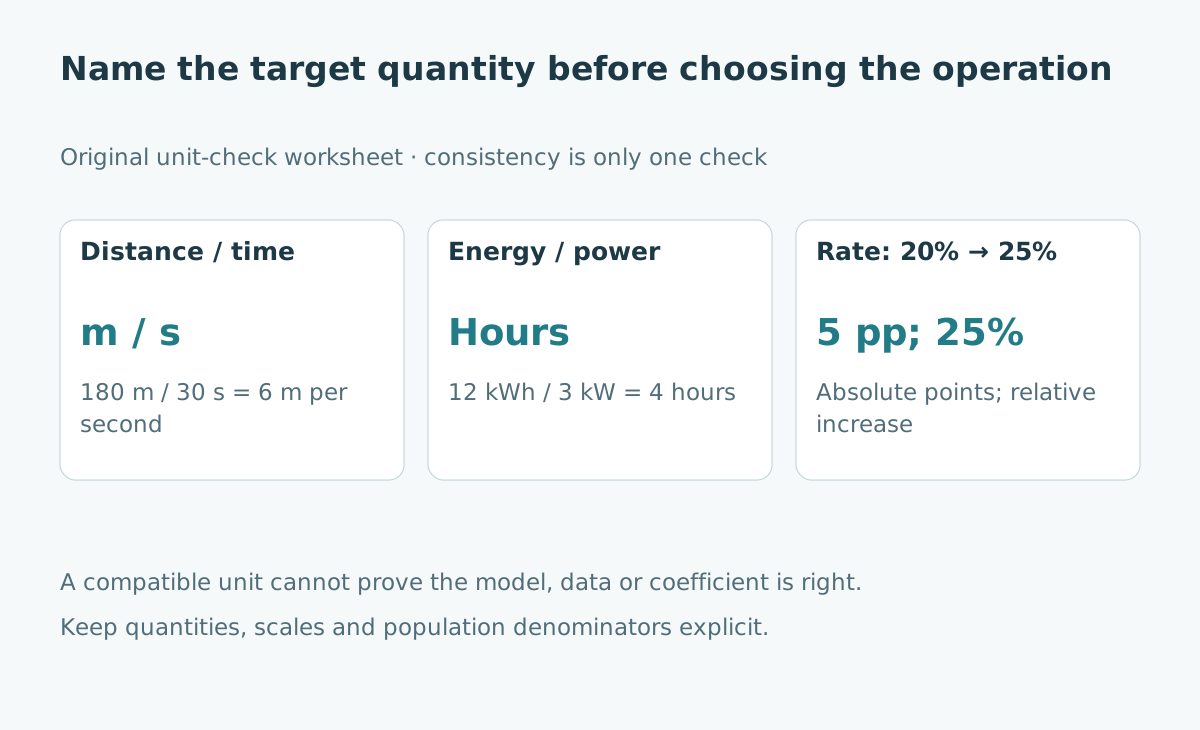
Name the target quantity first
Before choosing an operation, finish the sentence “I want to calculate...” with a quantity and its intended unit. For example, “the time required, in hours” is more useful than “the answer to question four.”
Write a small inventory of the inputs beside it. Distinguish distance from speed, stored energy from power and a fraction from a count. NIST describes a quantity's value as a number together with a unit. Preserving that pairing prevents a numerical value from losing its meaning during calculation.
If the target is unclear, arithmetic is premature. A request for “cost” might mean total spending, cost per item or cost per operating hour; those are different outputs.
Use units to test the proposed operation
Suppose a fictional cart covers 180 metres in 30 seconds. To obtain speed, distance divided by time gives 180 m / 30 s = 6 m/s. Reversing the division gives 1/6 s/m, a time per distance, which answers a different question.
| Proposed expression | Resulting unit | Does it match the stated target? |
|---|---|---|
| Distance divided by time | m/s | Yes, for speed |
| Time divided by distance | s/m | No, though useful for pace |
| Distance multiplied by time | m·s | No, for this speed question |
| Speed multiplied by time | m | Yes, for distance under an appropriate motion model |
The wrong expression may still describe a meaningful quantity. The error is using it for a question with a different target.
Convert values without changing the quantity
Two compatible units can have different scales. A duration of 2 minutes is 120 seconds. A calculation expecting seconds must use 120, not the numerical value 2 stripped from its original unit.
For a fictional motion example, 3 m/s for 2 minutes gives 3 m/s × 120 s = 360 m, assuming that speed applies throughout. Alternatively, convert the speed to 180 m/min and multiply by 2 min. Both routes produce the same distance.
Show the conversion factor: 2 min × 60 s/min = 120 s. The minutes cancel. Writing the factor makes an incorrect direction visible instead of relying on a remembered instruction to “multiply somewhere.”
Distinguish energy from power
Consider a hypothetical resource containing 12 kWh of usable energy and supplying a constant 3 kW load. In the simplified lossless model, the duration is 12 kWh / 3 kW = 4 h. The power units cancel, leaving time.
This is a relationship between energy, power and duration, not a prediction for a particular battery or vehicle. A real system may have conversion losses, reserve limits or changing demand. Those conditions require additional information beyond unit cancellation.
The difference in question matters. Multiplying 3 kW by 4 h gives energy, while dividing 12 kWh by 4 h gives average power. A column labeled only “capacity” can conceal which of these quantities it actually contains.
Check addition as well as multiplication
You can combine compatible quantities only after their units are made consistent. Adding 2 m and 30 cm gives 2.30 m after conversion; adding their bare numbers to obtain 32 m is a scale error.
Dimensions provide a broader category than a particular unit. Metres and centimetres both describe length. Length and time have different dimensions, so an unexplained sum such as “2 metres plus 3 seconds” does not define a physical total.
In a dataset, also check what the values represent. Two counts can share the same unit while covering overlapping people. Adding them may double-count even though the units do not object.
Treat percent as a number with a defined denominator
NIST identifies the percent symbol with the number 0.01. Thus a fraction of 20 % is 0.20, rather than 20. When applying it to a count of 250 eligible cases, 0.20 × 250 gives 50 cases.
Now suppose a rate changes from 20 % to 25 %. The absolute change is 5 percentage points. Its relative change from the starting rate is (0.25 − 0.20) / 0.20 = 0.25, or 25 %.
| Question | Calculation | Interpretation |
|---|---|---|
| How many cases at the initial rate? | 0.20 × 250 = 50 | Count, with this eligible population |
| How far apart are the rates? | 25 % − 20 % = 5 percentage points | Absolute rate difference |
| How large is the increase relative to the start? | 0.05 / 0.20 = 25 % | Relative increase using the initial rate |
Units alone cannot distinguish every fraction. Label the numerator, denominator and reference period so a conversion rate is not confused with a cancellation rate.
Keep a unit contract beside data columns
For an analysis table, record the quantity, unit, time basis and population definition. A duration column might contain elapsed seconds, rather than active minutes. A rate might mean requests per second, rather than per reporting interval.
Check the contract when combining files. Two columns both called duration are not enough evidence that they share a scale or definition. Convert deliberately and preserve the original value if it is needed for audit.
This is an original worksheet suggestion, not a claim that dimensional analysis automatically validates a dataset. Missing records, incorrect timestamps and the wrong population can remain after every unit is consistent.
Know what the check cannot catch
OpenStax explains that dimensional reasoning does not recover missing dimensionless factors. For example, both r² and 2r² have the dimensions of area; cancellation cannot decide which coefficient a particular geometric relationship requires.
A unit check also cannot prove that constant speed is appropriate, that the energy is usable or that a measured rate applies to tomorrow's population. Check the governing relationship and assumptions separately.
Use three questions after cancellation: does the arithmetic work, is the model appropriate and are the inputs trustworthy? A plausible unit narrows the search for errors without finishing it.
Turn the habit into a short study routine
For the next quantitative exercise, write the target unit, attach units to every input, inspect the proposed expression and only then calculate. Finish with a scale check: should the answer be seconds or days, a fraction or hundreds of cases?
When a result fails, preserve the first attempt and label the error as quantity selection, conversion, arithmetic or model assumption. That label tells you what to practice next.
For explaining why a chosen expression applies, see self-explanation and mechanism checks. For testing whether the method survives a changed question, see learning-transfer test design.
Sources and limits
- NIST Guide to the SI, Chapter 7: quantity values, numerical values, units and percent notation.
- OpenStax University Physics Volume 1, Section 1.4: dimensional consistency and its limitations.
Checked October 26, 2026. Examples and study worksheets are original. No learning-effect size or engineering-system performance claim is made.