An Open-Book Exam Still Has a Time Limit: Practice Finding and Using the Right Evidence
Prepare for open-book exams by separating recall, lookup and application. Build a usable index, test a timed paper and diagnose where the minutes go.
You know the formula is somewhere in the notes. After opening three files and searching two similar terms, you find it. The question now makes sense, but several minutes have gone before you begin applying it. Open-book access solved an information problem while leaving a time problem untouched.
Preparation therefore needs two different checks: can you recognize the method a question requires, and can you locate permitted supporting information quickly enough to use it? A beautifully organized folder does not answer the first question. Knowing a definition does not automatically answer the second.
This evergreen guide develops an original practice workflow for that combination. Research on open-book testing helps explain why easy access and durable learning should be examined separately. The suggested timing budgets and index design below are teaching adaptations, not experimentally validated performance targets.
Begin with the actual resource rules
Find out what “open book” permits before designing your notes. An instructor might allow one printed sheet, a textbook, local files or a specific platform. Internet access, collaboration and generative tools may have different rules. Treat each permission separately.
Write those conditions at the top of a practice checklist. Rehearse with the permitted resources, including any restrictions on search or annotation. If the exam uses printed pages, practicing only full-text search leaves navigation under different conditions untested.
Ask the instructor about ambiguity through the normal course channel. Do not assume that permission to consult notes also grants permission to use an external answer service.
Separate retrieval, lookup and application
Retrieval supplies something from memory. Lookup finds information in a resource. Application decides how that information answers this particular question. A timed attempt may involve all three, and a failure in one can resemble a failure in another.
| Part of the attempt | Useful practice question | Observable evidence |
|---|---|---|
| Recognize and recall | Which principle seems relevant before opening notes? | Initial method choice and a short reason |
| Navigate and verify | Where is the required rule, including its conditions? | Resource location, search term and lookup time |
| Apply and explain | How does the rule connect to this case? | Worked reasoning, units and justified conclusion |
Record these separately. Finding the correct page is progress, but it does not demonstrate that you can select the rule independently or interpret its assumptions.
Understand what the research actually compared
Agarwal and colleagues' 2008 paper reported two experiments using prose passages. Open-book tests produced better initial performance, but the initial advantage over closed-book testing did not persist on the delayed test. The study also highlights the importance of feedback in its testing comparisons.
Those findings concern the tasks and delayed assessments used in the experiments. They do not establish that every open-book exam is easier, that memorization should replace resource use or that the timing plan in this article will improve marks.
The useful distinction for preparation is modest: success while an answer is available and performance later are different outcomes. Check both rather than using one as a substitute for the other.
Build an index for decisions, not just chapters
Create a compact index organized around the questions you need to answer: “compare two means,” “choose a cipher rule” or “interpret a cash-flow change.” Add the official topic name and precise page or section so the index connects ordinary wording to the course material.
For each entry, include a reminder about when the method applies and one common confusion. Keep the explanation in the main notes. The index should point you to the relevant material without becoming another document that takes several minutes to read.
Test the index using unfamiliar question wording. If it works only when the question repeats the chapter title, improve the mapping rather than adding more decorative tabs.
Try a timed budget before committing to it
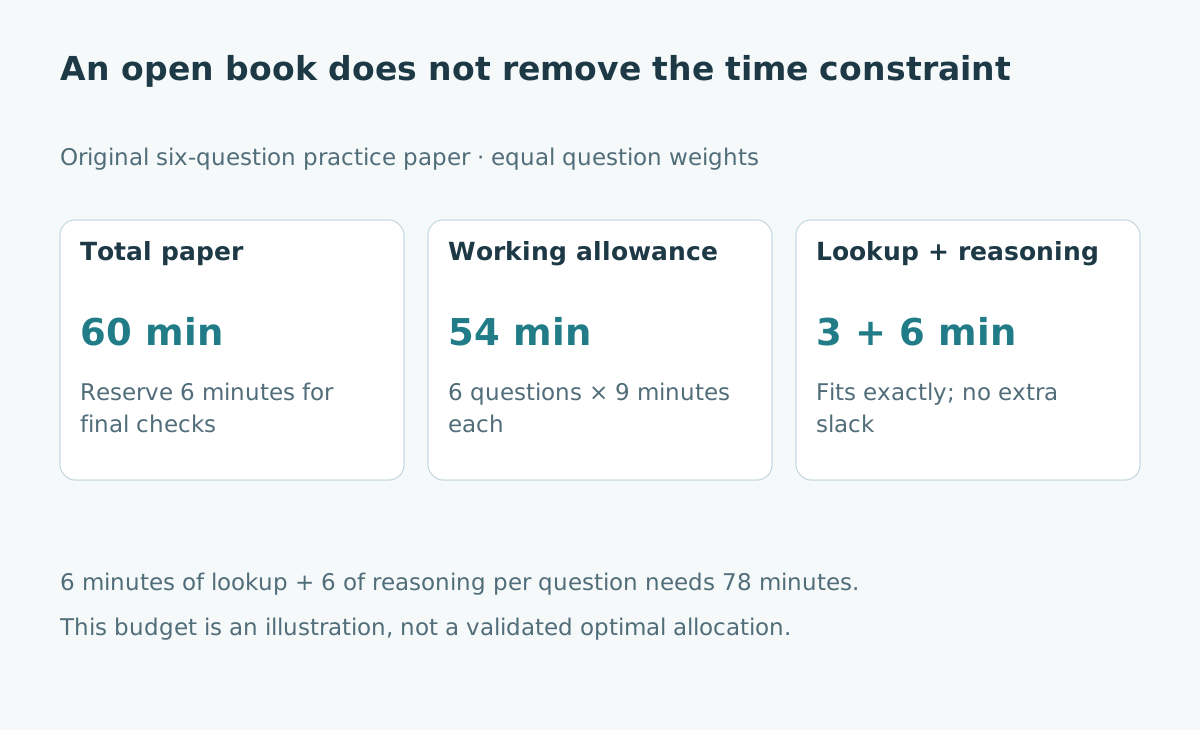
Imagine a practice paper with six equally weighted questions and a sixty-minute limit. Reserve six minutes for final checks. That leaves fifty-four minutes, or nine per question. This is an original planning example, not a recommendation for every exam.
| Proposed timing per question | Six-question working time | Plus six-minute check | Fits sixty minutes? |
|---|---|---|---|
| Lookup 3 minutes; reasoning and writing 6 | 54 minutes | 60 minutes | Exactly, with no extra slack |
| Lookup 6 minutes; reasoning and writing 6 | 72 minutes | 78 minutes | No: 18 minutes over |
The arithmetic makes the tradeoff visible. More notes may improve access while making search slower. If questions carry different marks or require different amounts of writing, use a different budget and test that arrangement.
Preserve the first attempt before consulting
During preparation, pause briefly to write a candidate method and the information you expect to need. Then consult the allowed resources and finish the answer. Keep both the initial choice and the corrected version.
This practice step helps diagnose whether the difficulty was recognizing the concept or locating a detail. It is not a rule requiring you to refuse legitimate resources during the actual exam. Use exam resources in accordance with its instructions and the strategy your rehearsal supports.
When your initial choice is wrong, explain the condition you missed. Copying the right formula without identifying that condition leaves method selection uncertain.
Rehearse the whole resource environment
Try a small, timed set that includes reading, lookup, reasoning and checking. For example, three nine-minute questions plus three minutes of review make a thirty-minute rehearsal. Use fresh questions with available solutions or feedback.
Record the time spent finding information, the time spent reasoning and whether you completed a defensible answer. Approximate observations are enough for diagnosis; constant stopwatch switching should not interrupt every thought.
If retrieval is weak, repair the concept. If navigation is slow, simplify labels and locations. If application is wrong, work through a checked example and explain the decision point. These are different repairs, even when the total score looks similar.
Watch the expectation of easy access
Agarwal and Roediger's 2011 study examined test practice and expectations using reading materials. In its second experiment, expecting an open-book test reduced study time and performance on delayed closed-book comprehension and transfer assessments compared with expecting a closed-book test.
The delayed assessment format matters: this does not prove that expecting an open-book exam always lowers performance on an actual open-book final. It does give a reason to check whether anticipated access has quietly reduced your preparation.
Use observed attempts rather than reassurance such as “I can always look it up.” Your resource may be available while the relevant connection remains hard to identify.
Turn the rehearsal into a short repair plan
Finish with three notes: the question type that consumed the most lookup time, the concept you selected incorrectly and the resource change you will test next. Repeat a fresh small set after making that change.
A faster lookup is useful only if the answer stays correct and supported. Avoid treating navigation speed as the goal when the exam requires interpretation, comparison or justification.
For help with reasoning after locating the method, see self-explanation and mechanism checks. For deciding whether practice carries over to a changed question, see learning-transfer test design.
Sources and limits
- Agarwal, Karpicke, Kang, Roediger and McDermott, 2008: primary open-book and closed-book testing experiments; first published online in 2007.
- Agarwal and Roediger, 2011, author-hosted paper: primary experiments on test practice, expectations and delayed assessments.
Checked October 25, 2026. This is an evergreen study guide. The index, rehearsal sequence and time budgets are original suggestions; neither cited study validates this specific workflow or guarantees a score improvement.