When Should a Study Session End? Use a Stop Rule, Then Return Later
Use successive relearning to separate today's stopping point from durable recall. Build a practical concept log without treating one correct answer as mastery.
You finally explain a difficult concept correctly. Should you repeat it five more times, move to another topic, or stop studying it forever? These choices allocate scarce time differently, yet a green flashcard often treats them as the same decision.
Successive relearning offers a useful distinction: reach a defined performance criterion within one session, then return in later sessions and reach it again. Today's success can justify moving on for now. It does not certify that the knowledge will still be available next week.
This evergreen guide focuses on that stopping decision. It provides an original planning log for concepts and short explanations, rather than a universal calendar or a promise that one prescribed number of repetitions works for every subject.
Define what would count as success today
Choose a small, observable response. For a statistics concept, this might be explaining a confidence interval's target and rejecting one common misinterpretation without notes. For vocabulary, it might be supplying a suitable word from a meaning prompt. “Understand chapter four” is too broad to serve as a usable stop rule.
Write the required elements before practicing. If a definition must include the population, the quantity being estimated and uncertainty, check those elements separately. Otherwise a familiar-sounding answer can pass because it feels close, while the missing idea remains hidden.
The criterion should match the learning target. Producing a definition is evidence about that definition. It cannot establish that you can select and execute an entire statistical procedure.
Separate the session criterion from the retention goal
A local criterion answers “Have I practiced this item sufficiently for this session?” A retention goal asks “Can I produce the needed response after a meaningful delay?” One observation cannot answer both questions.
Rawson and Dunlosky's 2011 experiments varied initial correct-recall requirements and later relearning sessions for conceptual material. Their abstract reports that additional relearning supported long-term retention and reduced the importance of the initial criterion. That finding motivates recording later returns instead of using the first successful session as a permanent completion label.
The experiments do not turn a particular recall count into a universal standard. A course assessment, a safety procedure and a language conversation place different demands on the learner.
Record the first attempt before repairing it
At the beginning of a later session, try the prompt without first reading the previous answer. Mark that first attempt separately. Then inspect accurate feedback, repair the response and practice toward the current criterion.
This separation makes the record informative. If you only save the final successful response, every session can appear perfect even when its opening attempt repeatedly fails. Conversely, an opening failure is not the session's final outcome: the learner may repair the misconception and finish successfully.
Keep hints visible in the record. An answer produced after seeing a keyword is performance with that cue. It can help learning, but it should not silently become an unaided success.
Use a small log rather than a permanent mastery badge
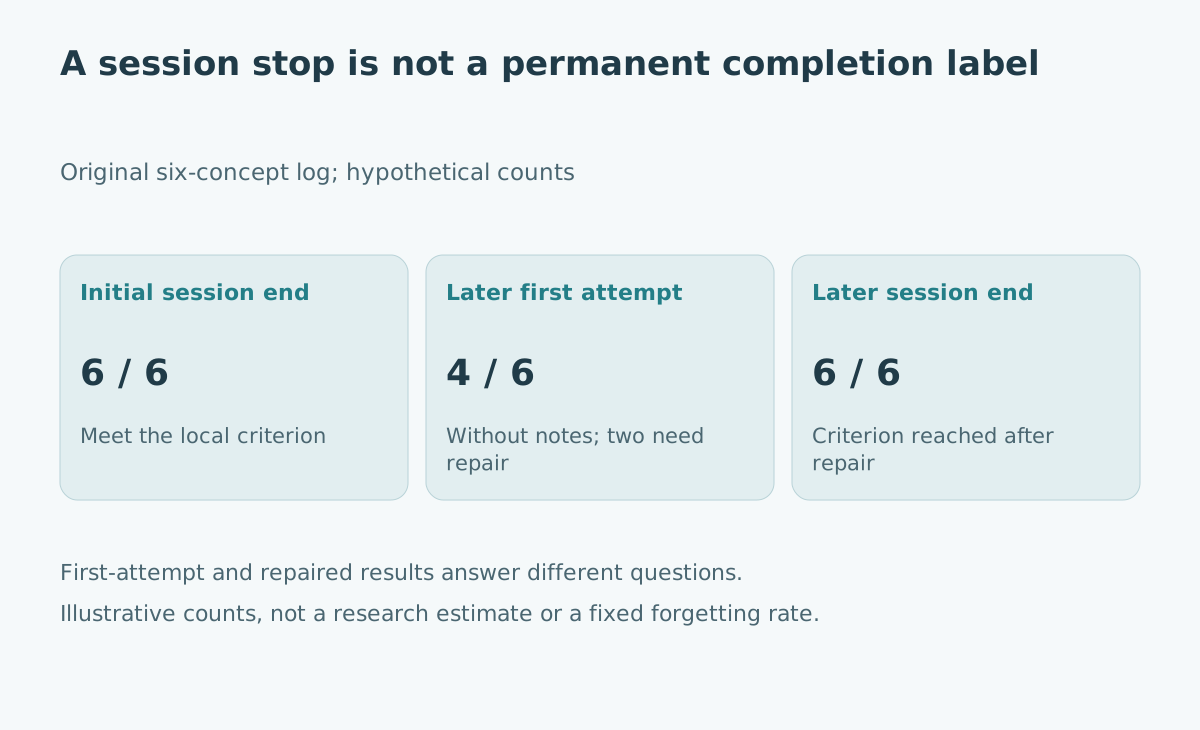
Consider six concepts in an invented study set. In the initial session, all six eventually meet the learner's chosen criterion. On the next occasion, four are correct on the first attempt and two require repair. After feedback, all six again meet the criterion.
| Observation | Result | What the record establishes |
|---|---|---|
| End of initial session | 6 of 6 meet the local criterion | Successful performance under that session's rules |
| First attempt in later session | 4 of 6 correct without help | Delayed retrieval for these six prompts |
| End of later session | 6 of 6 meet the criterion | Two concepts were repaired and practiced again |
The delayed first-attempt score is about 66.7%. It does not mean the learner permanently lost one third of all knowledge in the chapter. Inspect the two responses: a missing condition and an entirely wrong explanation require different repairs.
Move successful items out of the immediate queue
Once an item meets today's rule, move it to the scheduled-return list. This frees attention for unresolved items instead of allowing a comfortable definition to occupy most of the session. Preserve the item for later practice rather than deleting it.
An original working log can contain the prompt, essential answer elements, first-attempt result, help received, end-of-session status and next return. Add approximate practice time if you want to compare time costs across items.
This is a planning adaptation, not a validated scoring instrument. It is most useful when the log stays simpler than the material being learned. If maintaining the tracker consumes the session, reduce the fields and keep the first-attempt distinction.
Keep the number of returns adjustable
The authors' 2022 review emphasizes both retention and the time needed to reach a criterion. It also cautions that a single recommendation about the number of sessions will not generalize to every context. Relevant factors include materials, spacing and the delay before the final assessment.
For a practical starting plan, reserve several separate occasions before the knowledge is needed, then inspect the opening attempts. This is a scheduling heuristic. It is not a claim that particular dates are biologically optimal.
If every return begins with extensive failure, review whether the prompt is overloaded or the original explanation was understood. If performance remains strong, a later check may be more informative than repeatedly confirming the same answer minutes apart.
Do not extend a definition criterion to complex problem solving
The evidence has boundaries. Rawson, Dunlosky and Janes' 2020 probability-problem study found only a small pooled advantage for successive relearning over single-session practice on a delayed novel-problem test. Strong results for verbal materials do not guarantee equally strong results for mathematical procedures.
For a procedure, include decisions that a memorized example can conceal: identify the problem type, justify assumptions, execute the method and check the result. Use changed examples rather than merely replaying the same calculation.
If you repeatedly reach the local criterion but fail a changed task, revise the criterion. More checks of an incomplete target can make the log look better without addressing the actual assessment demand.
Finish with a return plan and an unresolved list
End the session by distinguishing items that met today's criterion from those still unresolved. Give unresolved items a concrete next action: consult the course explanation, ask a targeted question or break a complicated prompt into parts. Do not force a success mark to make the dashboard tidy.
Keep a separate delayed check near the real performance goal. The target is usable knowledge, while the session criterion is a tool for allocating practice. For broader scheduling principles, see retrieval practice and spacing. To check performance on changed tasks, use learning-transfer test design.
Sources and limits
- Rawson and Dunlosky, 2011: Optimizing schedules of retrieval practice: primary study abstract reviewed; conceptual-material experiments.
- Rawson and Dunlosky, July 13, 2022: Successive Relearning: authors' full review and discussion of scheduling limits reviewed.
- Rawson, Dunlosky and Janes, April 21, 2020: A Potential Boundary Condition: primary publisher abstract reviewed; mathematical-procedure findings.
Checked October 28, 2026. The log, numbers and practical workflow are original illustrations. No optimal schedule, universal mastery threshold or guaranteed exam improvement is claimed.