Knowing What a Word Means Is Different From Being Able to Use It
Separate vocabulary recognition from producing a suitable word and sentence. Use a small worksheet to identify whether meaning, form or usage needs practice.
You understand “reliable” when it appears in a sentence. Later, while describing a colleague, you pause and settle for “very good.” The word was available when someone supplied it, but harder to produce when you needed it yourself.
That difference is useful information about a learning task. It does not mean the earlier understanding was fake, or that the word belongs permanently in a separate mental box. Different prompts reveal different parts of what you can currently do.
This evergreen guide offers an original worksheet for checking recognition, prompted production and sentence use separately. It is a practical diagnostic, not a standardized vocabulary-size test or a universal schedule for language learning.
Define the language action you need
Receptive vocabulary tasks begin with language you hear or read and ask you to understand it. Productive tasks require you to supply language, for example when speaking or writing. Within each direction, the amount of support can vary substantially.
Selecting a meaning from four options, explaining a word without options and understanding it in fast speech are different receptive tasks. Filling a strongly cued gap, naming a concept and choosing a word spontaneously during conversation are different productive tasks.
Choose the action that matters for your goal. Preparing to understand an article and preparing to explain your own work require overlapping knowledge, but they do not provide interchangeable evidence of readiness.
Avoid turning recognition into a mastery label
A correct multiple-choice answer may reflect understanding, partial knowledge, elimination of distractors or a guess. Ask what the response establishes before labeling the word “learned.”
Likewise, producing a word after seeing its first three letters is useful performance under that cue. It does not establish that the same word will come readily during an unprompted conversation.
Record the prompt beside the result. A simple label such as “meaning selected,” “word supplied without options” or “sentence checked” is more informative than a single green tick. The distinction helps you choose the next exercise without treating one successful response as comprehensive knowledge.
Read the research with its test conditions intact
Stuart Webb's 2008 study compared receptive and productive vocabulary sizes using translation tests and different scoring sensitivities. Receptive vocabulary was larger under fuller-knowledge scoring, while partial-knowledge scoring produced smaller differences.
That qualification matters. A gap depends partly on what the task requires and what counts as correct. The study does not establish a fixed proportion of words that every learner can recognize but cannot use.
For your own worksheet, state the scoring condition first. Otherwise a change from strict to generous marking can look like learning when the actual change is the rule used to score it.
Build three different checks for one small set
Choose a manageable group of target words from material you need. Prepare different prompts that test the intended meanings, rather than showing the answer repeatedly. The examples below illustrate three words; they are original teaching items.
| Target | Meaning check | Production or use check |
|---|---|---|
| reliable | Explain the word in “a reliable colleague” | Describe someone you can depend on, using the target adjective |
| borrow | Identify who temporarily receives something | Complete: “May I ___ your charger until lunch?” |
| deadline | Explain the requirement in a project notice | Write one sentence about when work must be submitted |
Accept “borrow” for the gap. For the other prompts, check whether the target word communicates the intended meaning in an acceptable sentence. Do not confuse failure to follow the target-word instruction with inability to express the idea using other vocabulary.
Score the relevant parts of the response
Separate meaning, word form and sentence use. A learner may choose the intended word but spell it incorrectly, or spell it correctly while using the wrong grammatical pattern. A single total can hide the repair that is needed.
For a small writing check, define an acceptable response as one that uses the target meaning, supplies an appropriate form and fits its sentence. Keep the original response and the correction. A sentence can contain an unrelated error while still demonstrating the target word; decide beforehand how that will be recorded.
This rubric is an original learning aid. It has not been validated as a measure of overall language proficiency or vocabulary size.
Interpret a small scorecard carefully
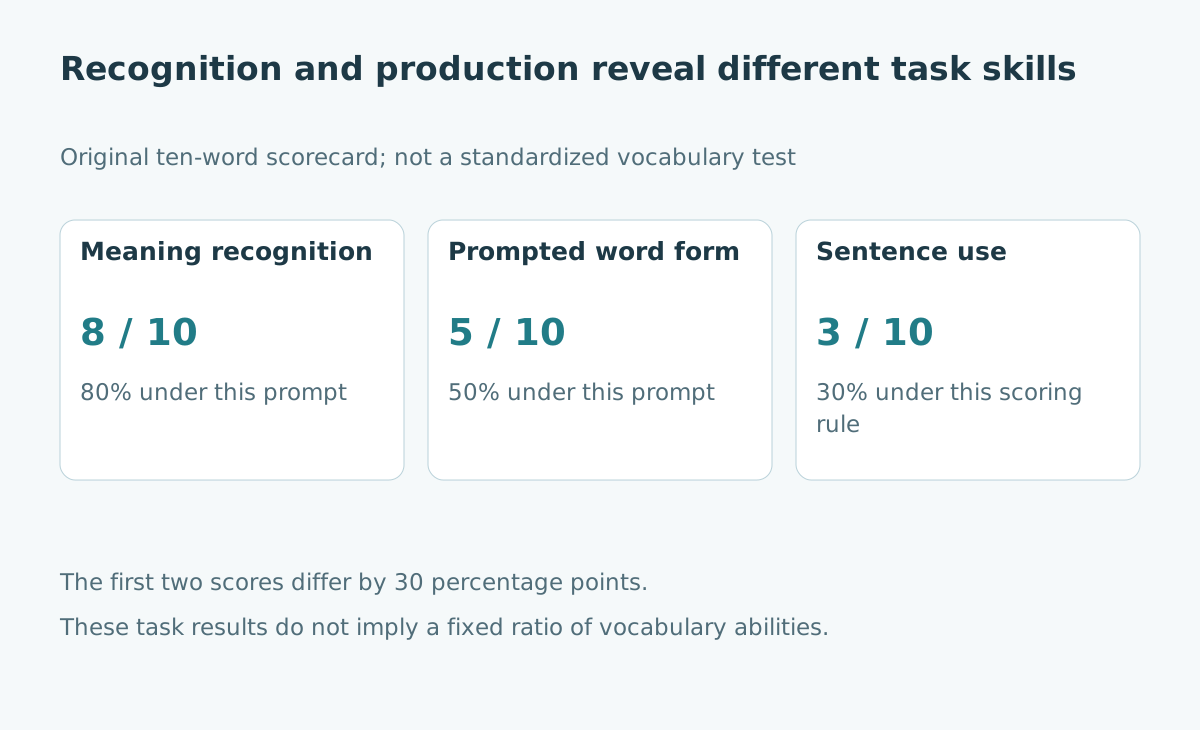
Imagine ten target words checked in three ways. These invented counts make the denominator explicit; they do not describe an actual learner or study.
| Check | Successful responses | Task score | What remains uncertain |
|---|---|---|---|
| Meaning recognition | 8 of 10 | 80 % | Unprompted production and broader meanings |
| Prompted word form | 5 of 10 | 50 % | Fluent, context-appropriate use |
| Sentence using the target | 3 of 10 | 30 % | Listening, pronunciation and spontaneous speech |
The recognition and prompted-form scores differ by 30 percentage points. That is a difference between these task scores, not proof that exactly three words sit in a permanent receptive-only category. Inspect the item-level responses and cue conditions.
Practice in the direction of the difficulty
If you recognize the meaning but cannot supply the form, try a meaning or situation prompt with the word hidden. If you can supply the word but misuse it, practice a short sentence and compare it with reliable examples. If the meaning itself is unclear, repair that first.
Webb's 2009 word-pair learning study found that learning direction affected which aspects of vocabulary knowledge improved. Productive and receptive learning had different advantages across the measured tests.
The narrow practical inference is to inspect what your exercise asks you to do. That research does not validate this particular worksheet, prove that reading is unnecessary or prescribe one ideal practice ratio for everyone.
Separate checking from immediate answer exposure
Seeing a recognition answer can cue a later production response. Copying a sentence and immediately reproducing it also provides support that may disappear in a new situation.
For a more informative personal check, use a changed order or a separate occasion, and record when the target was recently shown. Keep feedback until after the responses you intend to compare. These are practical precautions, not a way to turn a home worksheet into a controlled experiment.
When testing conversation readiness, add an appropriate spoken task. A written sentence score cannot establish pronunciation or retrieval speed during live speech.
Use the record to select the next few words
Make a short repair list with the target, the observed problem and one new prompt. For “borrow,” the problem might be choosing the wrong direction of transfer. For “reliable,” it might be producing the form without first seeing it. Those observations call for different practice.
Try a fresh sentence after correction and note whether help was used. Preserve recognition practice where comprehension is your goal, while adding production checks for words you need to say or write.
For organizing a focused repair, see self-explanation and mechanism checks. For deciding whether a skill survives a changed task, see learning-transfer test design.
Sources and limits
- Webb, 2008, Receptive and Productive Vocabulary Sizes of L2 Learners: primary research; publisher abstract and test/scoring description reviewed.
- Webb, 2009, The Effects of Receptive and Productive Learning of Word Pairs on Vocabulary Knowledge: primary research; publisher abstract reviewed.
Checked October 27, 2026. This is an evergreen guide. Examples, scorecard and practice suggestions are original adaptations. Research summaries rely on the published abstracts; no effect size or validated mastery threshold is claimed.