COVID-19 Device EUA Termination Is an Inventory Question Before It Is a Calendar Reminder
Prepare for the December 26, 2026 COVID device EUA declaration termination with model-level evidence, manufacturer follow-up and an original inventory worksheet.
This guide explains research and technology. It does not provide diagnosis or treatment, and regulatory status should be checked with the relevant authority.
A purchasing spreadsheet says “FDA authorized.” That phrase may have been copied from a supplier document several years ago. It does not tell a hospital, distributor, or procurement team which authorization applies to the exact model in its inventory, or what must happen when that authority changes.
The practical preparation task is therefore more specific than adding a deadline to a calendar. Match the physical product and its configuration to the relevant evidence, then assign the unresolved questions to someone who can answer them. This article offers an original administrative worksheet for that process, not a device-specific legal or clinical decision.
According to the FDA's COVID-19 medical-device page, the HHS Secretary made the relevant determination on June 29, 2026. The associated COVID-19 emergency-use declarations for SARS-CoV-2 diagnostics, personal respiratory protective devices, and other covered medical devices will terminate effective December 26, 2026. The page states that the COVID-19 device EUAs listed there will then cease to be in effect. This is a previously announced transition, checked here on October 25, not a new announcement today.
Keep the three status questions separate
The same FDA page distinguishes the section 319 public-health emergency, which ended May 11, 2023, from section 564 EUA authority. It also says the enforcement-policy guidances within the scope of the companion transition plan are no longer in effect. These are distinct legal and policy tracks; one date should not be substituted for another.
| Evidence being discussed | Administrative question to record |
|---|---|
| COVID-19 EUA | Which authorization and exact product configuration does it cover? |
| Traditional marketing authorization | Does the cited clearance, approval, or other applicable authorization match this product and use? |
| Pandemic enforcement policy | Which policy was relied on, and what is its current scope and status? |
The table organizes an inquiry. It does not classify a product simply because a supplier chooses one of these labels.
Start with the model and configuration
A family name can conceal meaningful differences. A fictional “Monitor A” might appear in an asset register without a model suffix, software version, or accessory set. A supplier's newer brochure could describe a different configuration. Joining those records by brand name alone creates a plausible-looking match without establishing that it is correct.
Build one record per distinguishable product configuration. Capture the manufacturer, precise model, relevant software or firmware version, labeling revision, intended use, location, and quantity. Where a field is unavailable, record it as unknown rather than copying a value from a similar item. The purpose is to make uncertainty inspectable.
Link evidence to the actual record
Store the authorization reference, the source document, its date, and the reviewer who checked the match. A saved hyperlink alone can become ambiguous if the supplier updates the page later. Preserve enough document identification to explain what was reviewed.
For an original review rule, require a second person to check uncertain model matches before the record is marked complete. This is an editorial workflow suggestion, not an FDA-mandated staffing requirement. The reviewer should be able to follow the evidence without repeating a conversation that occurred outside the register.
Treat a submission as a stage, not a final outcome
The FDA's March 2023 EUA transition guidance describes a conditional enforcement policy for continued distribution: a marketing submission is accepted by FDA before the EUA termination date, and FDA has not taken final action on it. “Submitted” and “accepted” are different milestones. Neither is a positive marketing decision, and the policy does not extend the EUA itself.
The guidance separately addresses already-distributed devices and manufacturer transition implementation plans. Its recommendations and device-specific circumstances require careful reading. Do not compress them into a universal statement that every product must be removed, or that every product can continue unchanged.
Count unresolved records honestly
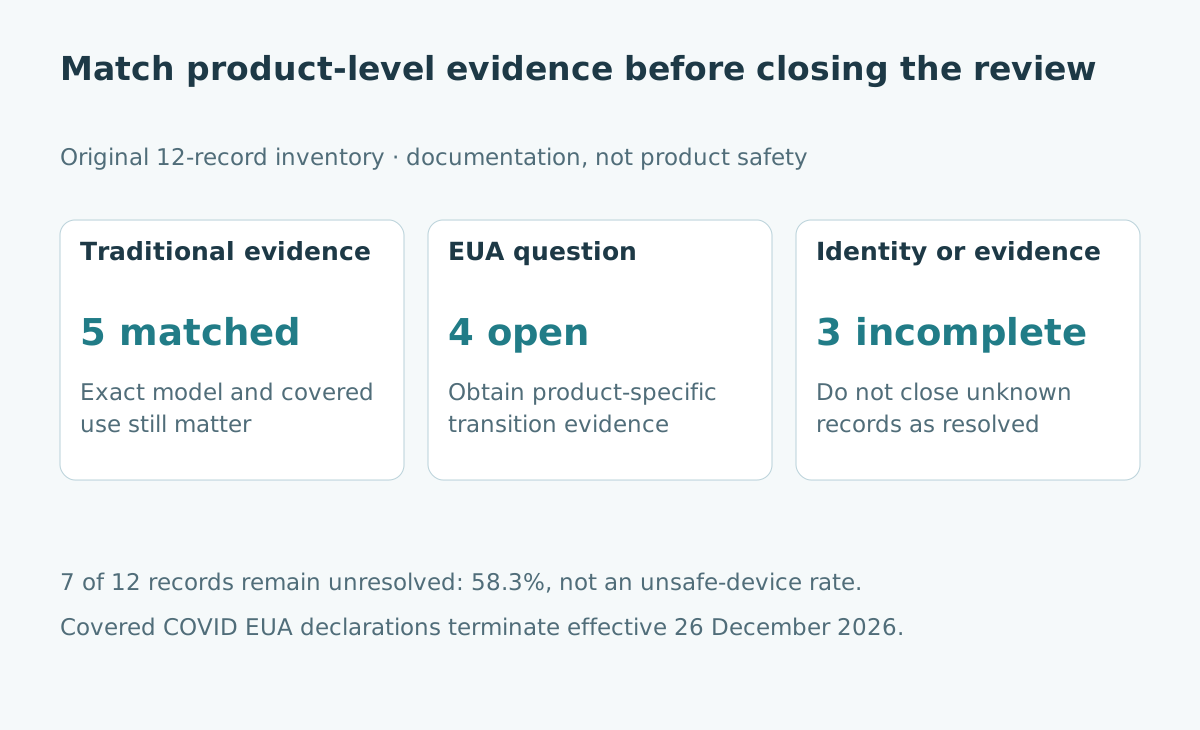
Consider a fictional review of twelve product records, not twelve individual units. Five have matched traditional-authorization evidence. Four have an identified EUA reference but an unresolved transition question. Three lack sufficient model or authority evidence to determine the next inquiry.
| Original review category | Records | Next administrative step |
|---|---|---|
| Traditional evidence matched | 5 | Preserve evidence and verify the covered configuration and use |
| EUA transition question assigned | 4 | Obtain product-specific manufacturer information |
| Evidence incomplete | 3 | Resolve identity or authority before closing the review |
| Total reviewed | 12 | Retain all records in the denominator |
Seven of twelve records remain unresolved: 58.3%, rounded to one decimal place. That is a documentation-review measure, not an estimate that 58.3% of products are unsafe, unauthorized, or subject to removal. Quantities and clinical importance should be tracked separately from record counts.
Ask the manufacturer questions that can be answered
A broad email asking whether a company is “ready” may produce a broad reassurance. Instead, identify the exact model and request the relevant authorization reference, configuration mapping, current labeling, and the manufacturer's transition communication for that product.
If the response mentions a submission, ask which stage it has reached and what supporting evidence can be shared. If it discusses already-distributed devices, ask which instructions apply to the stock or installed configuration being reviewed. Preserve the answer with its date and named organizational source. An unresolved answer remains unresolved even when it arrives on impressive letterhead.
Give each question an owner and a review point
Purchasing can establish order and supplier information; technical staff can identify installed configurations; regulatory specialists can assess the authority and transition details; clinical leadership can consider continuity of care. Do not assume one department already holds all the necessary evidence.
For each open record, assign an owner, the exact missing fact, the next action, and a review date. Escalate a missing manufacturer response through the organization's established governance process. The administrative worksheet should support qualified decisions, not silently make clinical or legal decisions through a spreadsheet formula.
Close the loop when evidence changes
Keep the previous status when a record changes. A new label, component update, authorization decision, or manufacturer instruction may resolve one question while creating a new configuration to check. Record what changed, who reviewed it, and where the resulting instruction was communicated.
The useful outcome is a register in which someone can explain every material conclusion. A calendar reminder helps start the work; the model-level evidence makes the work reviewable. For related evidence distinctions, see medical AI risk and authority and medical-device recall inventory matching.
Sources and reading notes
- FDA COVID-19 medical-device page, checked October 25, 2026.
- FDA EUA transition guidance, issued March 27, 2023, especially Sections V.B and V.C. Guidance contains nonbinding recommendations; applicable legal requirements and product-specific circumstances remain relevant.
- FDA companion transition guidance for pandemic enforcement policies.