Use the NICE Framework to Turn a Cybersecurity Job Title Into Work You Can Inspect
Map a cybersecurity job's responsibilities to NICE work roles, knowledge and skills, then build a scoped readiness check without treating a title as a syllabus.
Two vacancies say “junior security analyst.” One emphasizes investigating alerts; another emphasizes reviewing access and documenting controls. Studying every topic associated with the title can consume months without clarifying what either employer expects someone to do.
The NICE Workforce Framework for Cybersecurity offers a more useful starting point: describe the work, then identify the knowledge and skills needed for it. The framework helps structure a conversation about readiness. It does not certify that a person is qualified merely because their course list contains familiar terms.
The timing is relevant. NIST's October 30, 2026 Cybersecurity Career Week recap highlights career mapping and pathways using NICE Work Roles. This article develops an original task-readiness worksheet for that purpose, rather than a ranking of qualifications or a promise of employment.
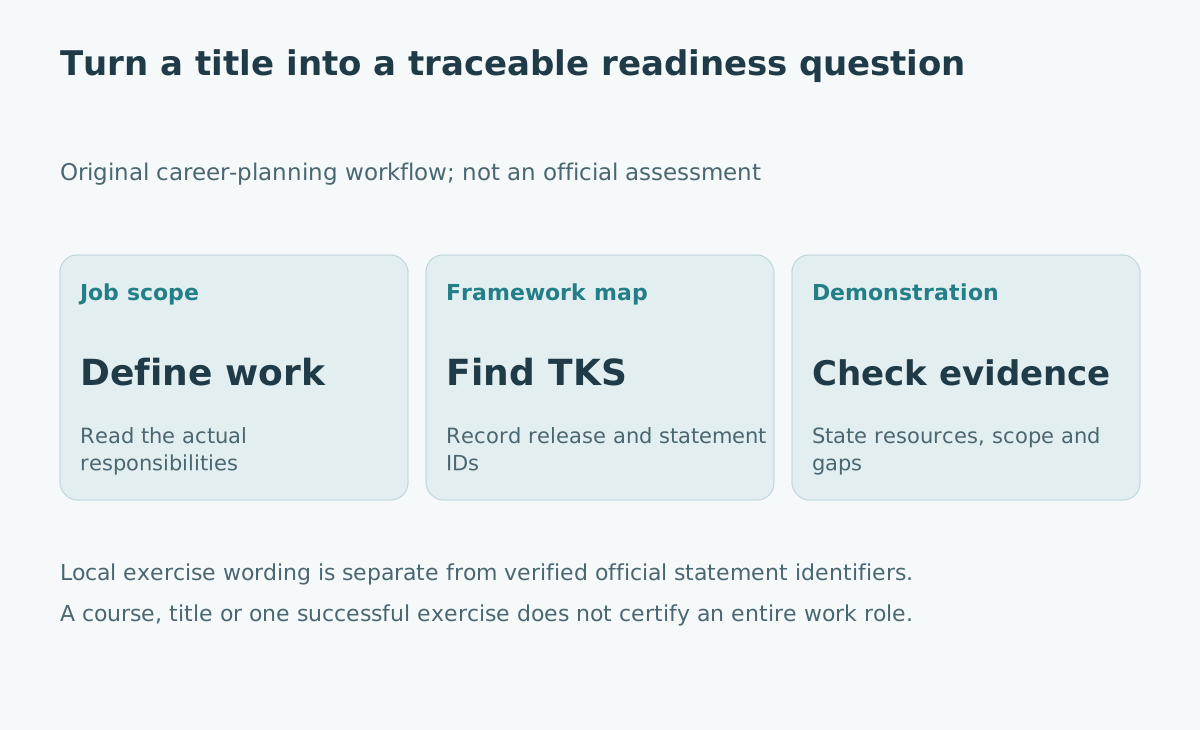
Separate a job title from a work role
NIST's workforce-framework playbook describes a Work Role as a grouping of accountable work, built from Tasks and associated Knowledge and Skill statements. A Work Role is not synonymous with a job title; one job may combine work from several roles.
That makes the vacancy description more useful than its headline. Extract the responsibilities, expected outputs, tools and reporting relationships. Mark vague phrases such as “support security” as questions to clarify, not as complete requirements.
For a fictional analyst role, the stated outputs might include a reviewed alert record, a documented access exception and an escalation note. Those are more concrete than a long list of product names. They also make it easier to identify where authorization or supervision is required.
Record the framework version you actually use
The NICE current-versions page separates the framework's structural publication from its maintained components, which include work roles and task, knowledge and skill statements. Treat the component set as a versioned reference.
Save the version, retrieval date and exact statement identifiers in your private mapping. Do not combine identifiers copied from unrelated older tables without checking that they refer to the same component release. A blog's role count can remain online after the framework changes.
This guide deliberately avoids prescribing a fixed count of roles or claiming that every job fits one official role perfectly. The goal is a traceable mapping, not a memorized taxonomy.
Translate one responsibility into a local task
Suppose the fictional vacancy says “review suspicious sign-in alerts.” Clarify the expected work: inspect supplied events, distinguish observations from hypotheses and document whether the case needs escalation under a supplied procedure.
Then consult the selected NICE components for relevant statements. Preserve the official statement separately from your local wording. If the mapping covers only part of a task, say so. A local exercise can be narrower than the responsibility described by a framework statement.
Do not invent official task codes to make the sheet look authoritative. Use verified identifiers from the release you consulted. The examples below are original local tasks, not quotations or asserted one-to-one NICE mappings.
Keep knowledge and skill evidence distinct
NIST's occupations, jobs and work roles explanation connects work-role tasks with what a person must know and be able to do. A correct definition and successful task execution provide different evidence.
| Original local task | Knowledge to explain | Skill to demonstrate | Evidence boundary |
|---|---|---|---|
| Review a sign-in alert fixture | Meaning of fields and time context | Trace an event sequence | Synthetic records only |
| Review an access exception | Difference between requested and approved access | Match a request to a supplied policy | No real account changes |
| Prepare an escalation note | Required facts and unresolved questions | Produce a concise, attributable record | Supplied local procedure |
A course completion can support a learning history without demonstrating every skill in the skill column. Conversely, one successful exercise does not show that someone can perform the entire Work Role in an unfamiliar organization.
Make the demonstration small and accountable
Create a safe fixture and specify the output before attempting the task. For the alert exercise, provide a few synthetic records, a field dictionary and a clear escalation rule. Ask the learner to produce a short decision record with the evidence behind it.
State allowed resources: documentation, hints, an AI assistant or a mentor. Record which were actually used. A demonstration completed after extensive guidance can be valuable training, but it should not be labeled independent execution.
Also define what the learner must not do. A career exercise does not authorize testing public systems, accessing real user accounts or changing a production security control. Scope is part of professional work, not an optional addition to technical skill.
Turn gaps into specific practice decisions
Suppose the learner explains the sign-in fields correctly but orders events using the wrong time zone. The next task should target time interpretation, not automatically repeat an entire cybersecurity course.
If the event reconstruction is correct but the escalation note states a suspicion as a confirmed compromise, practice separating evidence, hypothesis and uncertainty. If both are sound but the relevant policy is unclear, clarify the local procedure rather than scoring the learner against an unstated rule.
Keep the original attempt, feedback and later attempt separate. A corrected final artifact can show learning while concealing which steps originally needed help. A useful readiness sheet preserves those distinctions instead of compressing them into one green badge.
Use the map to ask better questions
In a career conversation, explain the scoped work you practiced and the conditions under which you performed it. Then ask how the employer's actual task differs: event volume, tools, escalation responsibility, supervision and expected turnaround.
A map can also expose a poorly specified vacancy. If several responsibilities require different levels of authority or different professional functions, ask which ones belong to the initial role and which are later development goals.
For evaluating an artifact, see work-sample assessment rubrics. For the evidence needed when accepting responsibility from another person, see workplace handoff acceptance. This framework guide supplies the work vocabulary; those articles address separate assessment and ownership questions.
Revisit the mapping when the work changes
Update the sheet when a role, system or procedure changes. Record the revised requirement and which previous evidence still applies. A new tool version might require a small additional check; a new responsibility may require supervised learning rather than a superficial relabeling.
The result should be a defensible statement: these tasks were examined, these knowledge and skill gaps remain, and these are the conditions of the demonstrations. That is more informative than claiming readiness for an entire profession from a title, credential or framework label.
Sources and limits
- NIST, Cybersecurity Career Week 2026 recap, October 30, 2026: career-mapping and pathway context.
- NIST, Playbook for Workforce Frameworks: work-role and task/knowledge/skill definitions; checked October 31, 2026.
- NIST, NICE Framework current versions: structural publication and separately maintained components; checked October 31, 2026.
- NIST, Occupations, Jobs, and Work Roles: relationships among jobs, roles and associated statements; checked October 31, 2026.
The local tasks and readiness worksheet are original adaptations. No official statement identifiers, hiring probability, certification equivalence or universal proficiency score are invented.