A Work Handoff Is Finished When the Next Owner Accepts It, Not When You Send the File
Build a practical work handoff with a named owner, acceptance criteria, unresolved risks and confirmation. Follow an original reporting-team example.
The message says “All yours,” and a spreadsheet appears in the channel. The sender considers the task transferred. The receiver assumes it is background information and waits for approval. Nothing in the file explains who now owns the deadline.
A handoff needs more than a delivery event. It needs a shared understanding of the next action, the state of the work, the authority to proceed and the condition that completes the transfer. Without those details, both people can act reasonably while the work remains unattended.
This guide adapts a communication idea from AHRQ's TeamSTEPPS handoff guidance to ordinary workplace projects. The clinical source concerns patient care. The reporting example below is an original analogy, not evidence that a hospital protocol produces a particular productivity gain in offices.
Define the decision being transferred
Start by naming what the receiver becomes responsible for. “Take over the report” is too broad if the receiver may reconcile data but cannot authorize publication. A useful description identifies both the permitted action and the authority that remains elsewhere.
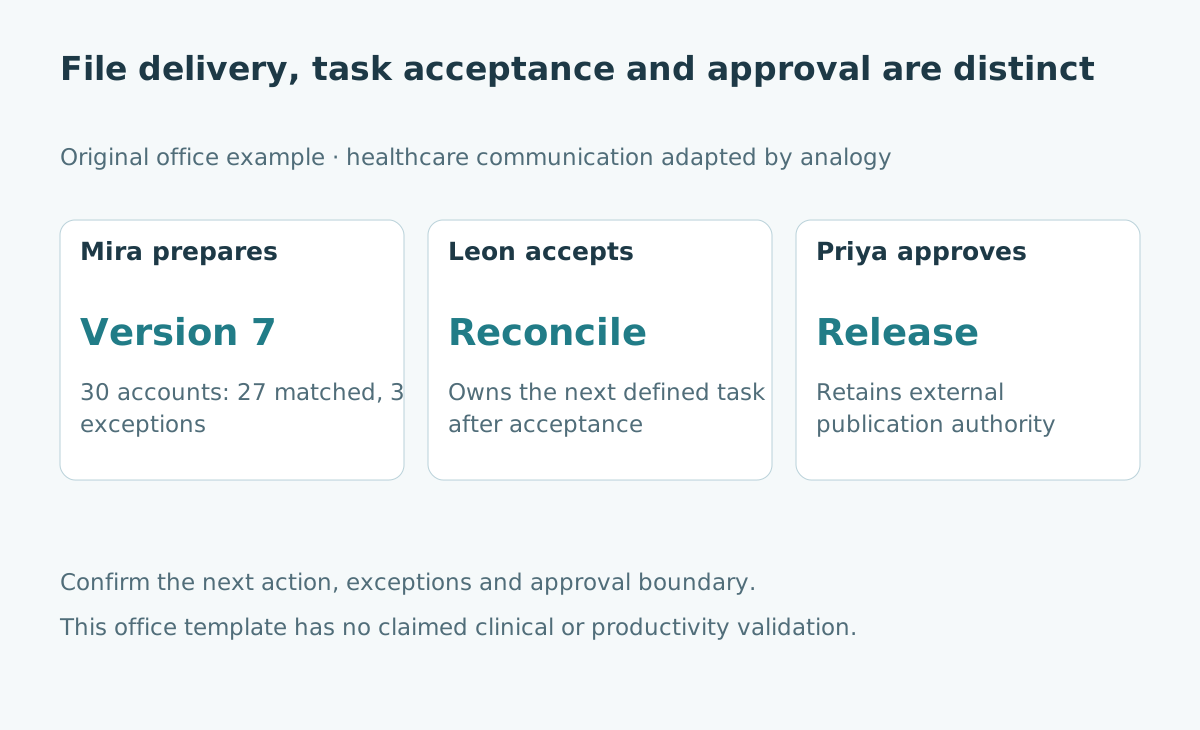
For example: “Leon owns reconciliation of the October draft from acceptance until review. Priya retains external-release approval.” Mira can stop actively performing reconciliation after the agreed transfer, while still answering factual questions about her earlier work.
This distinction is especially helpful when several people contribute to a deliverable. A contributor, a task owner and an approver can be different people without leaving the next action ambiguous.
Show the current state, including uncertainty
Write what is complete, what is incomplete and what has not been verified. A status label such as “almost done” hides the specific work the receiver must plan.
In our fictional example, Mira has prepared a draft covering 30 customer accounts. Twenty-seven reconcile to the source export. Three require clarification because their account identifiers changed. The draft is ready for reconciliation, not ready for external delivery.
Give the source version and the location of the exception list. If one important assumption remains uncertain, state it directly. The receiver should not have to infer that uncertainty from a yellow cell or an old chat message.
Package only the information needed to act
A long history can obscure the immediate decision. Put the current artifact, the next action and the unresolved risks first; link the supporting history afterward.
| Handoff field | Fictional example | Why it changes the next action |
|---|---|---|
| Artifact and version | October report, version 7 | Prevents editing an older attachment |
| Verified state | 27 of 30 accounts reconcile | Separates completed checks from remaining work |
| Exceptions | Three identifier changes, listed separately | Defines the investigation scope |
| Next owner | Leon, reconciliation | Identifies who must act |
| Completion evidence | Source-matched accounts or documented exceptions | Makes review possible |
| Approval boundary | Priya approves external release | Prevents treating preparation as permission |
The table is an original office template. Adapt its size to the consequence of an error; a routine draft does not need the same record as a production change.
Make acceptance criteria observable
“Finish the reconciliation” leaves room for different interpretations. In this example, a better criterion is: every account either matches the approved source or has a named, documented exception that Priya has agreed to review.
That criterion does not demand pretending all uncertainty has disappeared. It defines how unresolved cases must be represented so the next decision remains informed. A receiver should be able to show evidence of completion, and an approver should be able to inspect it.
Avoid criteria based only on activity, such as “spent an hour checking.” Time spent can matter for planning, but it cannot establish that a defined result exists.
Ask the receiver to confirm the meaning
AHRQ describes closed-loop communication as a message followed by receiver feedback and sender verification. For this office example, the receiver might reply: “I own reconciliation of version 7, starting now. I will investigate the three identifier changes. Priya still approves release.”
Mira then confirms or corrects the interpretation. If Leon says “I will send the report to customers,” the misunderstanding becomes visible before an external action occurs.
This is stronger evidence of shared understanding than an emoji reaction. The adaptation can be written and asynchronous when the task permits, although the clinical guidance emphasizes verbal feedback.
Treat acceptance as a separate state
A recipient can see the message and still lack the access, time or authority to accept the task. Make it easy to say that explicitly. “I can accept after the source export is accessible” identifies a dependency rather than creating a silent ownership gap.
Use a small set of states: proposed, accepted, completed and reviewed. Do not label a proposed transfer “accepted” merely because the notification was delivered.
The team also needs a rule for proposals that remain unanswered. In this example, Mira retains active reconciliation ownership until acceptance or an agreed escalation assigns another owner. That is a local working agreement, not a universal legal rule about responsibility.
Include a contingency that the receiver can use
Specify what happens if the expected path fails. Suppose the three identifiers remain unresolved at the review cutoff. Leon should know whether to pause the whole report, send an internal exception summary or ask Priya for a decision.
A useful contingency names the trigger, the person with authority and the allowed interim action. “If any identifier remains unresolved at noon, send Priya the exception summary and hold external release” provides all three.
A contingency cannot grant authority the sender does not possess. Confirm the approval arrangement with the team before relying on it during a difficult deadline.
Check the transfer with a short rehearsal
Before adopting a template, try it on one low-risk task. Ask the receiver to identify the current version, the next action, the remaining uncertainty and the approval boundary without opening the whole message history.
Where answers differ, repair the package or the agreement. Adding more fields is useful only if it resolves a recurring ambiguity. Otherwise the handoff can become a form people complete mechanically.
Record specific problems such as missing access or unclear exception ownership. Do not report a productivity improvement from one successful handoff; that observation does not supply a comparison group or account for task difficulty.
Keep confirmation proportionate to the work
Not every file transfer needs a meeting. A familiar, reversible task may need only a concise written acceptance. A novel or consequential transition may warrant direct discussion and a read-back of the critical action.
AHRQ's check-back guidance explains the communication mechanism in healthcare. Here, its practical value is the question it encourages: did both people understand the same action? It does not remove the need for expertise, adequate staffing or sound decisions.
For related workflow tools, see meeting goals and decision records and workplace response contracts. A handoff adds an explicit transfer of ownership to those broader coordination practices.
Sources and limits
- AHRQ TeamSTEPPS, Tool: Handoff: transfer of information, responsibility and authority during clinical transitions.
- AHRQ, Closed-Loop Communication: sender, receiver feedback and verification.
- AHRQ, Check-Back: confirmation of exchanged information.
Checked October 24, 2026. These established healthcare communication resources inform an original workplace analogy. Names, accounts, workflow states and deadlines are fictional; the office template has not been validated as a clinical or productivity intervention.