Oil Discovery News Can Move Demand Before the First Barrel Is Produced
Read new research on oil discoveries and inflation without confusing future supply with current demand. Use an original timeline, scenario and decision worksheet.
An oil discovery promises additional production years from now. Why might activity and some prices respond before extraction begins? Because information can change decisions before it changes the physical supply of a commodity. Hiring plans, construction orders, household expectations, and financing can start moving on a different clock from production.
That is the distinction behind BIS Working Paper No 1389, published on October 23, 2026, by Bohou Cai, Liugang Sheng, and Hongyan Zhao. It studies news shocks and inflation using large oil and gas discoveries. The findings are the authors' research, not a BIS policy position, a forecast of today's oil price, or a rule that every discovery raises inflation.
Identify what has changed today
News is a change in the information available to decision-makers. Current extraction is a change in physical output. A discovery announcement can affect the first without immediately affecting the second.
This does not mean every announcement is credible or commercially important. A useful first question is what new fact the announcement establishes: geological evidence, an appraisal result, project financing, a development decision, or actual production. Treating all five as equivalent skips the uncertainties between them. A confirmed geological resource is not the same thing as a ready-to-deliver supply contract.
Read the new evidence at its proper scale
The official BIS summary describes 1,309 large discoveries across 79 economies from 1980 to 2019, focusing on realized production lags of at least five years. Using panel local projections, the authors report higher core consumer prices over the subsequent decade, with about half the increase before extraction. The response is concentrated in nontradables and differs across exchange-rate regimes. A three-sector small-open-economy model is used to interpret the findings.
This article relies on that official abstract and research summary; the linked full PDF could not be retrieved during this review. Consequently, it does not report unverified coefficients, confidence intervals, or detailed robustness results. Historical average responses do not specify what a particular new project will do.
Keep the announcement and production clocks apart
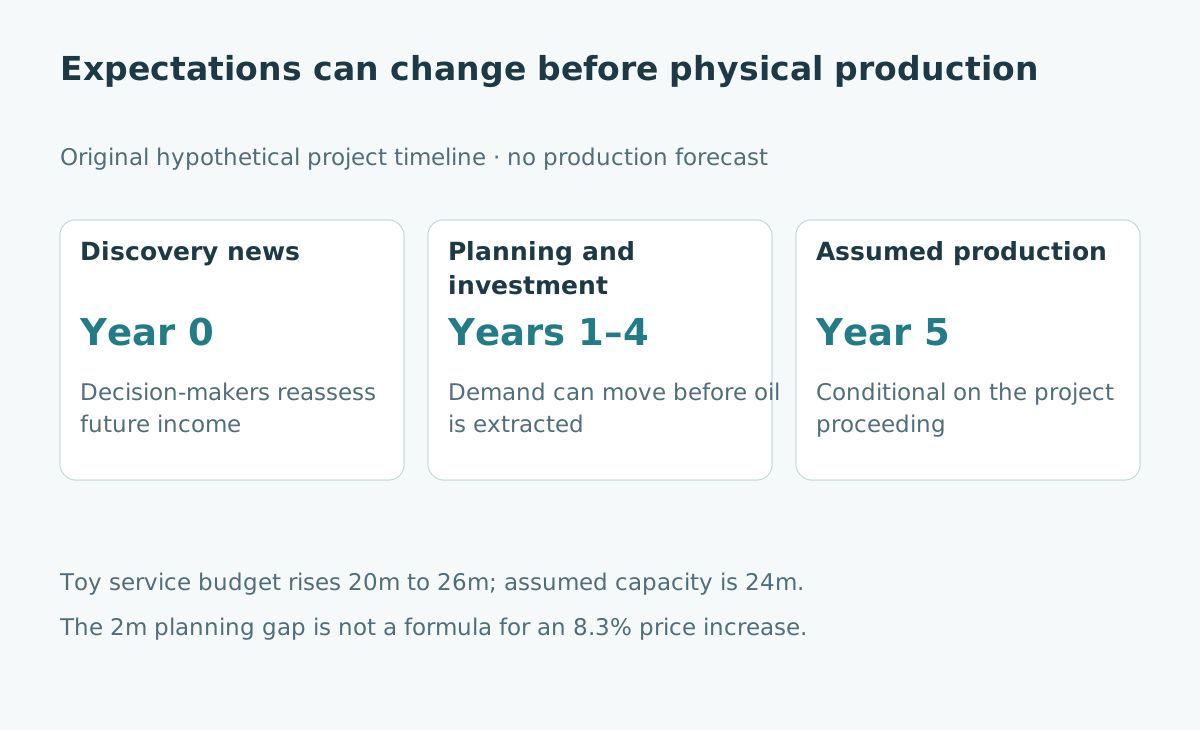
Imagine an original fictional economy in which a discovery is announced in year zero and production is assumed to begin in year five. The five-year delay is an illustrative assumption, not a prediction for a named field.
| Illustrative stage | Physical oil output from the new field | Decision that could change |
|---|---|---|
| Year 0: discovery news | None | Expected future income is reassessed |
| Years 1–2: appraisal and planning | None | Firms consider equipment and staffing commitments |
| Years 3–4: assumed development | None | Construction demand and financing needs may increase |
| Year 5 onward: assumed operation | Production begins if the project succeeds | Actual sales and supply enter the accounts |
The conditional language matters. A delayed permit, financing problem, revised resource estimate, or cancelled project can interrupt this sequence. News changes beliefs; it does not guarantee the promised future.
Separate local demand from the world oil price
A field-development program may require local accommodation, transport services, construction, and specialized labor before it produces oil. In a hypothetical town with limited short-run service capacity, additional orders can compete with existing users. That is a local-demand story, not proof that the global price of crude must rise.
Conversely, expectations of future global supply could matter for commodity pricing through other channels. The two observations are not contradictory: different prices cover different markets and time horizons. Always name the price under discussion. A hotel room, a consumer-price basket, and a barrel of oil are not interchangeable inflation measures.
Use a small budget example without inventing a forecast
Suppose an entirely fictional development office increases its annual local-service budget from 20 million to 26 million currency units. The increase is 6 million, or 30%. Assume, only for this worksheet, that an existing supplier can fulfill at most 24 million at unchanged prices.
| Original scenario | Planned orders | Assumed unchanged-price capacity | Planning gap |
|---|---|---|---|
| Earlier plan | 20m | 24m | No positive gap |
| Revised plan | 26m | 24m | 2m |
| Delayed-project alternative | 22m | 24m | No positive gap |
The 2 million gap identifies a question about quantities, scheduling, imports, new capacity, or prices. It does not imply prices rise by 2/24, or 8.3%. Translating spending intentions into a price change requires a model of supply, substitution, contracts, and other buyers that this worksheet does not provide.
Remember that financing moves the timing too
Expected future revenue can influence investment plans, but a business still needs money to pay today's invoices. In the fictional example, planning expenditures are not yet operating receipts from oil production. Financing, spending, and future income must remain separate lines.
Earlier NBER Working Paper 20857, issued in January 2015 by Rabah Arezki, Valerie A. Ramey, and Liugang Sheng, also studies discovery news and delayed production. Its abstract describes investment and current-account movements ahead of output. It is useful background for timing, not an independent replication of the 2026 inflation findings.
Convert the headline into a decision worksheet
For a business affected by a development project, record the announcement, the specific commercial milestone, the spending decision under consideration, and the evidence that would change it. Distinguish reversible preparation from a long-lived commitment.
For example, a fictional training provider could investigate required qualifications now while postponing a new building lease until a development contract is awarded. That is an original decision scenario, not a recommendation for a particular market. Record the downside if production is delayed and the earliest date at which a committed cost becomes unavoidable. A headline is an input to that review, not the review itself.
Avoid generalizing from discoveries to every promise
The study's setting contains dated, large discoveries and long realized production lags. A speculative corporate presentation, an election promise, and an established resource discovery are not automatically comparable shocks. Selection, historical institutions, exchange-rate arrangements, and the credibility of future income all matter when deciding whether the mechanism travels to another setting.
Read the new paper as evidence that anticipation deserves a place in economic analysis. Then ask what is expected, what has actually arrived, and which decision can respond before output changes. For related tools, see economic forecasts and business scenarios and the distinction between profit and cash in an investment-heavy business.
Sources and reading notes
- BIS Working Paper No 1389 official abstract and research summary, October 23, 2026. The full PDF was inaccessible during this review; no claim of full-text verification is made.
- NBER Working Paper 20857, January 2015. Earlier primary research on discovery news and macroeconomic timing; abstract reviewed for the limited background claim above.