Python 3.14 for Real Projects: Free Threading, t-Strings and Better Decisions
A practical Python 3.14 guide covering optional free threading, template strings, deferred annotations and JIT caveats.
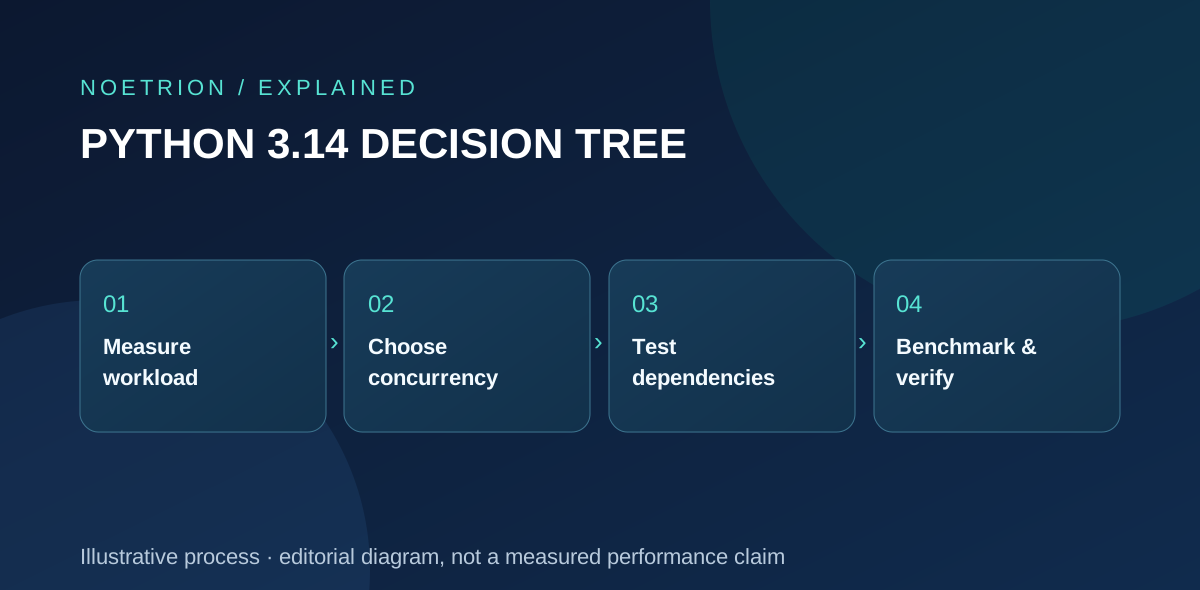
Updated October 13, 2026 · Developer guide
Python's biggest changes rarely matter because they look impressive in a release note. They matter when they solve a bottleneck you actually have. The stable release of Python 3.14 arrived on October 7, 2025, bringing officially supported optional free-threaded builds, template string literals and deferred annotation evaluation, among other changes. Those features are worth understanding even if your production project should not adopt all of them immediately.
The Python release announcement and official What's New documentation are the primary references. As of this article's date, the discussion below is about the 3.14 series, not an unverified claim that it is the newest release forever.
Free threading: useful, optional and not a free speed boost
Traditionally, CPython's Global Interpreter Lock (GIL) limits simultaneous execution of Python bytecode within one interpreter. A free-threaded build can allow multiple threads to execute Python code concurrently on multiple cores. In Python 3.14 this build option is officially supported, but it is not the default for every Python installation.
That does not mean a CPU-heavy script becomes faster the moment you upgrade. You must use a suitable build, write concurrent work correctly, account for thread-safety and check extension-library compatibility. For I/O-bound tasks, ordinary threads and asynchronous programming were already useful before this change. For CPU-heavy numerical work, libraries that release the GIL or multiprocessing may remain sensible choices.
| Workload | First tool to consider | Important caveat |
|---|---|---|
| Waiting for HTTP responses | Async I/O or threads | Network limits may dominate |
| CPU-heavy pure Python tasks | Processes or tested free-threaded build | Measure overhead and correctness |
| NumPy-based computation | Library-specific parallelism | Native code may already parallelize |
| Web server requests | Framework concurrency model | Database and I/O bottlenecks persist |
How to test whether a change helps
Create a representative benchmark, not a synthetic loop chosen to make the feature look good. Measure wall-clock time, CPU utilization, memory and correctness on the same machine. Run multiple trials and compare distributions, not a single fastest result. Check that outputs are identical and that shared state is protected by appropriate synchronization.
A simple project might process independent text files. First benchmark sequential processing. Then test a process pool. Finally, if your dependencies support it, test a free-threaded interpreter with threads. A result on one laptop is not a universal claim about Python performance.
Template strings: structure before interpolation
Python 3.14 introduces template string literals, commonly called t-strings, through PEP 750. Their syntax resembles f-strings, but instead of immediately producing an ordinary string, they expose structured information about literal text and interpolated values. That can help libraries build domain-specific processing systems where interpolation needs explicit validation or escaping.
For example, a template-aware SQL builder could distinguish literal query text from user-provided values and bind those values safely. But a t-string by itself is not a SQL injection defense. Security depends on what the receiving library does with the structured template. For most ordinary messages, f-strings remain straightforward.
name = "Mira"
message = f"Hello, {name}!"  # ordinary formatted string
# Python 3.14 also supports t"Hello, {name}!"
# A t-string yields a Template object for a processor to interpret.
Do not pass untrusted text into a homemade SQL formatter merely because it uses new syntax. Use parameterized queries through a maintained database driver.
Deferred annotations and code maintenance
Python 3.14 changes the evaluation model for annotations under PEP 649. This affects tools that inspect type hints at runtime, such as serialization frameworks, dependency injection systems and schema generators. Most everyday function definitions will feel familiar, but frameworks that previously relied on annotation objects being evaluated immediately may need testing.
If your codebase uses runtime reflection, run the unit test suite against the exact Python and library versions you plan to deploy. Look at the behavior of annotation inspection, not only whether imports succeed. Upgrade notes from dependencies matter as much as the language release notes.
What about the experimental JIT?
The official documentation describes an experimental just-in-time compiler in certain release binaries. It is not a blanket production recommendation. The reported impact varies by workload, and debugging or profiling limitations may matter more than a modest benchmark improvement. A reliable production service usually benefits more from algorithmic improvements, caching and reduced unnecessary I/O than from enabling an experimental feature without measurement.
A cautious upgrade checklist
Start by recording the current Python version and dependency lockfile. Run tests and static checks on a clean environment. Confirm support for database drivers, compiled extensions, scientific libraries and deployment images. Benchmark critical paths. Then roll out gradually with monitoring and a rollback option. Keep security updates separate from speculative optimization experiments where practical.
The best takeaway from Python 3.14 is not "turn on everything." It is that the language offers more execution and processing options, each with trade-offs. Choose them because measurements and requirements justify them, not because a release announcement promises magic.
Sources and editorial notes
- Python Insider, Python 3.14.0 Final, October 7, 2025.
- Official Python 3.14 What's New, checked October 13, 2026.
Related reading: Data Contracts and Quality Checks and AI Agent Reliability. Reader action: Benchmark one real workload before changing its concurrency architecture.