QRIS MDR Is a Transaction-Level Cost: Read the Threshold Before Estimating Net Receipts
Apply October 2026 QRIS MDR thresholds by merchant category and transaction value. Follow original rupiah examples from gross payments to net receipts.
Educational analysis, not a personal investment or payment recommendation. Check the dated sources and the rules that apply in your jurisdiction.
A shop receives several QRIS payments and estimates its service cost by multiplying the day's total by one rate. The result can be wrong even when the multiplication is correct. The applicable rate depends on the merchant category and the value of each transaction, not simply the total arriving during a shift.
This matters after the expansion of QRIS's zero Merchant Discount Rate policy. Bank Indonesia announced the change on August 17, 2026, with an effective date of October 1, 2026, in press release No. 28/159/DKom. It is an existing October policy, not a new announcement today. This article checks the applicable schedule as of October 26 and uses original transactions to explain the arithmetic.
Start with the registered merchant category
BI's merchant categorization explainer displays October 13, 2026 as its page date and October 19 as its last-update date. It lists the following schedule, effective October 1. The zero-rate expansion applies to all categories for transactions up to Rp100,000, while the micro-enterprise concession extends to Rp500,000.
| Merchant category | Transaction amount at 0% MDR | MDR above that threshold |
|---|---|---|
| Micro enterprise, UMI | Up to and including Rp500,000 | 0.3% |
| Small, medium, large enterprise, UKE/UME/UBE | Up to and including Rp100,000 | 0.7% |
| Education | Up to and including Rp100,000 | 0.6% |
| Fuel station, SPBU | Up to and including Rp100,000 | 0.4% |
| BLU, PSO, G2P, P2G and nonprofit social donations | All amounts in the listed category | 0% |
Check the category registered with the payment-service provider rather than assigning one informally. “Small shop” in everyday speech is not evidence that an account is registered as UMI.
Apply the threshold to the whole transaction
The threshold selects the rate for a transaction. It is not a tax-style allowance under which only the excess is charged. In an original UMI example, a payment of Rp600,000 is above Rp500,000, so 0.3% of Rp600,000 is Rp1,800. Applying 0.3% only to the Rp100,000 excess would incorrectly produce Rp300.
A payment exactly at the stated threshold belongs to the “less than or equal” category. The distinction deserves a boundary check in a spreadsheet or accounting import. A formula that uses less-than instead of less-than-or-equal silently changes the result at the boundary.
Reconcile three payments individually
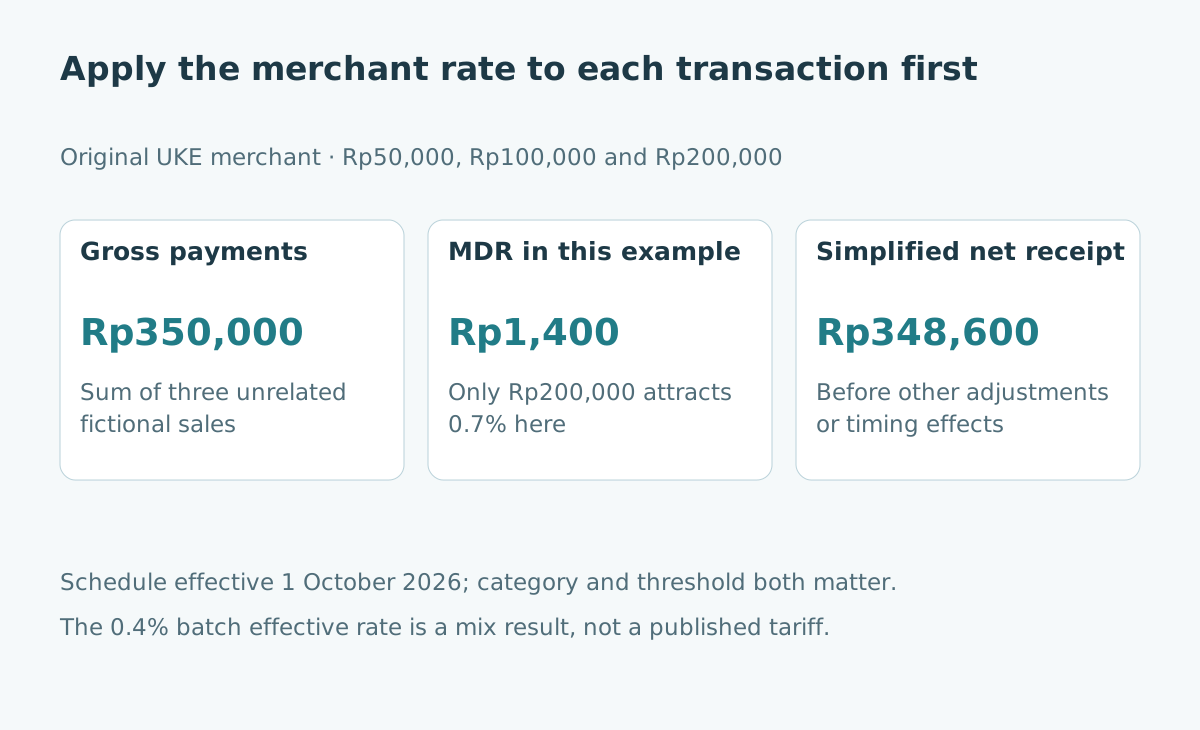
Suppose a fictional merchant is registered as UKE. During a short demonstration period it receives three unrelated payments: Rp50,000, Rp100,000, and Rp200,000. These are normal independent sales, not a recommendation to divide a purchase to change its fee treatment.
| Original payment | Applicable MDR | MDR amount | Simplified net amount |
|---|---|---|---|
| Rp50,000 | 0% | Rp0 | Rp50,000 |
| Rp100,000 | 0% | Rp0 | Rp100,000 |
| Rp200,000 | 0.7% | Rp1,400 | Rp198,600 |
| Total | Mixed | Rp1,400 | Rp348,600 |
The gross total is Rp350,000. Multiplying that total by 0.7% would produce Rp2,450, overstating the example's MDR by Rp1,050. The batch's effective MDR is Rp1,400 divided by Rp350,000, or 0.4%; that is a result of this transaction mix, not a new published tariff.
Keep the merchant cost separate from the buyer's payment
BI states that MDR is borne by the merchant and must not be passed on to the consumer. In the fictional Rp200,000 sale, the customer's payment remains Rp200,000. The example's Rp1,400 is a merchant processing cost, not a QRIS surcharge added to that buyer's bill.
For an internal reconciliation, preserve the amount paid by the customer, the MDR deduction, and the resulting expected receipt as separate fields. Combining them into one “payment” column makes it harder to explain why a bank credit differs from a sales record. It can also obscure an incorrect extra charge at checkout.
Distinguish net receipts from revenue and profit
The simplified equation is gross payments minus MDR equals expected receipts before other adjustments. It is a cash-reconciliation bridge, not a complete rule for recognizing revenue or calculating taxable income. Those treatments depend on the underlying transactions and applicable accounting requirements.
In the worked example, the business still needs to pay for inventory, wages, rent, and other costs. Rp348,600 of simplified net receipts is therefore not Rp348,600 of profit. Similarly, a fee-free transaction can still be unprofitable if its underlying sale has insufficient margin. The payment method answers only part of the business question.
Compare the expected receipt with the actual statement
A settlement statement may cover a different period from the sales report. An original closing worksheet should therefore record transaction time, provider reference, gross amount, registered category, expected MDR, reported MDR, and settlement-batch reference. Add refunds or other adjustments only when supported by the provider's records.
Do not change the rate merely to force the closing total to match. First inspect which transactions belong to the batch and whether a reversal or correction has been recorded. The numerical example intentionally omits timing and adjustment complexity so the threshold logic is visible; a real reconciliation must restore those details.
Test the boundary and retain the source date
Use a copy of the calculation sheet to test transactions at the threshold and above it. Verify that the formula chooses the correct category before multiplying. When testing fractional-rupiah results, follow the provider's documented rounding convention; do not invent one from a single statement.
Keep the effective date next to the rate table. Historical transactions should be reviewed against the schedule applicable to them, rather than automatically recalculated with today's rules. A dated source and a transaction-level audit trail are more useful than a remembered percentage. BCA's September 1 implementation notice independently confirms its October 1 schedule for its merchant partners.
Turn a discrepancy into a precise support request
If a deduction differs, send the provider the merchant reference, registered category, transaction identifier, amount, date, reported fee, and expected calculation through its approved support process. A specific discrepancy can be investigated; “QRIS charged too much today” leaves most of the necessary facts unresolved.
This worksheet explains a published rate schedule and original arithmetic, not a guarantee of settlement timing or a provider-specific accounting conclusion. For broader cash-flow distinctions, read working-capital cash gaps and invoice terms and why profit and operating cash flow differ.
Sources and reading notes
- Bank Indonesia press release, August 17, 2026: expansion effective October 1.
- BI merchant categorization and simulation explainer: updated October 19, 2026; checked October 26.
- BCA merchant implementation notice, September 1, 2026. Provider notice is corroboration, not a substitute for BI's schedule.