Reading or Listening? Choose the Controls Your Learning Task Needs
Compare reading and audiobooks through pacing, navigation and delayed comprehension. Use a practical format trial without assuming one medium always teaches better.
An audiobook fits the journey home. A textbook makes it easier to find a definition again. Both can deliver the same words, yet the practical learning experience depends on what you can pause, inspect, revisit and explain afterward.
“Does listening count?” is therefore less useful than “What must I be able to do with this material?” Following a narrative, evaluating an argument and applying an unfamiliar formula are different goals. A convenient format can help you begin, while a poorly matched review interface can make a difficult passage expensive to revisit.
This evergreen guide pairs evidence with an original study-setup comparison.
Start with the performance you need later
Write the intended output before choosing a medium. “Explain the author's main claim and one limitation” gives you a clearer target than “finish chapter two.” A programming chapter might require tracing a function, while an economics chapter might require distinguishing a mechanism from an example.
Then inspect what the material contains. Tables, equations, diagrams, unfamiliar spellings and cross-references create different navigation demands from a continuous story. An audio version may describe them well, poorly or not at all; check the actual edition rather than assuming equivalent coverage.
This is a task-design decision. It does not classify a person as permanently suited to one sensory channel. A preference tells you something about comfort and willingness to use a format, but it is not the delayed performance you are trying to establish.
Read the audiobook experiment within its boundaries
Rogowsky, Calhoun and Tallal's 2016 experiment randomly assigned 91 adults to audiobook, electronic text or both. Participants received the same narrative nonfiction material and completed comprehension tests immediately and two weeks later. The study found no statistically significant condition differences at either time.
That does not prove that the formats are identical for every reader and every task. The participants were college-educated, native English-speaking adults; there was no print-book condition, and the material was not a technical textbook. The paper also discloses funding from Audible and the National Science Foundation.
The useful conclusion is bounded: this experiment does not support dismissing audiobook comprehension in that setting. It cannot decide how you should study a dense proof or a second-language listening assignment.
Treat review access as part of the setup
A different 2010 study by Daniel and Woody reports poorer quiz performance for students hearing a podcast of a primary source than for those reading it. Its publisher abstract also reports that initial preferences for podcasts changed after the quiz. The full article was not available for this review.
These findings and the 2016 experiment should not be averaged informally into “audio works” or “audio fails.” Their tasks and study conditions differ. The practical question is whether your setup lets you perform the actions the assignment requires.
Try locating a particular claim in the player. Can you bookmark it, search a transcript or return to a named section? Then try the equivalent in the text. Those checks reveal friction that the label “audiobook” or “ebook” does not describe.
Distinguish playback speed from study time
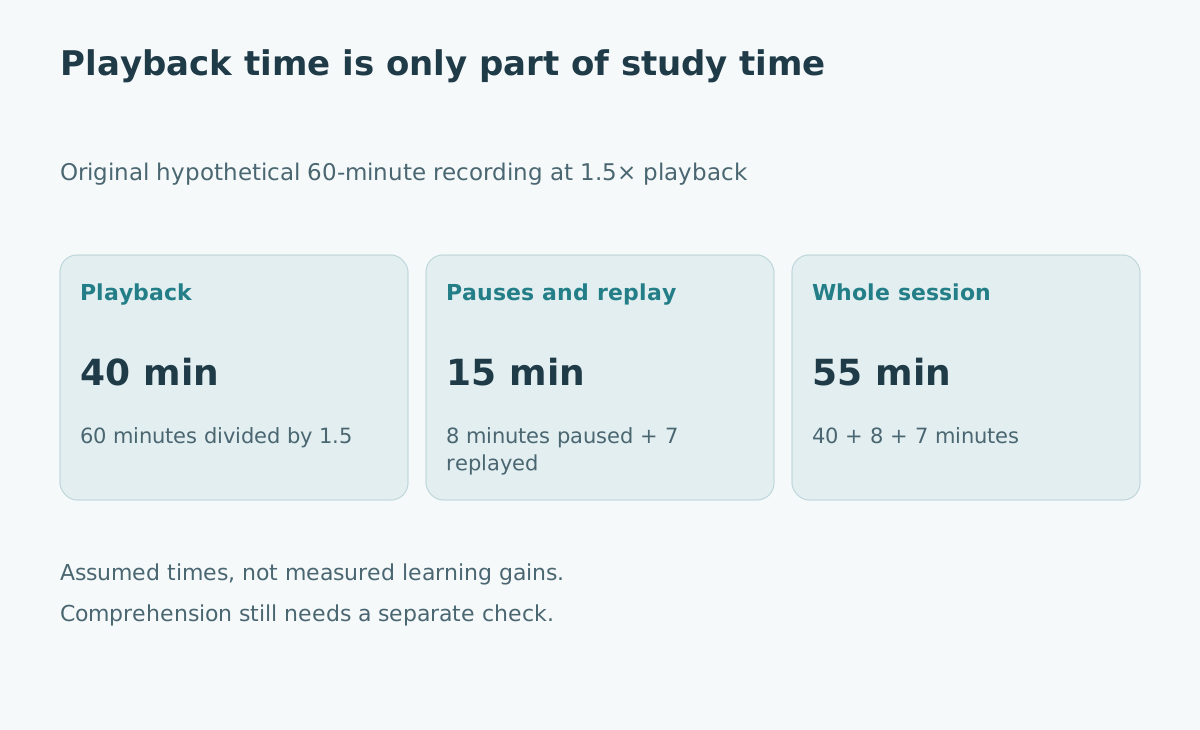
For a fictional sixty-minute recording, uninterrupted playback at 1.5 times normal speed lasts 60 / 1.5 = 40 minutes. Add eight minutes paused for thought and seven minutes replaying difficult sections, and the session takes fifty-five minutes.
That arithmetic does not establish that the faster setting saves learning time. It simply records elapsed time under the stated assumptions. If the quicker setting creates more missed explanations or requires a second session, the apparent saving may disappear.
Track your whole study activity rather than only the player's progress bar. Include navigation, note checking and unfinished sections. When comparing with reading, record its actual elapsed time too; a page count does not automatically reveal the work spent understanding it.
Match the controls to the material
Use this original planning table to inspect a specific format rather than assign a universal winner. The final column names an action to test, not a research-proven prescription.
| Material demand | Useful control | Small check before committing |
|---|---|---|
| An argument develops across several sections | Section navigation and bookmarks | Return to the evidence for one claim |
| Exact definitions or terminology matter | Searchable text or accurate transcript | Find the term and inspect its context |
| A diagram carries the explanation | Access to the actual figure | Explain one labeled relationship |
| The sequence moves faster than you can follow | Pause, replay and adjustable pace | Restate the difficult step before continuing |
An accessible format may be necessary for participation, not merely a preference. Where audio is the workable option, improve its navigation and obtain companion material rather than framing the choice as a test of effort or seriousness.
Run a useful personal comparison
Choose two short, reasonably comparable passages that you have not already studied. Specify the output you want, such as a brief explanation and two application questions. Use one format for each passage and keep a record of time, interruptions, navigation problems and help received.
Check comprehension later under the same conditions, with the material closed if independent explanation is the goal. Use accurate questions and a scoring rule prepared beforehand. A rough log can be enough: correct explanation, missing condition or unsupported claim.
This comparison is a personal diagnostic, not a controlled experiment. Passage difficulty, prior knowledge, fatigue and order can explain differences. Repeat on another occasion with the format order reversed before drawing even a provisional conclusion about your setup.
Interpret the difficulty before changing medium
If you remember the storyline but cannot explain the argument, inspect the task. Perhaps you never identified the author's claim. If you understand individual sentences but lose their connection, shorter sections and explicit section summaries may be worth trying. These are practical troubleshooting ideas, not findings directly tested by the cited experiments.
If exact notation is the problem, access to the written expression may address a more specific need than abandoning audio altogether.
Keep one change visible at a time where feasible. Switching medium, speed, location and question type together can improve the experience while leaving you unable to tell which problem was resolved.
Choose a repeatable setup, then check the outcome
A useful routine makes the next session easy: the relevant edition is available, sections are findable and difficult points can be marked. Keep the format that supports the actual work, while allowing different formats for different parts of the same topic.
For checking whether performance survives a changed task, see learning-transfer test design. For turning an explanation into a testable causal account, see self-explanation and mechanism checks.
The decision is provisional. Keep observing whether you can produce the intended explanation after the session; finishing a recording or reaching the bottom of a page is only evidence that the material was traversed.
Sources and limits
- Rogowsky, Calhoun and Tallal, September 1, 2016: Does Modality Matter?: primary experiment, full paper reviewed; immediate and two-week comprehension of narrative nonfiction.
- Daniel and Woody, June 29, 2010: They Hear, but Do Not Listen: primary study, publisher abstract reviewed; podcast/text comparison in a classroom context.
Checked October 30, 2026. This is an evergreen guide. The timing example, interface checks and personal comparison are original adaptations, not validated interventions or evidence of a universally superior medium.