FDA's Sleep-Apnea Risk Device Order Clarifies a Notification, Not a Diagnosis
Understand FDA's October 2026 sleep-apnea risk-device classification, its earlier history, and the evidence separating a consumer notification from diagnosis.
This guide explains research and technology. It does not provide diagnosis or treatment, and regulatory status should be checked with the relevant authority.
A wearable reports signs associated with sleep apnea. The screen is persuasive because it is personal, numerical and produced by a regulated feature. Yet the meaning of that result depends on the feature's intended use, not the authority implied by its interface.
The FDA CDRH update dated October 29, 2026 points to a classification order for over-the-counter devices assessing sleep-apnea risk. The order is a useful occasion to examine what the category permits and what a product's evidence must actually establish.
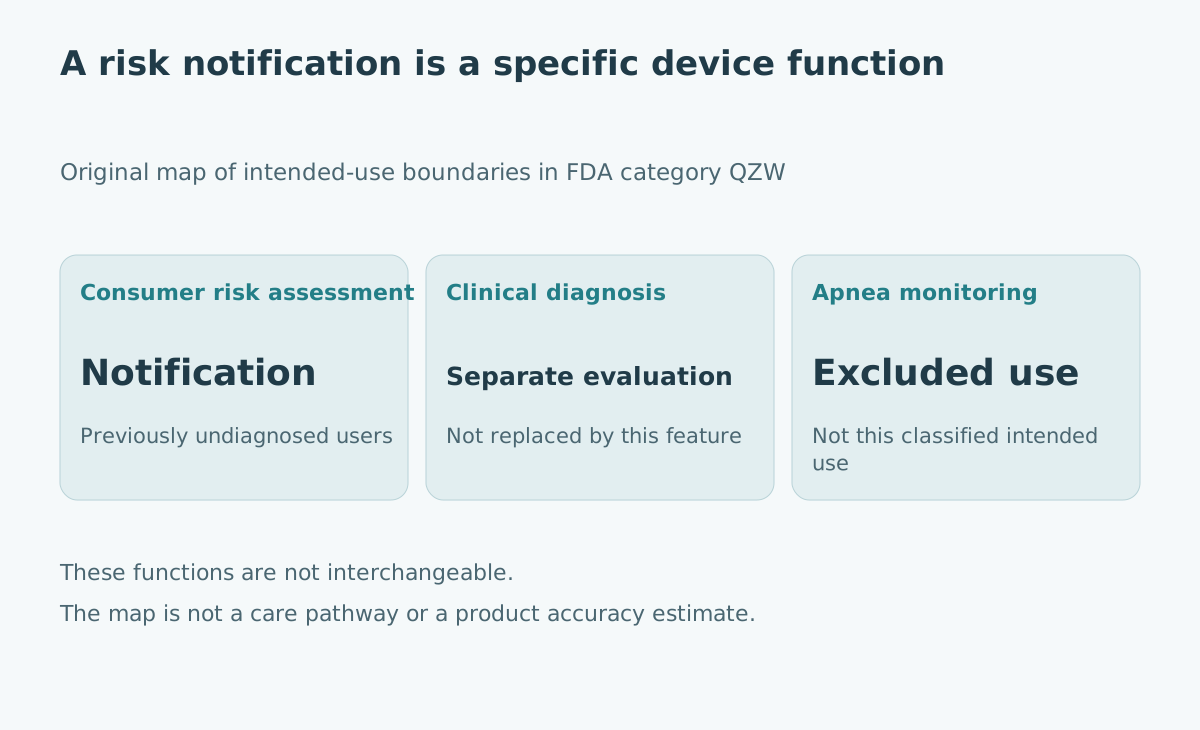
The central distinction is concrete: a consumer risk notification is not a standalone diagnosis, a substitute for a diagnostic evaluation or an always-on apnea monitor. Keeping those functions separate makes the regulatory news easier to read accurately.
Read the two dates before calling this a new approval
The published final order, document 2026-22182, is effective October 30, 2026. It states that the classification was applicable on February 6, 2024, and codifies it at 21 CFR 868.2378 as class II with special controls.
Publication and the earlier classification action are different events. A headline saying that FDA first authorized this entire type of technology on October 30 would miss that history. Nor does the category's codification establish the authorization status of any particular newly advertised product.
For a news note, preserve the document number, the publication date and the earlier applicability date. It prevents codification being confused with a new clinical trial.
Identify exactly what the category is intended to do
The FDA product-classification record for QZW describes software algorithms analyzing sensor inputs to notify previously undiagnosed users about sleep-apnea risk. It explicitly excludes standalone diagnosis, replacement of traditional diagnosis such as polysomnography, assistance to clinicians in diagnosing sleep disorders and use as an apnea monitor.
Those exclusions are not interchangeable word choices. A label about risk cannot be silently rewritten as a diagnosis because the interface appears confident. A feature designed for assessment also cannot be assumed to monitor every breathing event continuously.
When reading a product page, copy its exact output description into your notes. Then ask whether the surrounding marketing changes the meaning by adding stronger verbs such as “diagnoses,” “rules out” or “monitors.” This comparison evaluates the claim, not the patient's condition.
Separate category rules from one product's implementation
The FDA De Novo summary for Samsung's Sleep Apnea Feature, DEN230041, provides a specific implementation: compatible watch-and-phone software intended to detect signs of moderate-to-severe obstructive sleep apnea in adults aged 22 or older over a two-night assessment. Its description uses wrist sensor information and makes the feature's limitations explicit.
That is evidence about the described product, not a requirement that every device in QZW uses identical sensors, timing or software. A new interface that looks similar still needs its own documented identity and intended use.
For comparison, create separate rows for generic classification, the named device and the version actually being discussed. Otherwise details from a familiar product can migrate into a claim about an unrelated device without anyone noticing.
Ask what the technical endpoint measures
The same DEN230041 review describes comparison with polysomnography and evaluates detection performance for its defined target. Its two-night logic and qualifying-data conditions matter when interpreting what a result represents. The document also includes human-factors work addressing interpretation of the output.
A useful reader's question is whether a statistic concerns signal estimation, classification of the target condition, successful completion of an assessment or understanding of a notification. Those are different endpoints, even if a summary calls all of them “accuracy.”
Before quoting a performance percentage, retain its denominator, comparator, assessment window and intended population. Do not substitute a sensor's measurement performance for the full feature's risk-assessment performance, or interpret a classification result as a complete diagnosis.
Use a claim-to-evidence table
The following original review aid keeps the needed evidence beside the wording being assessed. It is not a complete regulatory checklist and does not determine whether a device complies with FDA requirements.
| Proposed statement | Evidence to locate | Interpretation to avoid |
|---|---|---|
| This is a regulated risk-assessment feature | Exact device identity, category and authorization record | Every similarly named app has the same status |
| The feature detects its defined target | Intended-use wording and the matching performance evaluation | It detects every sleep disorder |
| The result is understandable to consumers | Instructions and relevant usability evidence | A clear-looking screen guarantees correct interpretation |
| The published result applies to this setup | Compatible hardware, software and use conditions | Any watch or app version produces equivalent results |
If a row remains unsupported, narrow the statement or record the missing evidence.
Read the controls as evidence obligations
The final order calls for clinical comparison, subgroup evaluation and separate validation data for machine-learning algorithms. Its controls also address noisy or missing signals, software verification and validation, usability and labeling. The order retains premarket notification requirements for this category rather than declaring it exempt.
These are requirements, not a set of measured results for every product. A requirement to evaluate subgroups does not mean performance is identical across them. A requirement to handle poor-quality signals does not mean every attempted assessment yields a usable result.
For an evidence review, request the actual report that answers the relevant question. Preserve unresolved limits in the summary rather than replacing the report with the fact that an obligation exists.
Keep notifications, missing results and clinical conclusions separate
Consider a fictional dashboard that contains three labels: “risk notification,” “no risk notification” and “assessment incomplete.” A reader changes the last two labels to “healthy.” That rewrite discards both the device's output boundary and its unresolved state.
An incomplete assessment describes an unsuccessful or unfinished measurement process, not proof of the absence of a condition. Likewise, the absence of a notification is not the same statement as a comprehensive diagnostic conclusion. These are logical distinctions, not sensitivity estimates for a named device.
In a report, retain the original output label and the associated instructions. Avoid creating a stronger conclusion during export, visualization or summarization. The same discipline matters when an AI assistant summarizes a health app's results.
Follow the evidence chain when the feature changes
For an updated product, note the software version, compatible hardware, intended-use wording and the evidence supporting that configuration. A category name alone cannot establish that a newly added function was part of an earlier evaluation.
This is especially useful when a news story combines a historical authorization with a current interface update. Ask which event occurred, which function changed and which document supports the current claim. For broader context, see medical AI evidence and regulation and wearable studies, missing data and wear time.
The order clarifies the assessment category. The individual device documentation and its intended-use limits still determine how a particular feature should be described.
Sources and limits
- FDA CDRH news, October 29, 2026: announcement listing.
- Federal Register, October 30, 2026, document 2026-22182: published final order; effective date, classification history and special controls reviewed.
- FDA QZW product-classification record: intended-use definition and category reviewed; page updated October 26, 2026.
- FDA DEN230041 decision summary: product-specific technical and clinical review associated with the February 6, 2024 classification.
Checked October 30, 2026. This is a regulatory-news explainer, not a new clinical study or an individual diagnosis. The table and dashboard scenario are original illustrations; no product-specific accuracy estimate or worldwide availability claim is made.