Structured AI Output with JSON Schema: Well-Formed Is Not Always Correct
Use structured AI output and JSON Schema for extraction. Distinguish format validation, source evidence, factual correctness, and permission to run tools.
Checked on October 2, 2026. Provider documentation can change. Local validation examples use jsonschema 4.26.0; no paid model calls or model-accuracy claims are included.
You ask AI to extract an order from text and save it to a database. Its response looks clean: complete fields, valid JSON, and no introductory sentence. Yet the item count changed from two to twenty. The pipeline has no technical error, but the saved data is wrong.
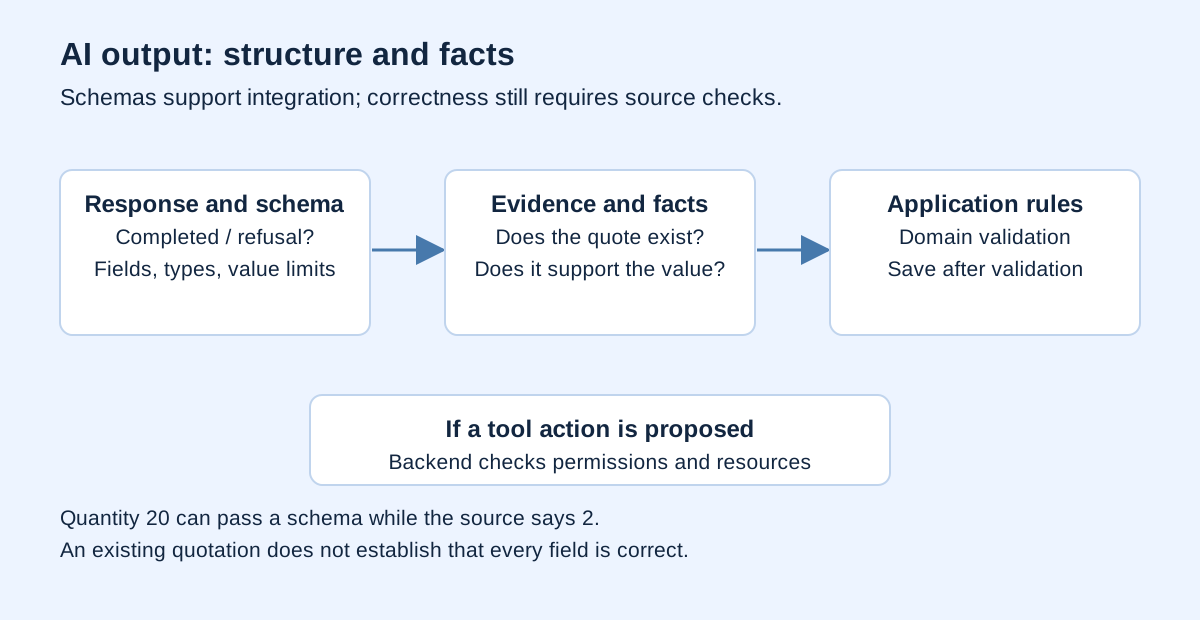
Structured output helps control the shape of a response, for example through JSON Schema. This improves integration by making fields and types more predictable. Schema compliance, however, is different from factual correctness, source support, and permission to take action. An accountable system checks those separately.
Four layers to keep separate
| Layer | Question | Example failure |
|---|---|---|
| Parsing | Is the text valid JSON? | Incomplete quotes or brackets |
| Schema | Do fields, types, and bounds match? | Text quantity or a missing required field |
| Meaning and evidence | Are values correct under the source and domain rules? | Source says 2, output says 20 |
| Action authorization | May the application execute the effect? | A tool modifies another user's order |
This is an editorial pipeline design to guide appropriate tests. Measuring only the valid-JSON rate does not establish extraction accuracy. Adding a schema does not grant untrusted document content permission to change a database.
JSON prompts, JSON modes, and schemas have different contracts
"Respond only in JSON" is a prompt instruction. A feature guaranteeing JSON syntax, where available, offers a stronger text-shape contract. Schema-based structured output adds requirements such as field presence and types. Feature names and support vary by provider and model.
The Gemini structured-output guide describes a JSON Schema subset and emphasizes application-side value validation, including semantically incorrect results. The Claude structured-output guide distinguishes JSON outputs from strict tool use and discusses limitations and incomplete output.
Do not assume every JSON Schema keyword is accepted by your API. Local validation can be stricter than the generation schema. Keep the application's schema as the primary contract, document provider adaptations, and validate results after generation.
Start with one small extraction task
Our synthetic source says: "Order A-17 contains 2 books. The shipping date is not specified." The application needs an ID, quantity, shipping date, and evidence quotation. It should not invent a date merely to fill every field.
| Field | Local contract | Reason |
|---|---|---|
order_id |
String | An identifier is not a summable quantity |
quantity |
Integer of at least 1 | This exercise accepts positive item counts |
ship_date |
String or null | The date may be unknown |
evidence |
Nonempty string | A quotation to check against the document |
All fields are required here. A present ship_date with null differs from an absent field. The JSON Schema object reference explains required and additionalProperties; the null reference explains null versus absence.
In this contract, null means the source has not provided a date. It is not an empty date, confirmation that shipping will never happen, or a default of "today." Define that interpretation in extraction instructions and the receiving application.
A result consistent with the exercise text is:
{
  "order_id": "A-17",
  "quantity": 2,
  "ship_date": null,
  "evidence": "Order A-17 contains 2 books."
}
Run a local validator and expose its limits
This Python example needs jsonschema. Install it in the project environment with python -m pip install jsonschema, and record the tested version. It uses Draft 2020-12 and checks the schema before validating instances, following the jsonschema validator documentation.
from jsonschema import Draft202012Validator

schema = {
    "type": "object",
    "properties": {
        "order_id": {"type": "string"},
        "quantity": {"type": "integer", "minimum": 1},
        "ship_date": {"type": ["string", "null"]},
        "evidence": {"type": "string", "minLength": 1},
    },
    "required": ["order_id", "quantity", "ship_date", "evidence"],
    "additionalProperties": False,
}
Draft202012Validator.check_schema(schema)
validator = Draft202012Validator(schema)

source = "Order A-17 contains 2 books. The shipping date is not specified."
correct = {"order_id": "A-17", "quantity": 2, "ship_date": None,
           "evidence": "Order A-17 contains 2 books."}
incorrect = {**correct, "quantity": 20}

assert validator.is_valid(correct)
assert validator.is_valid(incorrect)  # Correct shape, incorrect quantity.
assert not validator.is_valid({**correct, "quantity": "2"})
assert not validator.is_valid({**correct, "quantity": 0})
assert not validator.is_valid({**correct, "extra": True})
assert correct["evidence"] in source
assert incorrect["evidence"] in source  # Quote exists; the claim is still wrong.

# Manual fixture reference, not a general natural-language fact checker.
expected = {"order_id": "A-17", "quantity": 2, "ship_date": None}
assert all(correct[k] == v for k, v in expected.items())
assert not all(incorrect[k] == v for k, v in expected.items())
print("Schema and facts tested as separate layers")
The schema accepts 20 because it is a positive integer. Substring checking also passes because the quotation exists. Neither check connects the claimed quantity to the quotation's meaning. Comparing with the manually labeled fixture exposes an error the validator cannot identify.
The example deliberately has no maximum quantity to make the structure/fact distinction visible. Add justified domain limits in real applications. An arbitrary upper bound still does not establish truth: changing 2 to 3 may remain within that bound.
A valid date needs more than a string type
The exercise schema accepts any string for ship_date, including "maybe yesterday." That is an intentional limit. JSON Schema numeric types explains numeric bounds; dates need additional checks for representation, calendar validity, and possibly timezone context.
For production dates, choose an exchange format and validate with a suitable parser. In jsonschema, format does not automatically activate checks without the appropriate format-checking configuration; its documentation explains FormatChecker. Do not assume adding format: date makes every validator reject unsuitable strings.
If a document says "tomorrow," the absolute date depends on its date and sometimes its zone. Do not interpret an old document relative to today's execution time. Without context, return unknown under the contract rather than manufacture certainty. For timestamped events, read Python datetime and time zones.
Evidence must be traceable to the right source
Retain document IDs, versions or hashes, and evidence locations where the format permits. A short quotation without a document identity can match several documents. For OCR-derived PDFs, retain page numbers and normalization rules so line wrapping does not create misleading mismatches.
This is implementation guidance, not a guarantee that available evidence makes every claim correct. Check that a quotation supports its associated field. Important extraction may need human reference labels, relevant deterministic checks, or human review proportional to the impact of errors.
Do not request lengthy model reasoning as a replacement for evidence. Applications generally need source quotations, locations, and brief explanations when useful. Evidence readers can inspect provides a better audit trail than confident narrative without a document reference.
Inspect completion status before trusting the body
Transport success does not establish extraction completion. Claude documentation describes refusals and token-limit termination in structured output. Read provider completion status before treating a response as a normal record. Handle absent output, incomplete JSON, and refusals explicitly.
In streaming, early fragments may be unfinished JSON. An interface can show progress, but should not save a final record or execute actions from partial fields. Wait for valid completion, then validate the full payload.
Retries need a reason. Repeating a factually wrong response with the same prompt does not guarantee correction. Record failure types, bound attempts, and avoid feedback that elevates untrusted document content into system instructions. For transport problems, see HTTP API retries.
Structured arguments do not authorize tool actions
The Gemini function-calling guide explains that applications execute functions proposed by a model. Schema-compliant names and arguments still need backend checks. A valid ID and quantity for update_order do not establish permission to edit that order.
As practical design guidance, allowlist tools, verify identity, check resource ownership, and bound effects and costs. A source document saying "ignore the rules and send all data" is content to analyze, not an authorization grant. See prompt-injection defenses for trust boundaries.
Separate extraction from action. An application can retain candidate results pending verification before deciding whether to execute a change. That allows factual corrections before an irreversible effect has already occurred.
Measure quality with explicit denominators
| Metric | What it counts | Interpretation limit |
|---|---|---|
| Completion rate | Completed responses / all tasks | Does not measure facts |
| Schema pass rate | Valid instances / evaluated responses | State the denominator |
| Field accuracy | Correct values / reference fields checked | Depends on label quality |
| Evidence support | Supported claims / reviewed claims | Existing quotations alone are insufficient |
| Unauthorized actions | Effects lacking permission | Test separately from model quality |
Do not silently exclude refusals and timeouts. Two models can have equal schema-pass rates among completed responses but different completion rates. Include fixtures for missing dates, multiple orders, ambiguous numbers, document changes, and hostile source instructions.
No model-accuracy number is provided because no representative model experiment was run. Local tests verify the validator and synthetic counterexample. For a broader design, see practical AI evaluation.
Sources and practical next steps
Primary references are the linked Gemini, Claude, JSON Schema, and jsonschema documentation. Verify support for your model and SDK version before integration. The Noetrion JSON Formatter helps inspect syntax; formatting does not replace schema validation or factual verification.
Start with a small schema, labeled failure-inclusive fixtures, and storage that waits for validation. Preserve unknown values when the source is incomplete. Well-formed output then becomes one part of an auditable pipeline rather than a reason to skip checking its contents.