Interrupted at Work: Leave a Useful Return Note Before You Switch
Handle work interruptions with a clear return note, a tested-evidence boundary, and a practical worksheet for measuring transition costs without hype.
You are halfway through reconciling a report when a colleague needs an answer. After helping, you reopen the spreadsheet and stare at the same cells. Were you checking the refund dates or the duplicate customer IDs? The interruption lasted three minutes; reconstructing the unfinished decision takes longer.
A return note captures the state of the work before you switch. Its purpose is modest: leave enough information to identify what has been completed, what remains uncertain, and where to restart. It is not a promise to eliminate distraction or a reason to ignore urgent requests.
Research on interruption management supports careful attention to transitions. A 2026 laboratory study also complicates the familiar story that every interruption has the same cost. The practical response is to measure the work that matters, rather than attach a universal recovery-time estimate to every notification.
Distinguish the interruption from the transition
The interruption is the event that redirects you. The transition includes stopping safely, entering the new task, and later reconstructing the old one. A quick request can therefore occupy more time than its conversation alone.
There are also different attention problems. You may forget the next step when returning to the original task. Or thoughts about the unfinished original task may interfere with the new one. Those outcomes should not be treated as interchangeable.
This distinction changes your measurement. If a note helps you engage with the colleague's request but does not shorten the return, that can still matter. If return time falls while error corrections rise, the faster restart may not be an improvement.
What the ready-to-resume research established
In research published online May 11, 2018, Sophie Leroy and Theresa Glomb examined attention residue when people anticipated returning to interrupted work under time pressure. Their four-study paper reports that a brief ready-to-resume plan reduced residue and protected performance on the interrupting task.
That last phrase matters. It is tempting to summarize the paper as proving that notes make the original task faster when resumed. The verified publisher abstract addresses performance on the new, interrupting task instead. This article does not infer a measured return-time benefit from that finding.
The practical note below is inspired by the research, but its particular fields and time budgets are editorial choices. The publisher abstract and bibliographic information were reviewed; full methods were not available for this verification. No effect size or universal optimal note length is claimed.
Why the 2026 experiment is a useful caution
Radović and colleagues' March 25, 2026 experiment used a memorized five-step laboratory task interrupted by letter classification. Groups differed in how often tasks were interrupted and how many interruptions occurred within a task.
Both groups with 75% of tasks interrupted resumed faster and more accurately than the lowest-frequency group. However, the most heavily interrupted group was slower on uninterrupted tasks than the other groups. Adaptation to interruptions could therefore coexist with a cost elsewhere in the studied workflow.
This was not an office-productivity trial, and it did not test the return-note worksheet. Its value here is methodological: a narrow improvement in resumption cannot be assumed to mean better total work. Do not start scheduling extra interruptions on the basis of this result.
Write the note around an unfinished decision
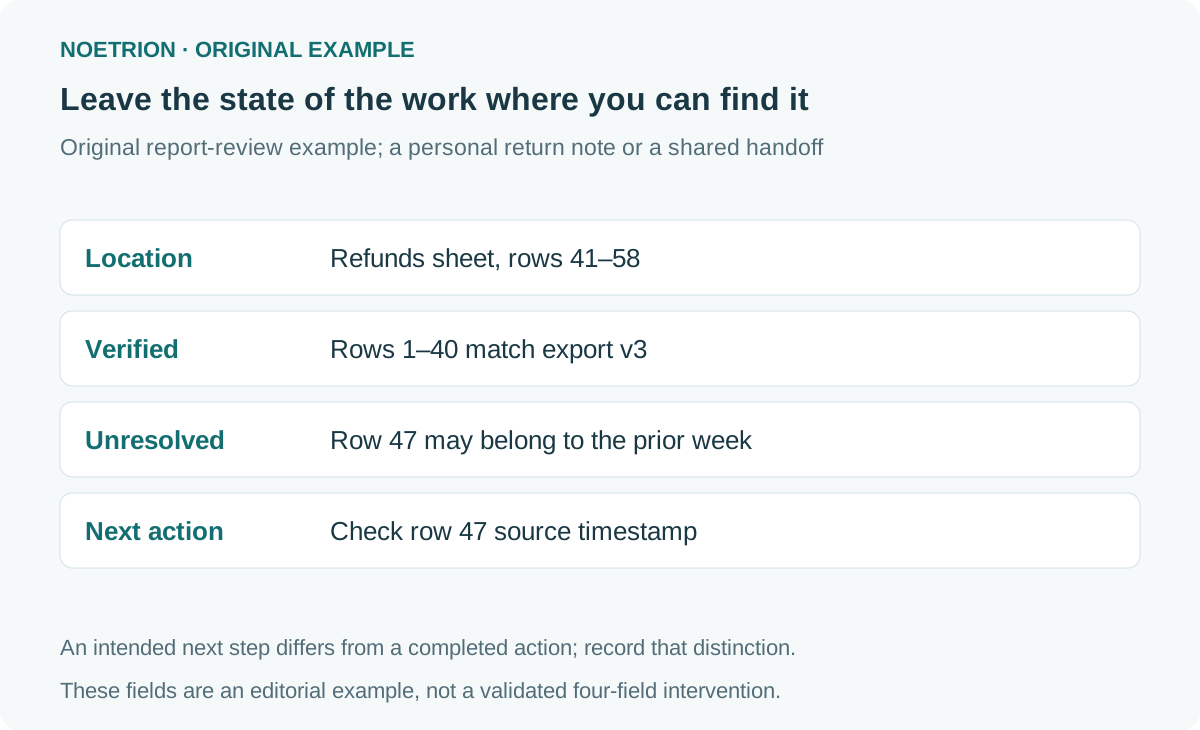
“Continue report” describes a goal but leaves the reconstruction problem untouched. A useful note identifies the file or location, the last verified step, the unresolved issue, and the next observable action.
| Field | Vague note | Useful report-review note |
|---|---|---|
| Location | “Spreadsheet” | “Weekly report, Refunds sheet, rows 41–58” |
| Verified state | “Mostly checked” | “Rows 1–40 matched to export v3” |
| Open issue | “Numbers look odd” | “Row 47 date may belong to prior week” |
| Next action | “Finish checking” | “Compare row 47 source timestamp before including it” |
Record whether an action has actually happened. “Need to send correction” differs from “correction sent at 10:20.” Confusing an intention with a completed step can create duplicate messages or leave a necessary action undone.
Use enough detail for the risk. A reversible draft edit may need one sentence. A sensitive financial or operational process needs the organization's established controls and audit trail; a personal sticky note does not replace them.
A worked transition-cost budget
Imagine a fictional analyst records six interruptions during one reporting day. Each request takes four minutes. Without a note, reconstructing the old task takes three minutes on each return. Total time is 6 × (4 + 3) = 42 minutes.
Now suppose a note takes half a minute to write and the measured reconstruction time is one minute. Request time remains four minutes. Total is 6 × (4 + 0.5 + 1) = 33 minutes, a nine-minute reduction in this synthetic example.
| Component across six interruptions | Without note | With note |
|---|---|---|
| Request handling | 24 min | 24 min |
| Note writing | 0 min | 3 min |
| Reconstruction | 18 min | 6 min |
| Total tracked transition workflow | 42 min | 33 min |
The reduction is approximately 21.4% of the 42-minute tracked workflow, not a 21.4% increase in whole-day productivity. No real employee data supports these assumed durations. The calculation shows what to measure and which denominator a claim would require.
For a second scenario, suppose reconstruction falls only from three minutes to 2.75 minutes. Adding a half-minute note then produces 6 × (4 + 0.5 + 2.75) = 43.5 minutes. The note has increased tracked time by 1.5 minutes. A plausible habit still needs to justify its cost.
Calculate a threshold without pretending to predict it
With the request duration unchanged, a time-only benefit requires the reconstruction time saved per interruption to exceed the note-writing time. If the note takes 30 seconds, saving 15 seconds is insufficient; saving 90 seconds yields a net minute per interruption.
That threshold leaves other outcomes out. A note may reduce duplicated work or improve decision quality, which could justify it even without a time saving. Conversely, a fast restart that skips a validation check is an undesirable result.
Do not price every interruption at a fixed number of lost minutes. Duration, task complexity, preparation, urgency, and the point of interruption differ. A universal figure would hide the very variation a local record is meant to reveal.
Agree on a transition protocol with colleagues
For a nonurgent request, a practical response is: “I can help; give me a moment to record where I stopped.” This communicates a small transition need rather than demanding that others guess whether you are available.
For urgent incidents, follow the team's escalation process. Do not delay a safety-critical response to complete a tidy note. If needed, ask another person to capture the current state or use the existing incident log when circumstances permit.
Define what counts as urgent and where ordinary requests should go. A protocol that protects one person's focus while making everyone else wait unpredictably may harm the team's work. Check request-resolution time and missed handoffs alongside individual concentration.
The workplace task audit helps identify task ownership and review requirements. When the interruption concerns a decision already made, a decision record may prevent the same question being reopened unnecessarily.
Run a small local comparison
For several comparable work periods, record interruption count, request duration, note time, reconstruction time, and any rework. Define reconstruction consistently—for example, from reopening the original task to the first correct next action. That operational definition is a practical suggestion, not a standardized psychological measure.
Use a few periods without a new note routine and a few with it. Keep differences in task difficulty, deadlines, and staffing visible. Do not compare a quiet morning with a crisis afternoon and attribute the result entirely to the note.
Avoid collecting personal message contents when time categories would suffice. A team trial should be transparent about the purpose and use of the record. The aim is to improve the workflow, not create an unsupported ranking of who is most distracted.
Practice with a report handoff
Pause a synthetic reconciliation after verifying 40 of 58 rows. Write a note stating the source version, completed range, unresolved row, and next check. Put it aside, do another short task, and return.
Ask whether you can restart without repeating completed checks or treating an unresolved value as verified. If a colleague reads the note, can they distinguish the same states? A note that only its author can interpret may be adequate for a personal pause but poor for a shared handoff.
At the end of the trial, keep the smallest note that preserves the necessary state. The useful outcome is a clearer transition with acceptable time, quality, and team responsiveness—not a longer note or a larger number of tracked focus sessions.
Primary sources and boundaries
- Leroy and Glomb, Tasks Interrupted, online May 11, 2018; May–June 2018 issue. Publisher abstract reviewed. The verified outcome concerns attention and performance on the interrupting task.
- Radović, Hirsch, Koch, and Schubert, Opposite effects of interruption frequency, March 25, 2026. Primary open-access article reviewed; laboratory five-step task, not an office note intervention.
Checked October 21, 2026. Durations, percentages, return-note fields, and local comparison are original illustrative designs. They are not measured research effects or guarantees of productivity.